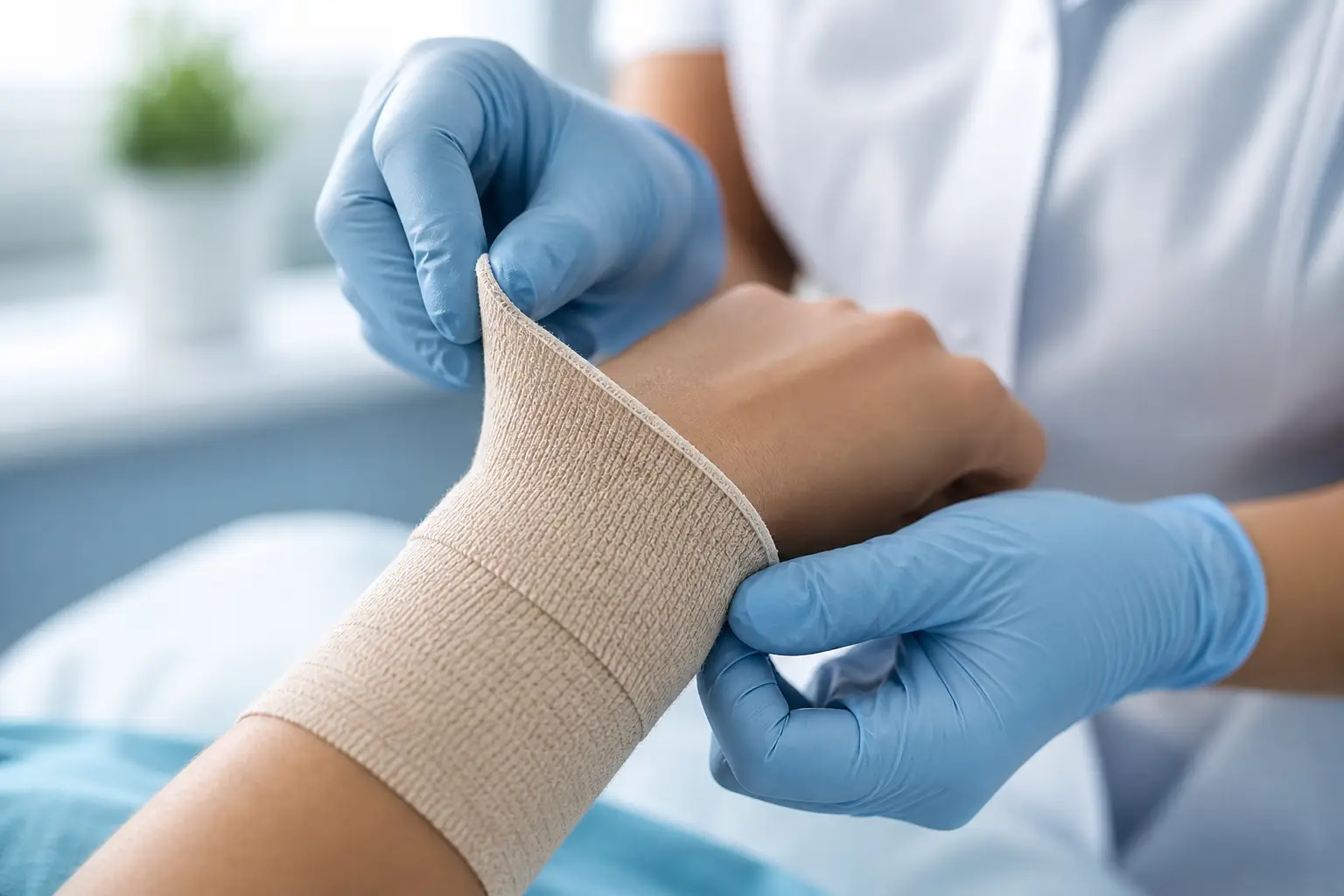
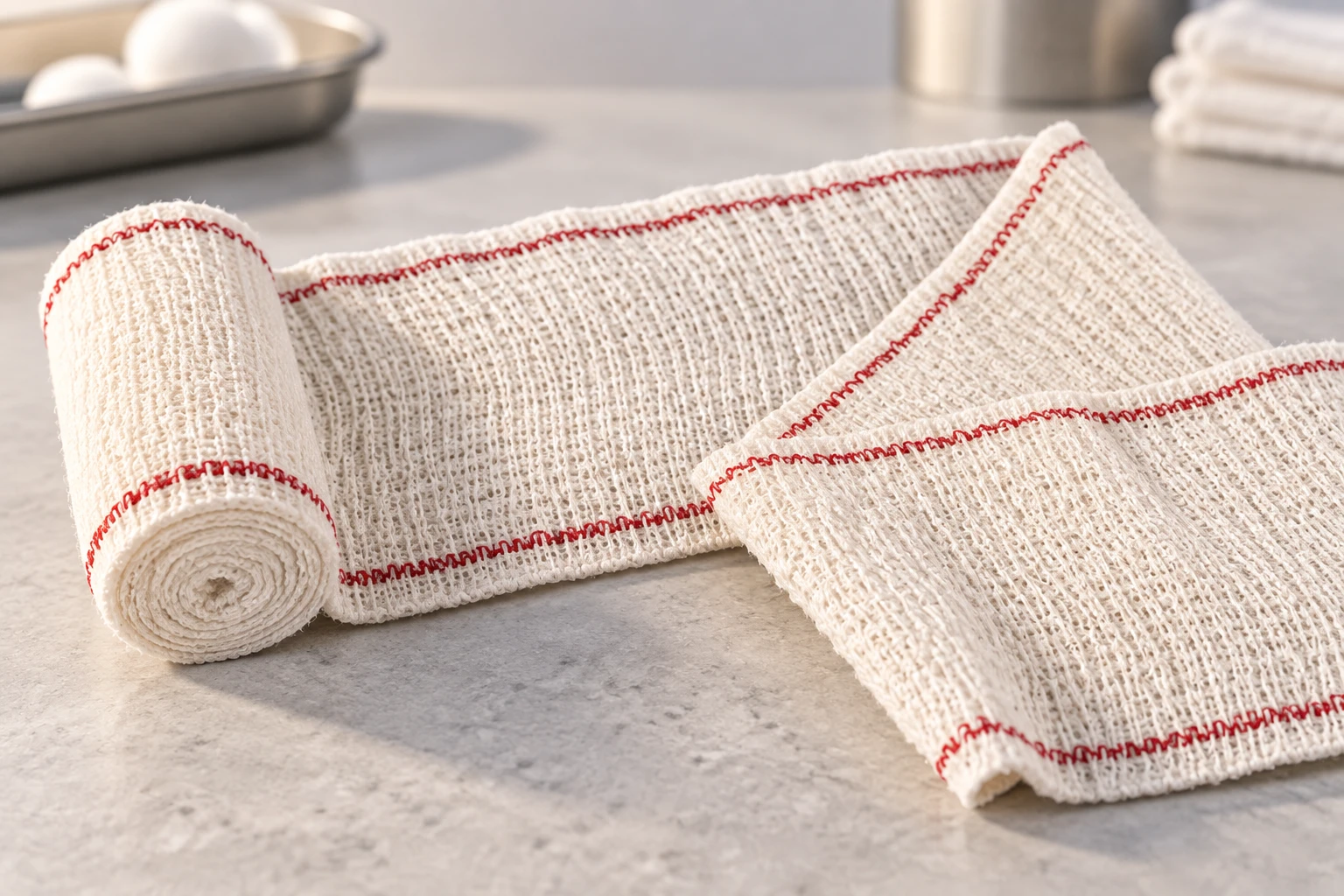
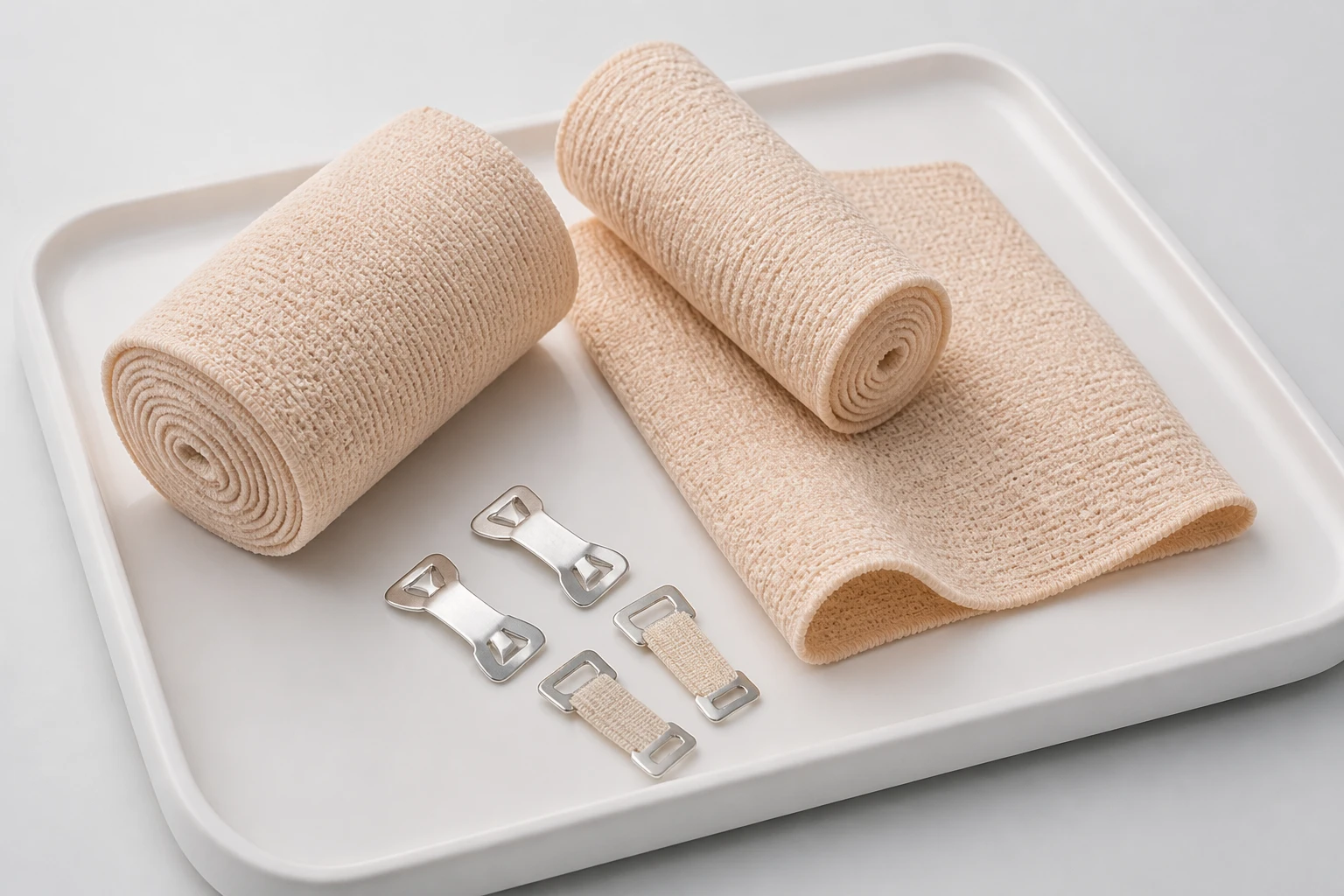
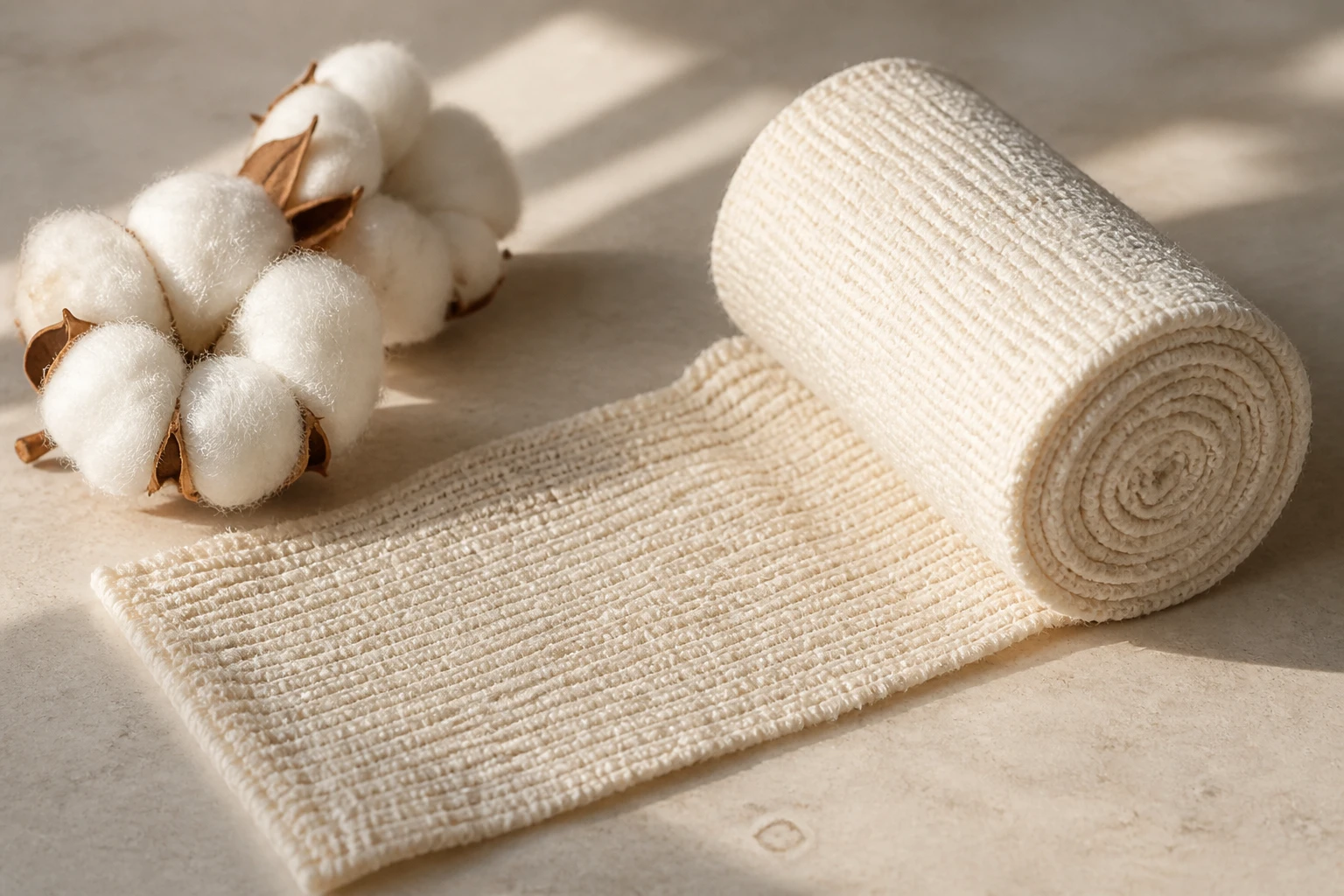
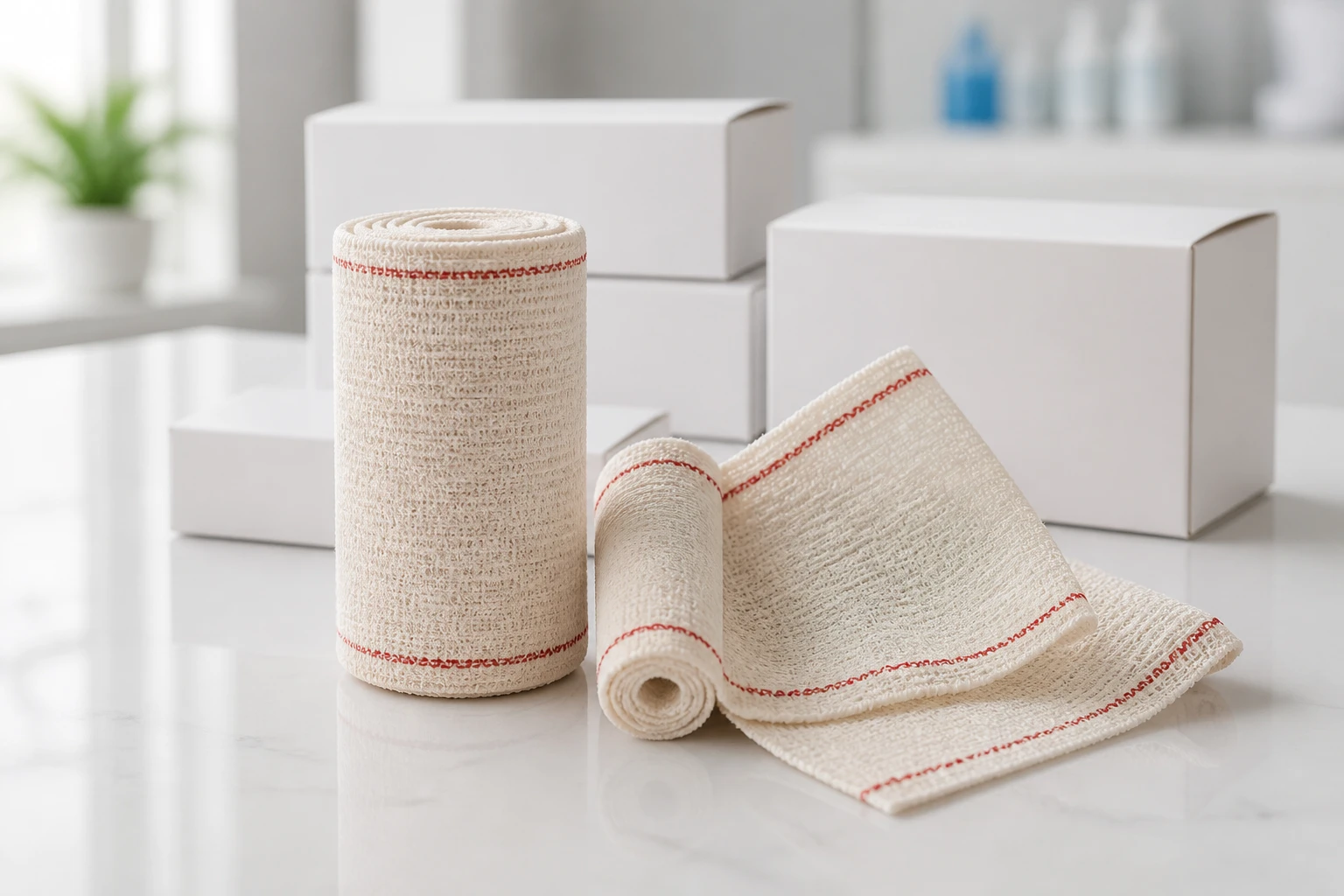
If you have spent any time walking hospital wards or auditing surgical supply chains, you already know the sinking feeling of seeing a nurse unroll a crepe bandage only to have whispy, cobweb-thin cotton threads drift away from the margins.
It looks untidy. Worse, inside an operating theatre or over a fresh orthopedic incision, those fraying filaments are not merely cosmetic nuisances—they are active bio-hazards.
For hospital clinical directors and wholesale procurement teams, edge finishing on elastic bandages is rarely treated as a headline specification. Most tenders obsess over grammage, stretched length, and rubber-versus-spandex elasticity. But when bandages shed threads into open lesions or shed lint under cast padding, the problem routes directly back to how the mill built the edge.
Understanding why a genuine woven fast edge crepe bandage outperforms a cheaper cut-edge roll is the difference between reliable post-operative support and serious clinical complications. Let’s look behind the loom curtains, walk through the factory mechanics, and examine why edge stability matters so much to patient outcomes.
The Hidden Clinical Risk: What Edge Fraying Really Does to Wounds
Wound care teams often fight an uphill battle against post-operative infection. When an elastic wrap frays, loose cotton or viscose fibrils shed directly into the wound bed or wrap around external fixators.
It is not just a theoretical headache. Decades of surgical literature have tracked how foreign textile fibers spark delayed wound healing and foreign-body reactions. When stray fibers peel away from an unstable bandage edge and settle into broken tissue, the human immune system treats them as invader antigens. Macrophages surround the micro-fibers, unable to digest the cellulose, which leads directly to foreign body granulomas documented in wound pathology.
Micro-lint shed from cut wound dressings remains an under-reported trigger for foreign-body giant cell responses, chronic sterile inflammation, and persistent sinus tracts in surgical wounds.
Furthermore, as loose threads unravel along the margins of an unstable wrap, the bandage loses its structural hoop tension. A nurse secures an ankle or a surgical dressing at 25 mm Hg, but as the loose fibers pull and untangle over six hours of movement, that compression degrades rapidly. The result? Secondary edema, slippage, and the need for frequent bandage changes that burn through ward nursing time and inflate consumable budgets.
To guard against these issues, clinical buyers look for products certified under international compendia, such as the British Pharmacopoeia (BP) standards for cotton crepe wraps, which specify strict edge retention and minimal thread shedding.
Anatomy of the Bandage Edge: Cut/Slit vs. True Woven Fast Edge
Why do some bandages shed endless threads while others maintain a crisp, clean border no matter how hard you stretch them? It comes down to how the fabric was separated and finished at the mill.
| Edge Architecture | Slit / Cut Edge Design | True Woven Fast Edge Design |
|---|---|---|
| Weft Yarn Termination | Horizontal weft yarns are severed across the roll width by rotary blades or ultrasonics | Continuous weft yarn loops back dynamically around the outermost anchoring warp threads |
| Border Construction | Raw cuts exposed; relies on chemical sizing gum or weak side-stitching to hold yarns | Interlocked selvedge structure formed simultaneously during narrow loom weaving |
| Failure Mechanism | The moment mechanical stretch snaps the chemical binder, marginal yarns unravel | Thread loops lock under tension; zero outward-facing severed yarn tails |
| Visual Appearance | Fuzz, loose whiskers, and irregular frayed margins after unrolling | Uniform, flat, woven textile border with clean structural margins |
1. The Slit/Cut Edge Method (The Budget Shortcut)
A massive roll of cotton-elastic fabric—often 1.5 to 2 meters wide—is woven on a high-speed projectile loom. Once finished, this master beam passes through rotating circular blades or crude ultrasonic slitters that slice the roll into individual widths: 5 cm, 7.5 cm, 10 cm, or 15 cm.
The blades sever the horizontal weft yarns right through their path. Those transverse threads are now dangling loose at both borders. To hide this, some budget factories run the cut edges through a fast side-stitcher or apply a light chemical sizing gum along the border.
The moment a clinician tensions that bandage around an elbow or calf, that fragile chemical binder snaps. Threads begin to pull out in long, continuous strings. If a clinician pulls one dangling thread, the entire border unravels like an old sweater.
2. The True Woven Fast Edge (The Gold Standard)
In contrast, a genuine woven fast edge crepe bandage is woven directly at its specified width on narrow looms equipped with dedicated shuttle or needle-selvedge mechanisms.
The weft thread does not get chopped off. Instead, the filling yarn loops continuously around the outermost warp threads, doubling back across the fabric shed. As detailed in the textile engineering overview of selvedge structures, this creates an unbroken, self-locking edge.
No blades touch the perimeter. There are no severed yarn ends pointing outward. Even when subjected to intense 180% mechanical elongation and repeated hospital wash cycles, the edge holds tight.
Engineering Breakdown: Slit vs. Fast Edge Performance
To make the mechanical differences concrete, let’s contrast how these two manufacturing styles behave under real hospital storage, application, and recovery cycles:
| Performance Metric | Slit / Cut Edge Crepe | Woven Fast Edge Crepe Bandage |
|---|---|---|
| Manufacturing Technique | Master roll split with blades or ultrasonics | Narrow fabric loom with continuous weft turn |
| Edge Integrity After 100% Stretch | High fraying; marginal warp yarns peel loose | Zero thread shedding; solid border lock |
| Lint / Particulate Count | High (> 45 loose fibers per 10 cm edge under stress) | Negligible (< 2 loose fibers per 10 cm under stress) |
| Tensile Holding Uniformity | Uneven; edges stretch out and create loose scallops | Uniform; edge expands synchronously with core |
| Autoclave / Sterilization Stability | Edge binders degrade, causing severe edge curling | Maintains flat profile through multiple steam cycles |
| Wound Contamination Risk | Significant when applied near open wounds or drains | Minimal; trusted for peri-operative dressing support |
| BP / International Monograph Match | Often fails strict selvedge and unravelling clauses | Fully compliant with standard hospital tender specs |
Inside the Surgical Bandage Manufacturing Process
Producing a high-performance woven fast edge crepe bandage requires deep textile knowledge and strict quality control on the factory floor. Unlike basic gauze processing, manufacturing a true medical-grade crepe bandage involves high-twist cotton spinning, specialized warping, and tensionless wet-finishing.
At MediTapes, our manufacturing process centers on maintaining exact structural control across five integrated stages:
Step 1: High-Twist Warp Yarn Preparation
Crepe elasticity does not depend solely on synthetic elastane or rubber cords. Genuine hospital crepe derives its characteristic pebble texture and bounce from alternating pairs of right-twist (Z-twist) and left-twist (S-twist) two-ply cotton yarns. These yarns are spun under high twist multipliers—often exceeding 35 to 40 turns per inch.
When tension eases, these alternating twist yarns fight against each other, causing the fabric to crinkle, contract, and form the classic non-slip crepe texture.
Step 2: Loom Setup and Fast-Edge Selvedge Formation
The yarns are dressed onto narrow-fabric looms where every roll width—be it 5 cm, 7.5 cm, 10 cm, or 15 cm—is produced inside its own dedicated reed space.
As the shuttle or rapier carries the weft yarn across the shed, the edge harnesses lock the outermost 4 to 8 warp ends in a tight plain weave or leno construction. The weft loops around these anchoring threads smoothly. Because the edge does not require blade slicing, the outermost fibers maintain unbroken molecular continuity.
Step 3: Tensionless Scouring and Hot-Water Relaxation
Once off the loom, the rigid loom-state grey cloth enters tensionless continuous scouring washers. Bathed in alkaline hot water, the extreme mechanical twist locked in the S-twist and Z-twist warp yarns suddenly relaxes and coils.
The fabric shrinks lengthwise by 40% to 50%, producing the deep, spongy crepe wave that gives a woven fast edge crepe bandage its natural recovery. Because the edges were woven fast, the borders shrink at the identical rate as the center of the cloth, eliminating wavy ruffle edges.
Step 4: Finishing and Calendering
The crinkled fabric passes through tension-free drying chambers. Here, technicians calibrate moisture levels so the cotton fibers maintain natural elasticity without turning brittle.
Throughout this phase, automated camera inspection arrays scan both borders to detect any tension anomalies or dropped loops before cutting down into designated roll lengths.
Step 5: Quality Certification Under Medical Standards
Medical device regulations leave zero margin for unverified production shortcuts. Operating under an ISO 13485 medical device quality management system, every lot runs through pull-force testing, elasticity modulus measurement, and border fraying stress counts before final boxing and packaging.
Understanding the Physics of Compression and Edge Roll
A frequent complaint from ward nurses using cut-edge bandages is edge curling or “roping.” As a cut bandage stretches, the loose marginal yarns migrate toward the center of least resistance. The bandage border rolls inward, transforming a wide compression wrap into a tight, cord-like band.
When a bandage cords along the edge, it creates sharp pressure spikes across the skin, which can lead to localized skin tears, blister formation, or deep tissue necrosis.
To understand why this happens, look at Laplace’s Law for sub-bandage interface pressure:
Sub-Bandage Interface Pressure Formula:
P = (T × N) / (R × W)
- P = Interface pressure exerted on the patient’s limb (in Pascals or mm Hg)
- T = Bandage tension applied along the wrap length (in Newtons)
- N = Number of overlapping bandage layers applied
- R = Radius of the affected limb segment (in meters)
- W = Active working width of the bandage band (in meters)
Notice the denominator: W represents the actual working width of the bandage.
If a nurse wraps a 10 cm (W = 0.10 m) cut bandage, and the edges immediately fray, curl, and rope inward by 50% (W = 0.05 m), the sub-bandage pressure P across that narrower strip doubles instantly under the exact same wrapping tension!
A woven fast edge crepe bandage resists this curling tendency. The reinforced, woven selvedge provides crosswise (weft-direction) lateral stiffness. When pulled along its length, the fast edge stays flat against the skin, maintaining the planned contact width W and distributing safe, predictable, uniform compression across the limb.
Field Report: How One Regional Hospital Network Eliminated Fiber Contamination
To see how this works outside the laboratory, consider a procurement shift carried out by a 650-bed private hospital network in Southeast Asia.
The Problem
The network’s central supply department switched to a low-cost, slit-edge crepe wrap to trim monthly consumables expenditure by 18%. Within three months, orthopedic surgical teams filed incident reports detailing lint contamination around knee arthroscopy port sites and pin-tract inflammation on external skeletal fixators.
Nurses also reported having to clip away dangling threads before taping down the bandages, which added unnecessary minutes to dressing routines.
| Clinical Audit Parameter | Previous Cut-Edge Batch | MediTapes Fast Edge Batch |
|---|---|---|
| Bandage Dressing Rework Rate | 28.4% of applied dressings | 3.1% of applied dressings |
| Edge Fraying Reports per Month | 84 documented incident reports | 0 documented incident reports |
| Textile Lint in Sterile Fields | 19 surgeon notices logged | 0 notices logged |
| Monthly Consumables Waste | +22% scrap from discarded frayed rolls | -14% scrap compared to baseline |
The Solution
The procurement board re-evaluated their purchasing criteria, throwing out price-per-roll benchmarks in favor of total clinical cost. They replaced the slit rolls with MediTapes woven fast edge crepe bandage across all surgical suites and emergency rooms.
The Outcome
- Zero fiber shed: Operating theatre incident reports involving textile debris plunged to zero in the first post-implementation quarter.
- Lower consumption: Because the fast-edge bandages retained their tension and did not roll into cords, dressing change frequencies dropped from an average of 2.8 times daily to 1.4 times daily on non-draining orthopedic cases.
- Net financial savings: Although the purchase cost per unit was roughly 12% higher for the woven fast-edge product, the reduction in daily bandage consumption yielded a net 9.6% annual cost savings across the department.
The Buyer’s Checklist: Practical Floor Tests for Bandage Edges
If you are evaluating tenders or testing supplier samples, don’t just rely on glossy catalog sheets. Put the rolls through direct, hands-on tests in your receiving warehouse or lab.
Here is a simple, three-step evaluation protocol to quickly spot slit-edge impostors:
1. The Dynamic Shear Pull Test
Take a 50 cm section of the bandage. Grip it at both ends and stretch it rapidly to 150% of its relaxed length ten times in succession.
While under tension, drag your index finger and thumb firmly along the outer 5 mm border.
- Result on cut rolls: You will see immediate “whiskering,” with dozens of broken weft filaments pulling loose from the core.
- Result on woven fast edge rolls: The border stays clean, flat, and intact without loose fiber dust.
2. The Transverse Needle Pick Test
Using a standard hypodermic needle or tweezers, try to snag a single yarn along the edge and pull it directly perpendicular to the roll length.
- Result on cut rolls: The weft thread will pull free across the entire length of the bandage, causing the edge warp fibers to peel away.
- Result on woven fast edge rolls: The weft will be securely anchored by the looping selvedge lock and will resist unravelling.
3. The Boiling Water Relaxation Test
Cut a 20 cm test specimen and submerge it in boiling water for five minutes, then let it air dry without tension.
- Result on cut rolls: Sizing gums wash out, and the severed edges curl into tight, unusable spirals.
- Result on woven fast edge rolls: The crepe recovers its deep crinkle while the borders remain completely straight and flat.
Why Quality-Focused Distributors Source from MediTapes
Building a dependable medical consumable business requires consistency roll after roll, container after container.
MediTapes operates dedicated narrow-fabric weaving facilities specifically focused on manufacturing medical compression products. Rather than slicing master rolls, our looms produce individual rolls with genuine shuttle-woven selvedges.
When you explore our broader line of Elastic Crepe Bandages, you are looking at medical textiles built from the yarn up for clinical reliability:
- 100% Unbroken Selvedge: Engineered specifically to prevent the micro-linting that compromises wound environments.
- Balanced S/Z Twist Architecture: Ensures uniform return action without twisting or roping across joints.
- Chemical-Free Edge Stability: We use zero harsh edge-glues or acrylic sealants that can cause contact dermatitis on sensitive patient skin.
- Full Customization for B2B Importers: Available in pure cotton or blended compositions, with or without central red/blue alignment lines, packaged under your private brand or MediTapes hospital livery.
Choosing a well-constructed wrap is not simply about aesthetics; it is about patient dignity and clinical peace of mind. Investing in a dependable woven fast edge crepe bandage protects patient outcomes, cuts dressing change waste, and keeps your brand off hospital quality complaint registers.
Frequently Asked Questions (FAQ)
Can a cut-edge bandage be treated to perform like a woven fast-edge bandage?
No. Some suppliers use ultrasonic slitting to lightly melt synthetic fibers, or apply liquid starch, PVA, or latex-based sealants along the edges to hold severed threads in place.
While this may look acceptable fresh out of the polybag, those binders break down rapidly under stretch, body heat, moisture, or autoclave cycles. Once the binder fails, the cut threads unravel. Only a true mechanical selvedge formed during weaving provides durable, non-shedding edge stability.
What causes elastic crepe bandages to roll into a cord when applied?
Edge curling happens when horizontal tension is lost along the margins. In a cut bandage, the severed edge yarns lose their lateral structural stiffness. As the bandage stretches lengthwise, the outer borders pull inward toward the roll center.
A high-performance woven fast edge crepe bandage has reinforced, looped selvedges that provide the crosswise stability required to keep the bandage lying flat across contours.
How do woven fast edges support compliance with pharmacopoeia standards?
Major medical pharmacopoeias—including the British Pharmacopoeia (BP) and European Pharmacopoeia (Ph. Eur.)—feature explicit clauses governing medical bandages. They require clean finishes free from frayed perimeters, pulled threads, and loose ends.
Because cut-edge rolls easily shed loose yarns during stretch testing, they often fail the strict unraveling and particulate criteria mandated in standard public hospital tenders.
Are woven fast-edge bandages reusable and washable?
Yes. Because the border is anchored by continuous looping yarns rather than temporary chemical sealants, our woven fast edge crepe bandage can be washed in warm, soapy water and line-dried without unraveling or losing its edge integrity. This makes it an economical, long-life solution for long-term sprain recovery and orthopedic rehabilitation programs.
Upgrade Your Medical Textile Sourcing Today
Are you struggling with client complaints about frayed bandage rolls, inconsistent tension, or particulate shedding in surgical packs?
Let’s fix your supply chain. Contact the technical textile team at MediTapes today to request product specs, factory audit documentation, or a free sample kit. Put our edge stability to the test in your own lab.
- Explore Products: Browse our full Elastic Crepe Bandage range
- Talk to an Expert: Visit our Contact Us page to discuss your market tender specs
- Direct Inquiries: Email our B2B procurement desk directly at info@meditapes.com