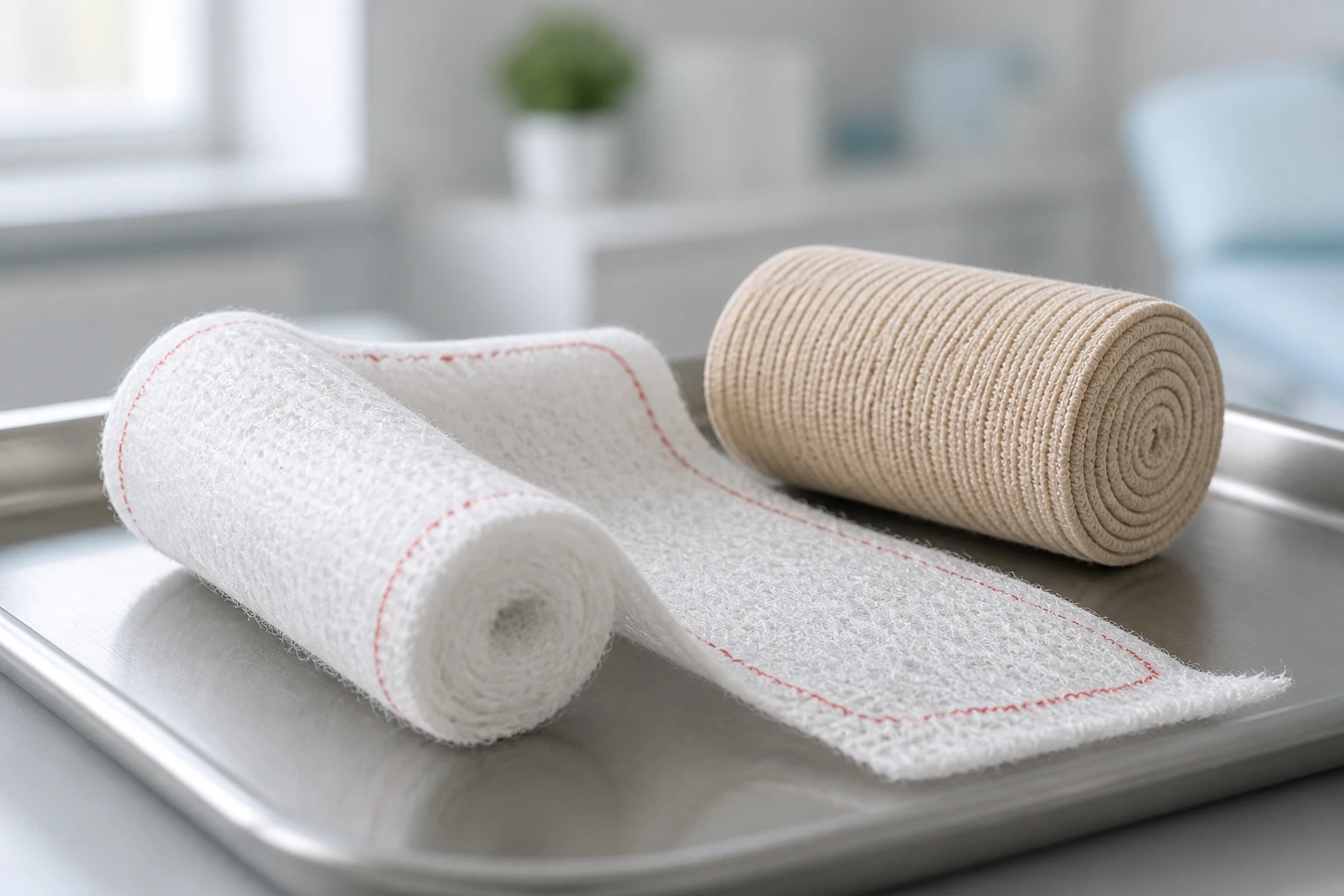
You are sitting in a stuffy conference room at a manufacturing hub, holding a clean-looking bandage. The sales rep is smiling, sliding a glossy catalog across the table, and telling you they have the best quality in the region. Everything looks great. But if you have been in the B2B medical sourcing game long enough, you know that what they show you in the showroom is rarely what ends up in your shipping container.
When you are doing a remote audit or sending a third-party quality inspector to a hospital grade crepe bandage factory, you have to ignore the marketing slides. You need hard, physical numbers. After years of dealing with medical textiles and solving supply chain disasters, I can tell you that the biggest quality issues always hide in three spots: Grams per Square Meter (GSM), elasticity, and the cheap little clips used to secure the wrap.
If you want to protect your margins and avoid getting a container full of useless, loose wraps, you need a solid inspection plan. Verifying the actual crepe bandage GSM is the absolute first step. A minor slip in the fabric weight can completely ruin the compression profile, which means the bandage won’t work in a clinical setting. In this guide, we are going to look at how to audit these physical parameters so you can make sure your elastic bandage specification sheet is followed to the letter, instead of just trusted blindly.
The Raw Truth About Crepe Bandage GSM
What exactly is crepe bandage GSM and why does it cause so many arguments between buyers and factories? Simply put, the crepe bandage GSM represents the weight of the fabric per square meter. But here is the tricky part that most people miss: crepe bandages are highly elastic. When a manufacturer claims their crepe bandage GSM is 75g, do they mean 75g per square meter when the bandage is completely relaxed, or when it is fully stretched?
If you do not specify this detail on your elastic bandage specification sheet, a dishonest factory will definately take advantage of the loophole. They will use less yarn, stretch the fabric to its absolute limit on the cutting table, and then tell you it meets your specs. In reality, the relaxed crepe bandage GSM will be way too low. You will end up receiving a thin, see-through wrap that has zero support. That is how you loose your clients’ trust.
To prevent this, your factory audit checklist must require a live, hands-on measurement. The inspector needs to cut a precise 10cm x 10cm sample from the middle of the roll. To calculate the relaxed crepe bandage GSM, they should use this simple text formula:
Relaxed crepe bandage GSM = (Weight of sample in grams * 10,000) / (Unstretched length in cm * Width in cm)
On the other hand, to calculate the stretched crepe bandage GSM, the sample must be stretched to its maximum nominal length under a standardized tension:
Stretched crepe bandage GSM = (Weight of sample in grams * 10,000) / (Stretched length in cm * Width in cm)
Most B2B buyers expect a standard stretched crepe bandage GSM of around 75g to 85g for daily hospital use. If you are auditing a hospital grade crepe bandage factory, they should have an automated GSM circular cutter and a calibrated digital scale right on the production floor. If they have to run to another building just to find a scale, that is a massive red flag. Always verify that the measured crepe bandage GSM matches the signed-off golden sample before any bulk production starts. Understanding how crepe bandage GSM relates to thread count is a basic skill for any B2B buyer.
Checking Elasticity and Stretch Recovery (Stretching the Truth)
Here is a controversial opinion: about 90% of third-party inspection agencies are completely useless at testing medical textiles. Why? Because they just check the paperwork and do a quick visual check. They do not actually test the physical limits of the material. If a bandage has the perfect crepe bandage GSM but lacks elasticity, it is dead weight. It won’t stay on a patient’s limb, and it won’t provide the uniform compression needed to treat sprains or varicose veins.
When you audit a hospital grade crepe bandage factory, you must inspect how they test elongation. You have to verify this alongside the standard crepe bandage GSM checks. Under British Pharmacopoeia (BP) standards, a high-quality crepe bandage should have an extension ratio of 1:1.8 to 1:2.5. This means a 1-meter relaxed bandage should stretch smoothly up to 1.8 or 2.5 meters without tearing the cotton fibers or snapping the elastic threads.
If the crepe bandage GSM is high but the elasticity is too low, the weave is likely too tight or the spandex quality is absolute garbage. We often see factories trying to save money by reducing the spandex ratio while maintaining the target crepe bandage GSM with cheap, heavy cotton. This results in a heavy but stiff bandage. A true expert will notice this instantly during a physical analysis of the crepe bandage GSM.
To catch this during your remote audit, make sure the inspector tests the elasticity recovery rate. Use this simple text-based formula to check the recovery rate, ensuring it aligns with your crepe bandage GSM requirements:
Elasticity Recovery Rate % = ((Stretched Length – Recovered Length) / (Stretched Length – Original Length)) * 100
Let the inspector stretch the bandage to its maximum limit, hold it for 10 seconds, and then release it. A high-quality bandage from MediTapes will recover to within 10% of its original unstretched length almost instantly. If the recovered length is too long, the bandage will sag after a few minutes of use on a patient. This test is just as critical as checking the baseline crepe bandage GSM. If a factory fails this test, even if their crepe bandage GSM is technically correct, you should reject the batch immediately. Understanding the relationship between elasticity and crepe bandage GSM keeps you from buying useless stock.
Skin-Color Elastic Crepe Bandage for Varicose Vein Treatment
Skin-Color Elastic Crepe Bandage for Varicose Veins | MediTapes Meta Description: Wholesale Skin-Color Elastic Crepe Bandages for Varicose Vein Treatment and Edema Control. Discreet, breathable compression rolls available in various widths. MediTapes offers factory-direct prices for vascular support supplies. Contact us for bulk orders.
Clips and Fasteners: The Hidden Quality Trap
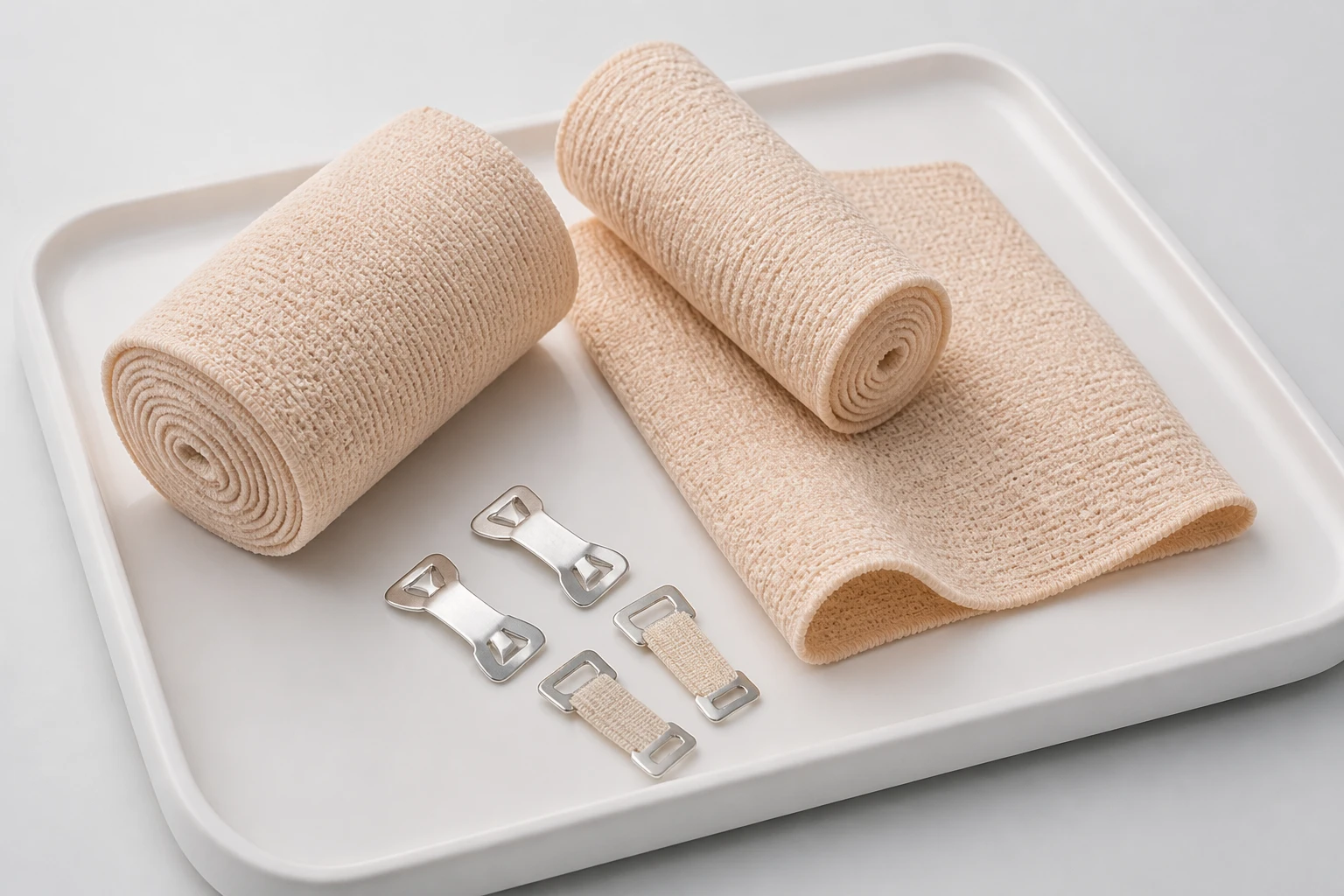
While most of your focus might be on the fabric weight and the overall crepe bandage GSM, do not ignore the clips. Many factories will quote a low price by cutting costs on the fasteners, regardless of your crepe bandage GSM requirements. A typical elastic bandage specification sheet should specify the exact type and material of the clips.
For example, if you are ordering bandage metal clips wholesale, are they made of 100% rust-resistant aluminum, or cheap steel that will rust in a humid warehouse? We have seen cases where the fabric had a premium crepe bandage GSM of 85, but the clips were so thin they bent like paper clips.
When sourcing bandage metal clips wholesale, always request material certificates. To check this during a factory audit, have the inspector test the clip tension and weight. A cheap 0.15mm aluminum clip is vastly different from a robust 0.3mm clip, yet both might be listed as “standard clips”. If the factory produces the clips in-house, inspect their stamping machines. If they source them from a third-party, check their incoming quality control (IQC) records to see if they test clip strength alongside the incoming crepe bandage GSM checks.
For bandages with elastic band clips, inspect the latex or latex-free elastic band itself. The rubber should not degrade or lose its stretch after being stored in a hot warehouse. This is a common failure point that is completely unrelated to the crepe bandage GSM, but equally devastating for the end-user. Always ask the factory to provide a separate spec sheet for the clips, alongside the main crepe bandage GSM datasheet. A mismatch in the crepe bandage GSM and the clip weight will lead to complaints from hospital buyers, even if your crepe bandage GSM is absolutely flawless.
Physical Parameter Checklist for Third-Party Inspections
When you hire a third-party agency to inspect a hospital grade crepe bandage factory, you cannot just tell them to “check the quality.” They will just count the boxes, take some nice photos, and call it a day. You need to give them a highly specific physical parameter checklist that links back to the crepe bandage GSM and weave density.
Here is a practical checklist we recommend using during your next audit, focusing on the relation between packaging, weave, and crepe bandage GSM:
| Audit Checkpoint | Target Specification | Testing Method | Relevance to crepe bandage GSM |
|---|---|---|---|
| Fabric Weight | 75g – 85g (Stretched) | 10cm x 10cm GSM cutter and digital scale | Direct measurement of the crepe bandage GSM |
| Weave Density | Warp: 12 threads/cm, Weft: 5 threads/cm | Counting glass/magnifier on relaxed fabric | Low density directly reduces the crepe bandage GSM |
| Elongation Rate | 130% – 180% | Tension testing jig or manual stretch test | Over-stretched yarn lowers final crepe bandage GSM |
| Selvedge Quality | Fast, locked non-fraying edges | Visual inspection during stretching | Poor edges lead to unraveling and loss of weight |
| Packaging Tightness | Firm, compact rolls | Caliper measurement of roll diameter vs length | Loose rolls hide a lack of material and lower crepe bandage GSM |
As shown in the table, every physical parameter is interconnected with the baseline crepe bandage GSM. For instance, if the warp yarn count is too low, the factory might try to compensate by over-weaving the weft yarn, which completely alters the finished crepe bandage GSM.
Additionally, check the packaging tightness. If a bandage is wound too loosely on the roll, it will look bulky on the shelf, but the actual crepe bandage GSM and stretched length will be far below your expectations. Make sure your inspector measures the diameter of at least 10 finished rolls. If they vary by more than 5%, the factory’s winding machine tension is inconsistent. This means some of your customers will recieve tight rolls and others will get loose, floppy ones.
A Real-World Sourcing Lesson: The “Wet Weave” Trap
Let me share a story about a Middle Eastern medical distributor who learned about crepe bandage GSM the hard way. They had ordered a massive container of bandages with a specified crepe bandage GSM of 80g. The pre-shipment samples looked perfect, but when the container arrived at their warehouse, the bandages felt thin and papery. The measured crepe bandage GSM had dropped to 68g!
What happened? The factory had used a common trick known as “wet-weaving.” They wove the cotton fabric while it was heavily misted with water. This caused the yarns to shrink and tighten on the loom, artificially inflating the crepe bandage GSM during initial production. Once the bandages dried out completely in the hot shipping container during transit, the fibers relaxed, the stretch collapsed, and the actual crepe bandage GSM plummeted.
By the time the distributor realized the issue, the factory blamed the humidity during shipping. It was a mess. This disaster could have been easily avoided if the distributor had mandated a dry-weight oven test for the crepe bandage GSM during the initial factory audit.
This is why choosing a reputable and highly transparent partner like MediTapes is so critical for B2B buyers who cannot afford these supply chain nightmares. We do not play games with wet weaving or cut corners on yarn density.

Sterile Elastic Crepe Bandage Roll with Clips – OEM Available
Certified Sterile Elastic Crepe Bandage featuring secure metal or elastic clips. We offer OEM customization for size and packaging. This high-grade elastic crepe bandage ensures sterile protection for surgical wounds. Reliable retention and soft texture make it essential for first aid kits.
Frequently Asked Questions
1. What is the difference between stretched and unstretched crepe bandage GSM?
The unstretched crepe bandage GSM measures the weight when the fabric is completely relaxed. The stretched crepe bandage GSM measures the weight relative to its fully extended state. Since crepe bandages are sold by stretched length, you must specify both on your purchase order to prevent the factory from cheating on material weight.
2. How do I ensure a hospital grade crepe bandage factory does not cheat on crepe bandage GSM?
You must mandate a dry-weight test and require the inspector to verify the crepe bandage GSM using a calibrated 10x10cm cutter. Do not rely on visual checks. Always cross-check the roll weight against the nominal length and width.
3. Can I use standard bandage metal clips wholesale for all types of crepe bandages?
No. Light-weight bandages can use standard 0.15mm aluminum clips, but heavy-duty, high-GSM bandages require thicker 0.3mm aluminum clips or elastic bands with robust metal hooks to hold the compression. Using cheap clips on a heavy bandage will cause the clips to bend and fail.
4. Why does the weave structure affect the crepe bandage GSM?
The density of the warp and weft yarns directly determines how much fiber is packed into each square meter. A loose weave with fewer threads will have a lower crepe bandage GSM, which reduces both the compression strength and the durability of the bandage after washing.
Ready to Secure Your Supply Chain?
Are you tired of receiving thin, flimsy bandages that fail clinical standards? Don’t let dishonest suppliers ruin your reputation with poor crepe bandage GSM and weak clips. You deserve a medical supplier who values transparency and consistent physical quality.
At MediTapes, we manufacture premium-quality wraps that adhere strictly to international standards, including the British Pharmacopoeia (BP). We provide complete transparency, from our certified crepe bandage GSM data to our robust aluminum and elastic clips.
Whether you need high-density rolls for compression therapy or looking to source bandage metal clips wholesale, we have you covered. Our elastic crepe bandage range is designed for consistent, graduated pressure, ensuring maximum patient comfort and recovery. We provide full inspection reports and golden samples before every single shipment, so you never have to worry about a drop in your crepe bandage GSM again.
Ready to secure your medical supply chain? Contact our sourcing team today at info@meditapes.com to request a customized quote, get a copy of our standard elastic bandage specification sheet, or order free samples. Let us show you why global hospital networks trust our quality!