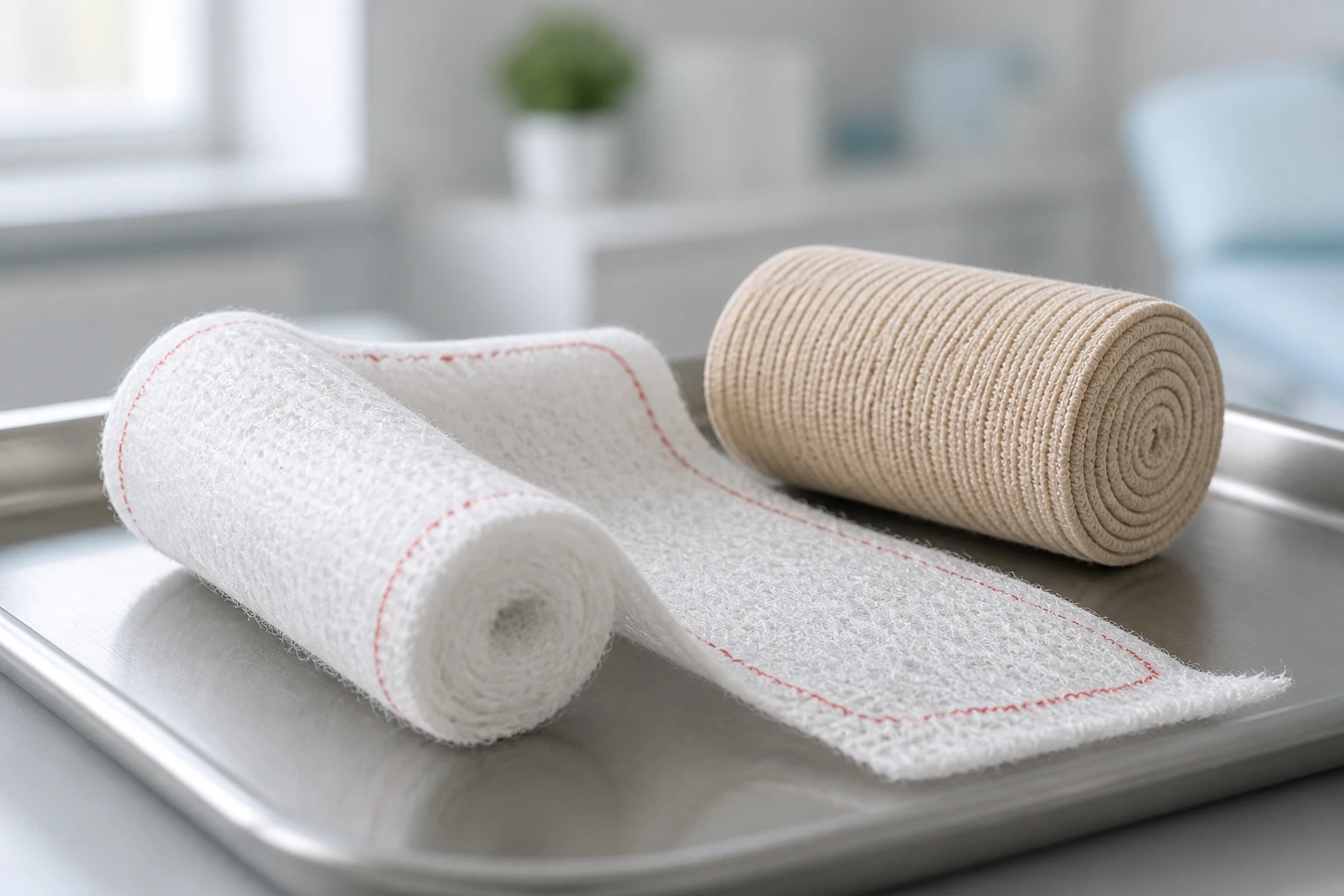
If you have spent any time dealing with hospital procurement committees or private clinic networks, you already know this truth: a deal worth tens of thousands of dollars can grind to a complete halt over an accessory that costs less than two cents.
We see it happen all the time. A distributor pitches a top-tier cotton crepe line, beats the competitor on bulk unit pricing, matches every tensile stretch requirement, and delivers flawless ISO documentation. Then the head of nursing looks inside the box, spots aluminum teeth instead of stretch hooks—or vice versa—and drops the order.
Clinicians are stubborn about their routines. Emergency room nurses who wrap forty sprains a shift want fast, one-handed grip. Orthopedic surgeons stabilizing post-op cast padding want absolute non-slip anchoring that will not pop loose under a patient’s trousers. When a medical supply wholesaler carries only a single closure setup, they immediately lock themselves out of roughly half the market.
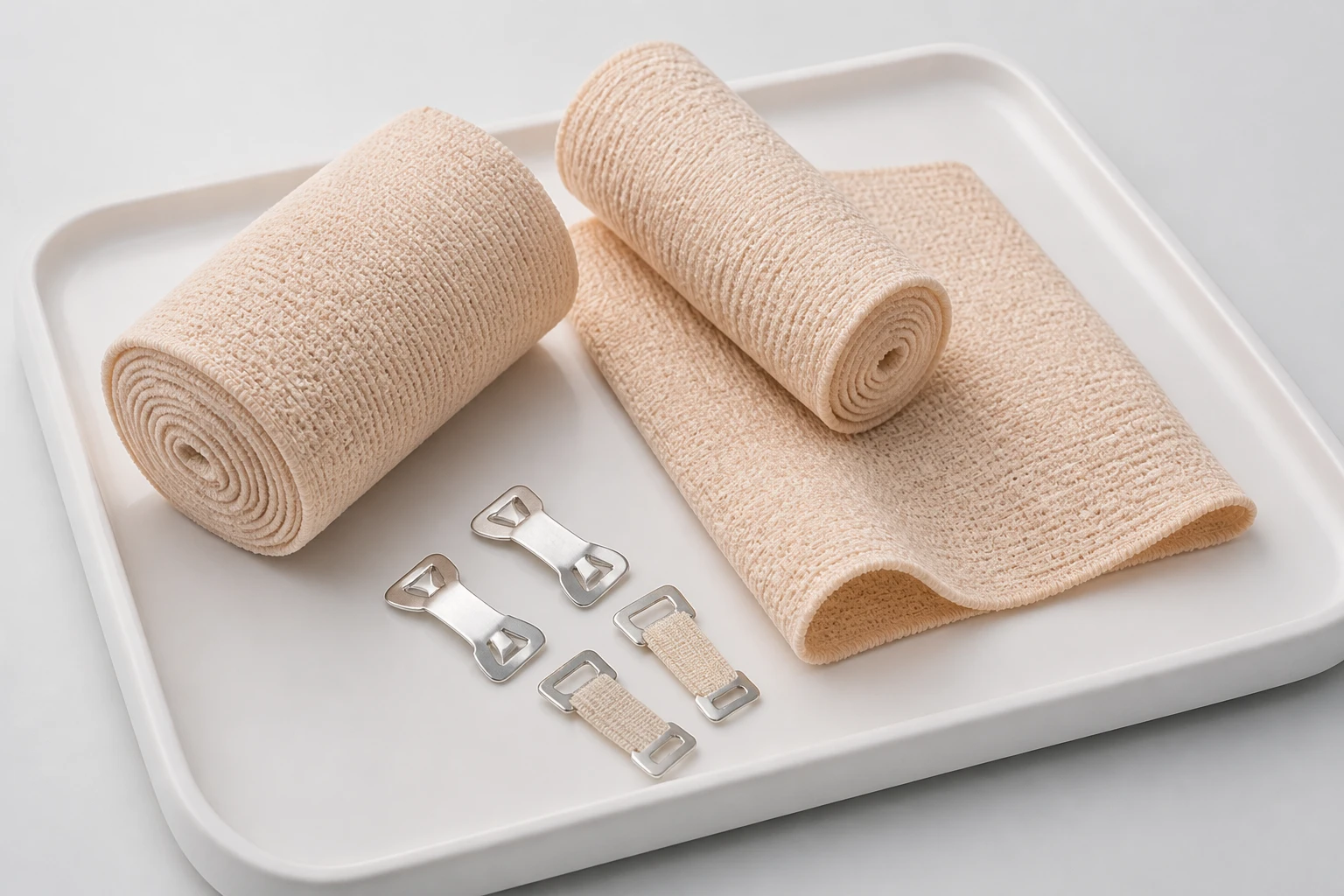
Offering an elastic crepe bandage with clips in multiple closure formats—specifically traditional aluminum clips and modern elastic band hook clips—is not just about product variety. It is a direct strategy to capture tender specs, increase average order value, and prevent your end-users from switching to another brand.
Quick Industry Reality Check: Over 68% of clinician complaints regarding light-to-medium compression slippage track back to closure failure rather than fabric elasticity loss. The clip is the mechanical anchor of the entire wrap.
The Core Debate: Bandage Aluminum Clips vs. Elastic Bandage Clips
Every tender document lists specific bandage closure types, but procurement officers often treat them as interchangeable line items. They are not. The mechanical behavior, workflow speed, and clinical safety profiles between metal and stretch closures are completely distinct.
Bandage Closure Architectural Differences
- Traditional Aluminum Clip: Formed from bare, ductile 1060 aluminum. Features rigid dual claws connected by a solid metal bridge. Offers re-bendable, high-friction anchoring into dense fabrics.
- Elastic Stretch Hook Clip: Formed from a flexible elastane/polyester center ribbon with micro-teeth crimped on each end. Offers continuous dynamic tension and sits flat against the skin under clothing.
1. Traditional Aluminum Bandage Clips
Aluminum clips have been the worldwide clinical baseline for decades. Stamped from soft, pliable aluminum strip stock (typically Grade 1050 or 1060 aluminum), they feature two stamped claws on opposing ends connected by a flat metal bridge.
- How they work: The clinician catches one set of claws into the outer layer of the wrapped bandage, pulls the wrap snug, and presses the opposing claws into the underlying wrap. The soft metal can be flattened against the limb with light thumb pressure.
- Where they win: Rigid anchoring. When securing heavy-weave cotton wraps where fabric thickness resists light pressure, pure metal claws bite deep into the yarns. They do not lose tension if exposed to water, sweat, or light ointments.
- The downsides: Sharp burrs. If a low-cost manufacturer uses worn stamping dies, micro-burrs along the claw edge can snag latex examination gloves or scratch sensitive, thin skin on geriatric patients.
For high-volume distributors looking at bandage aluminum clips wholesale sourcing, metal purity is everything. Brittle scrap-blend aluminum snaps after two re-adjustments, causing instant product returns from triage units.
2. Elastic Hook Bandage Clips (Stretch Band Clips)
Elastic bandage clips swap out the rigid metal bridge for a heat-sealed piece of woven or braided elastic webbing with miniature metal teeth crimped onto both ends.
- How they work: You hook one end into the bandage body, stretch the central elastic webbing across the wrap edge, and anchor the second end. The continuous contractive force keeps constant tension on the closure point.
- Where they win: Patient comfort and dynamic movement. Because the central bridge flexes, it expands and contracts when a joint (like an ankle or elbow) moves. It lays flatter under tight clothing and removes the risk of a rigid metal edge poking through thin dressings.
- The downsides: Over-stretch degradation. Cheap rubber cores inside the clip ribbon snap or loosen if sterilized or stored in hot warehouse conditions.
Distributors working with a reliable elastic bandage clip supplier usually demand heat-resistant synthetic elastane webbing to prevent the clips from turning brittle on the shelf.
The Mechanical Physics: Why Closure Mechanics Impact Sub-Bandage Pressure
A crepe bandage is designed to provide light support, retention, and controlled compression. The actual pressure delivered to the limb follows the classic mechanical principles of Laplace’s Law adapted for medical bandaging.
In clinical practice, sub-bandage pressure can be estimated using the standard formula:
Sub-Bandage Pressure Formula:
P = (T × N × 4630) / (C × W)
- P = Sub-bandage pressure (expressed in millimeters of mercury, mmHg)
- T = Bandage tension applied during wrapping (in Newtons or kgf)
- N = Number of overlapping bandage layers applied
- C = Limb circumference at the target application area (in centimeters)
- W = Bandage width (in centimeters)
- 4630 = Constant factor converting standard metric units into clinical mmHg
According to clinical research documented in the National Center for Biotechnology Information (NCBI), sub-bandage pressure drops dramatically within the first 120 minutes if the terminal wrap loses its anchor point.
Anchor Slippage vs. Pressure Loss Dynamics:
- Baseline Application: Layer 1 + Layer 2 + Layer 3 held firmly by a quality clip delivers steady, therapeutic target pressure.
- Slippage Impact: When a weak clip allows the tail to shift by just 1.5 cm, tension T across the outer layer collapses to zero, reducing the total effective pressure P by up to 35%.
A rigid aluminum clip maintains a static holding force, which works best when the wrap is applied over stationary support areas. An elastic clip acts as a shock absorber during muscle flexation, maintaining tension T without tearing out of delicate warp yarns.
Supplying the right closure style directly impacts whether an elastic crepe bandage with clips maintains its therapeutic standard in field trials.
Technical Comparison: Aluminum Clips vs. Elastic Band Clips
To help your procurement team evaluate product lines, here is a side-by-side technical breakdown of both closure styles:
| Specification Parameter | Pure Aluminum Metal Clips | Elastic Hook Bandage Clips |
|---|---|---|
| Base Material | Medical-grade stamped Aluminum 1060 | Polyester/Elastane webbing + Galvanized steel teeth |
| Holding Mechanism | Static mechanical claw bite | Dynamic tension grip + multi-point teeth |
| Tensile Holding Force | 18 N to 25 N (before claw disengagement) | 12 N to 20 N (continuous contractive pull) |
| Profile Thickness | ~1.2 mm to 1.8 mm | ~0.8 mm (lays flat against tissue) |
| Autoclave / Heat Stability | Excellent (withstands up to 250°C) | Moderate (up to 121°C depending on synthetic core) |
| Latex-Free Status | 100% Latex-Free naturally | Must specify synthetic elastane to be 100% Latex-Free |
| Primary Risk Point | Metal burrs / patient skin scratching | Rubber dry-rot / tooth pull-off from webbing |
| Preferred Clinical Setting | Heavy casting under-wrap, rigid sprain stabilization | Sports medicine, pediatric wrap, flexible joint support |
| Average Component Cost Impact | Base standard unit cost | +$0.005 to +$0.015 per finished pack |
When ordering an elastic crepe bandage with clips, leading B2B importers commonly split their orders: 60% packed with elastic stretch clips for general pharmacy distribution and sports clinics, and 40% packed with heavy aluminum clips for hospital orthopedic tenders.
Why Stocking Both Closures Accelerates B2B Revenue
Distributors who force a single closure variant onto their customer base leave clear openings for their competitors. Here is how segmenting closure options expands client retention:
- Private Pharmacies & Sports Clinics: Overwhelmingly prefer soft, elastic stretch clips to avoid scratch risks under athletic gear and casual clothing.
- Hospital Wards & Orthopedic Plaster Rooms: Often prefer rigid aluminum clips for maximum holding power over heavy cotton under-cast rolls.
- Tender Bidding Offices: Need exact compliance with government tender specifications that mandate one closure style over another.
1. Cracking Complex Hospital Tenders
Public health tenders and private hospital groups often issue highly specific technical sheets. One regional tender might require compliance with ASTM International textile standards alongside strict skin-safety rules that eliminate sharp-edged fasteners. Another military or field tender might mandate non-rubber, 100% metal fasteners that hold up in extreme heat and humidity.
If your catalog only features one style, your bidding team gets disqualified at stage one. Partnering with a manufacturer like MediTapes that provides both styles allows you to check every technical box without sourcing from multiple factories.
2. Slashing SKU Consolidation Overhead
Sourcing metal-clipped bandages from Factory A in Ningbo and elastic-clipped bandages from Factory B in India is a logistics nightmare. You deal with double the customs clearances, fluctuating lead times, mixed minimum order quantities (MOQs), and inconsistent fabric weights.
Sourcing from a single supplier that handles both configurations under standard ISO 13485 certified quality systems streamlines your supply chain. You get consistent cotton-poly yarn blends, uniform selvage edges, and standardized outer carton packaging across your entire catalog.
3. Lowering Hospital Churn Rates
Clinical staff rarely complain about bandage weave quality first; they complain when the wrap falls off the patient.
When a distributor ships a bulk batch of bandages with weak aluminum clips that bend out of shape on first use, nurses file complaints with hospital purchasing departments. Offering the right closure for the right clinical department protects re-order rates and safeguards multi-year supply contracts.
Quality Control Checkpoints: What to Inspect Before Ordering Wholesale
Not all closures are manufactured equally. Low-grade manufacturing creates downstream product liability issues that can ruin a distributor’s reputation.
| Quality Element | Substandard Grade (Red Flags) | Medical-Grade Standard (MediTapes Spec) |
|---|---|---|
| Edge Finish | Sharp micro-burrs along stamped claws | Vibratory deburred, smooth rounded edges |
| Metal Alloy | Recycled brittle alloy (snaps upon bending) | Ductile Grade 1060 pure aluminum |
| Ribbon Bonding | Weak single-point crimp (teeth pull off easily) | Multi-point mechanical punch crimping (>18 N pull) |
| Elastomer Core | Raw natural latex (high allergy risk) | Synthetic heat-resistant elastane (100% latex-free) |
When auditing samples from an elastic bandage clip supplier, run these basic warehouse quality checks:
1. Die-Cut Burr Inspection (Aluminum Clips)
Run your thumb across the reverse side of the metal teeth. If you feel sharp catches or jagged edges, the stamping mold is worn out.
- High-volume stamped clips must undergo vibratory tumbling or deburring to round off edges.
- Sharp burrs rip surgical gloves and cause micro-abrasions on patient skin, violating basic European CE and US FDA Medical Device safety expectations.
2. Tooth-to-Ribbon Crimping Force (Elastic Clips)
Grip the metal teeth with pliers and hold the elastic center with your fingers. Pull with moderate force (roughly 15 N to 20 N).
- Low-end factories use manual crimping presses where the teeth pull clean off the fabric ribbon under light tension.
- If a tooth detaches during application, it becomes a loose metallic foreign body in a clinical environment. Look for multi-point mechanical punch crimps.
3. Elastic Recovery & Latex Content
Stretch the elastic bridge to 200% of its relaxed length, hold it for ten seconds, and release.
- It should snap back to within 5% of its original length immediately.
- Verify that the elastic core uses synthetic elastane/polyurethane yarns rather than cheap natural latex threads, unless specifically labeled. Unlabeled latex creates severe anaphylactic allergy risks in clinical settings.
4. Fabric Weave & Edge Integrity
The closure is only as good as the textile it anchors to. An elastic crepe bandage with clips must feature reinforced, non-fraying selvage edges. If the warp threads unravel when the clip teeth bite in, the entire dressing slips within minutes.
Real-World Case Study: How a European Medical Wholesaler Slashed Product Returns by 34%
To see how closure selection impacts bottom-line revenue, look at this recent case from our OEM client files (anonymized for client confidentiality).
Distributor Turnaround Snapshot:
- Initial Challenge: 12% return rate on crepe wraps across German rehab and nursing facilities.
- Core Driver: Standard aluminum clips snagged delicate geriatric skin and loosened overnight.
- MediTapes Intervention: Implemented a Dual-SKU catalog split (aluminum for hospital casting, soft elastic hook clips for geriatric care).
- Final Commercial Result: 34% drop in returns, 4.2% margin expansion, and contract grew to €420,000/year.
The Problem
A regional medical distributor in Germany was supplying 10 cm × 4.5 m cotton crepe bandages to a network of outpatient rehabilitation clinics and geriatric nursing homes. Over six months, their return rate on crepe wraps jumped to 12%, with purchasing managers citing “frequent skin scratches” and “unstable fastening during sleep.”
The distributor was supplying standard, generic imported bandages fitted exclusively with stiff aluminum clips. While the metal clips worked well enough for heavy orthopedic casts, frail elderly patients with paper-thin skin were scratching their legs on the exposed metal claws.
The Solution
The distributor worked with the engineering team at MediTapes to revamp their catalog structure:
- SKU A (Hospital Orthopedic Line): Standard 100% cotton elastic crepe bandage with clips using polished, deburred 1060 aluminum clips.
- SKU B (Geriatric & Rehab Line): High-stretch cotton-poly blend crepe bandage fitted with dual soft-edge, latex-free elastic hook clips that sit flush against the skin.
The Commercial Outcome
- Overall product returns dropped by 34% in the first ninety days.
- The distributor won a new tender for twenty-eight private physical therapy clinics that had previously blacklisted metal-clipped wraps.
- Gross margins on the new elastic-clip SKU rose by 4.2%, as buyers were happy to pay a slight premium for improved patient safety.
- Total annual account value grew from €280,000 to €420,000 within fourteen months.
Optimizing Your Sourcing Strategy: Packaging, Pack Counts, and Clip Options
When placing bulk production runs with an OEM manufacturer, your packaging configuration matters just as much as the product specifications.
| OEM Packaging Format | Internal Configuration | Ideal Distribution Channel |
|---|---|---|
| 1. Loose Enclosed Clips | 2 clips tucked into core of rolled bandage | Retail pharmacy, general clinic inventory, first-aid kits |
| 2. Pre-Anchored Clips | 1 clip pre-fastened to outer bandage tail | Emergency response, rapid-triage kits, paramedic packs |
| 3. Bulk Secondary Pack | Bandages wrapped plain; clips bagged in 100s | High-volume hospital cast rooms, orthopedic centers |
- Loose Clip Insert (Standard): Two clips are placed inside the core of the rolled bandage, sealed within individual cellophane or poly wrappers. This is the most cost-effective approach for retail and general ward use.
- Pre-Pinned Clip (Fast Triage): One clip is pre-anchored to the tail end of the roll, allowing the clinician to immediately secure the wrap upon finishing without digging into the wrapper.
- Bulk Polybag Dispensers: Bandages are packed without clips inside the wrapper, and bandage aluminum clips wholesale are shipped in separate bulk bags of 100 or 500 units. This setup is common for high-volume plaster rooms and military field kits where clips are consumed at varying rates.
At MediTapes, we offer fully customizable OEM packaging: from custom printed inner boxes to private-labeled wrapper films and specific clip loading configurations.
Frequently Asked Questions (FAQ)
Can an elastic crepe bandage with clips be safely autoclaved with the fasteners attached?
Traditional pure aluminum metal clips can easily withstand standard steam autoclaving (121°C to 134°C) without losing structural strength or mechanical grip. However, elastic hook clips should only be autoclaved if the manufacturer explicitly certifies that the internal elastane core and tooth crimps are heat-stabilized. Standard cheap elastic clips will melt or lose elasticity during steam sterilization.
Why do some hospital procurement guidelines ban metal clips entirely?
Some pediatric wards, psychiatric facilities, and geriatric units restrict exposed metal clips due to scratch risks or intentional self-harm concerns. In those departments, medical facilities require either stretch clips, self-adhesive cohesive wraps, or medical tape. Carrying an elastic crepe bandage with clips alongside tape or cohesive alternatives lets you cover every department’s compliance rules.
How do I verify that aluminum bandage clips are free of dangerous sharp burrs?
During factory acceptance testing, use a standard cotton-ball drag test. Run a loose surgical cotton ball across the claw edges of a sample clip. If cotton fibers catch or tear on the teeth, the stamping die has excessive clearance and is producing burred edges. Reliable suppliers run all metal clips through secondary tumbling and polishing baths to eliminate rough edges before packaging.
What is the typical MOQ for custom branded packaging on dual-clip crepe bandages?
For standard bulk orders, our minimum order quantity starts at 5,000 rolls per size. Custom private-label retail boxes or specialized branded wrapper films typically start at 10,000 to 20,000 units depending on the dimensions and print colors.
Take the Next Step for Your Supply Chain
- Explore our full product range: Visit the MediTapes Product Catalog
- Contact our team directly: Reach out through our Contact Us Page or email us at info@meditapes.com. We will send full factory test reports, clip samples, and wholesale price sheets within 24 business hours.