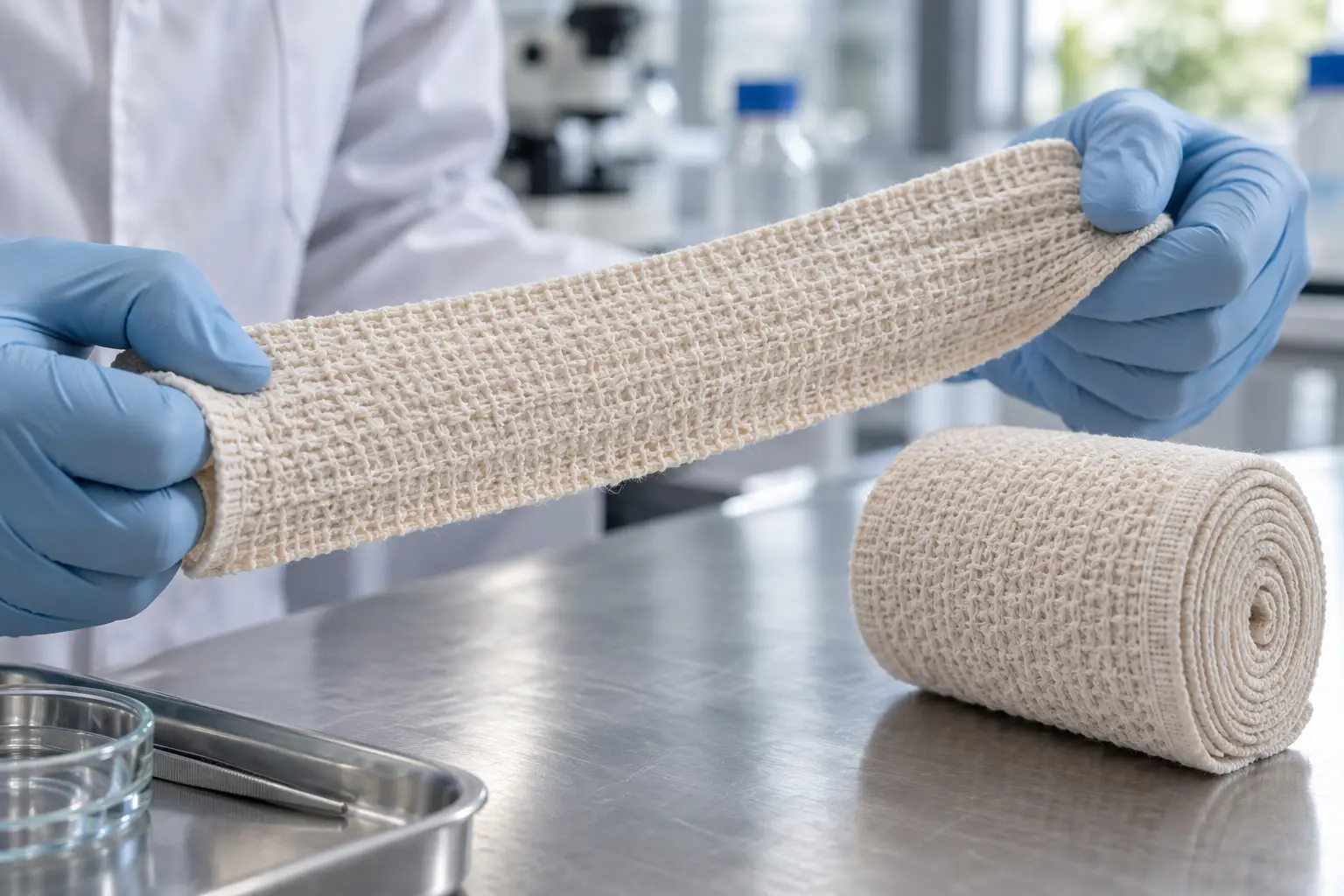
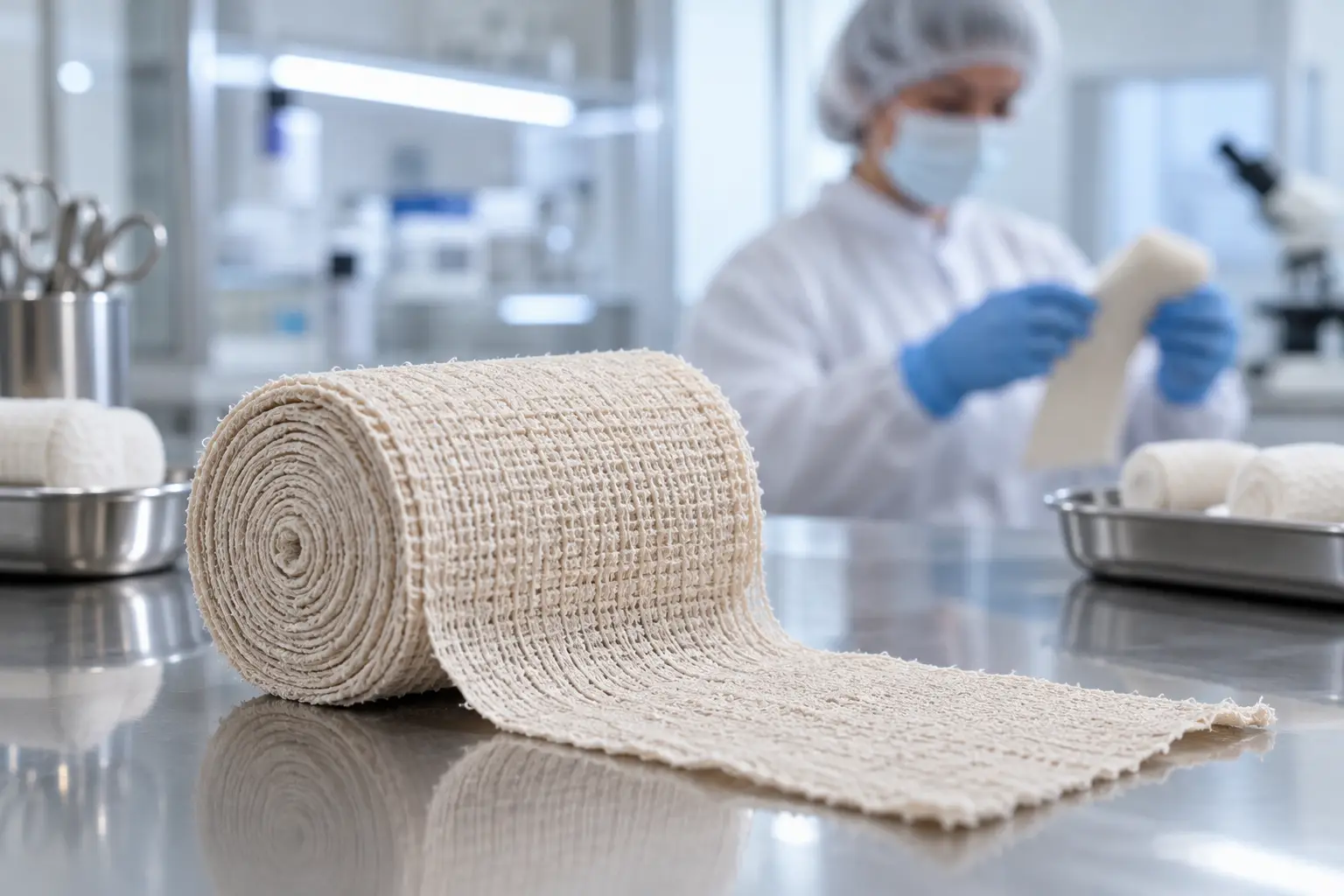
If you have ever managed supply chains for professional athletic clubs, medical clinics, or retail pharmacy chains, you know the absolute nightmare of opening a bulk ocean container only to find a total sourcing failure. You ordered a premium batch of non-elastic athletic tape, but what actually arrived at your warehouse has a subtle, bouncy stretch to it. It behaves more like a low-grade bandage than a high-performance stabilizer.
When importing products for elite physical therapists, medical distributors, or school sports teams, getting genuine non-elastic athletic tape is a non-negotiable requirement. In our industry, we call it by several names depending on the market—whether it is non-stretch athletic tape, rigid cotton strapping, or zero-stretch tape—but the basic performance demand remains exactly the same: absolute joint immobilization.
If you end up with even a tiny bit of elastic yield, the therapeutic benefits are completely lost. Athletic trainers cannot safely lock down a hyper-extended elbow or a badly sprained ankle. In this comprehensive specification guide, we will break down every critical detail of non-elastic athletic tape so you never get stuck with subpar, stretchy stock again. We will cover thread counts, fabric compositions, adhesive chemistry, and real-world testing standards that every serious B2B buyer needs to master.
What Exactly Makes a Tape a True Non-Elastic Athletic Tape?
To get to the bottom of this, let’s discuss fabric behavior. At its core, a professional-grade non-elastic athletic tape is designed to restrict joint mobility and prevent harmful, excessive movements during intense physical play. Think of it as a rigid cast made of fabric that can be applied in seconds.
Unlike flexible kinesiology wraps, a high-quality non-elastic athletic tape offers zero give. It acts as an external ligament. To achieve this rigid performance, manufacturers must use a heavy-duty fabric backing that does not stretch under sudden impact or continuous stress.
Let’s talk about the fiber itself. Honestly, many factories try to cut corners by mixing synthetic fibers into the cotton warp. If your wholesale suppliers try to pass off a synthetic polyester blend without your explicit approval, you are no longer selling a true non-elastic athletic tape. You have got an elastic hybrid on your hands, and your end customers will notice the difference the second they try to secure a joint.
At MediTapes, we have seen this issue happen repeatedly with buyers who switch suppliers based solely on a slightly lower unit price. They think they are getting a great deal on rigid tape, only to realize the fabric is a cheap poly-cotton blend that stretches and sags under the weight of an active athlete. A genuine non-elastic athletic tape must be crafted from high-grade cotton fibers that provide a solid, unyielding barrier.
The Downside of Polyester Blends in Non-Elastic Athletic Tape
Let’s talk about why some factories do this. Squeezing polyester into the weaving process is a classic manufacturer’s trick to save on expensive raw cotton. Polyester threads are cheaper to produce, and they make the raw fabric roll look shiny and appealing on a showroom floor. But when it comes to practical use, a polyester blend completely ruins the tearing behavior of your non-elastic athletic tape.
Ask any professional athletic trainer, and they will tell you they rarely use scissors on the field. They need to tear the tape instantly with their hands, both lengthwise and crosswise, while keeping their eyes on the injured athlete. A pure, 100% cotton non-elastic athletic tape has a natural structure that allows a clean, serrated rip. When you add polyester, the tape becomes incredibly tough to tear by hand, leaving annoying frayed threads and slowing down the trainer’s work.
On top of that, polyester does not breathe well. When players sweat, a polyester-blend tape traps moisture against the skin. This quickly breaks down the adhesive, causing the tape to slip. For demanding sports like rugby, basketball, or soccer, 100% cotton is the absolute benchmark for a high-performance non-elastic athletic tape.
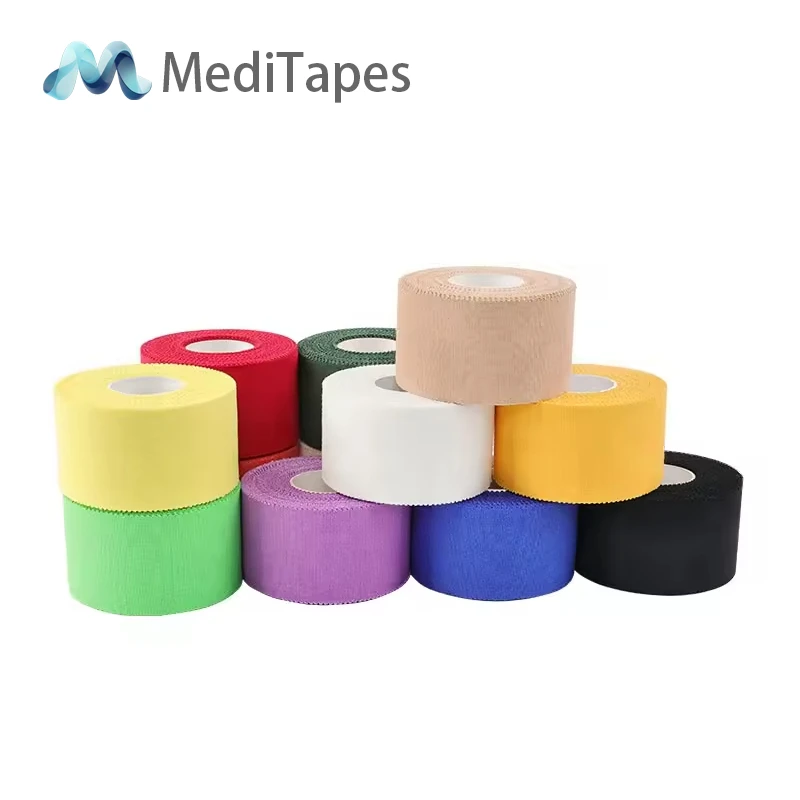
For brands that want to stand out on the retail shelf or match a team’s official uniform, we also offer a vibrant variety of shades like our Color Cotton Fabric Sports Tape. This range maintains the exact same pure-cotton, rigid structure while giving your brand a brilliant visual edge.
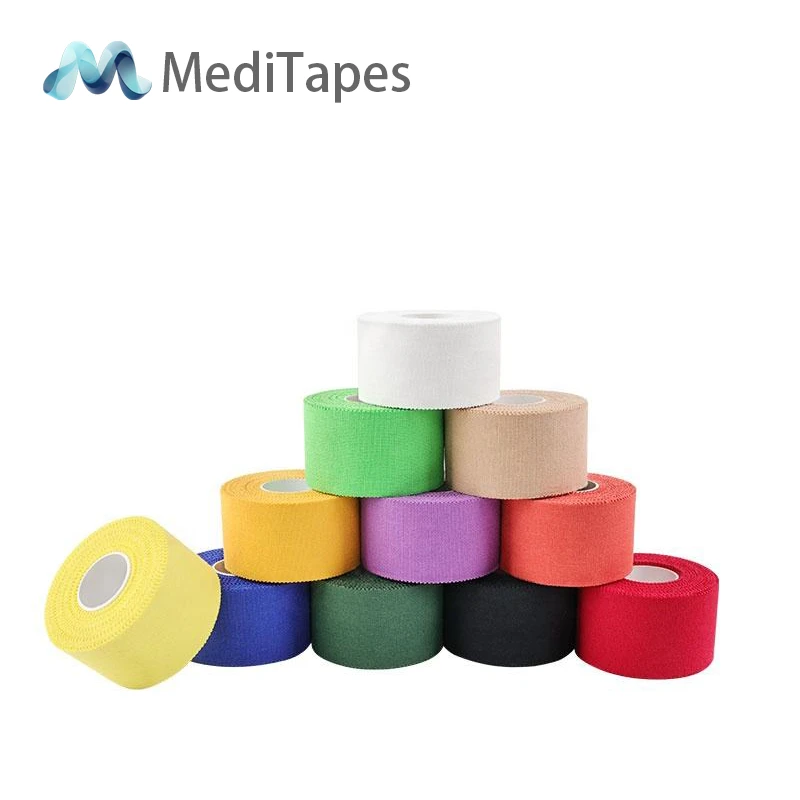
Heavy Duty Cotton Sports Tape Rigid Adhesive Tape for Ankle Wraps
Ensure peak performance with heavy-duty Cotton Sports Tape. Specifically designed for ankle wraps and joint support, this rigid adhesive tape withstands sweat and intense movement. Our durable cotton sports tape is the top choice for preventing sports injuries.
Key Technical Specs: Thread Count and Yarn Density in Non-Elastic Athletic Tape
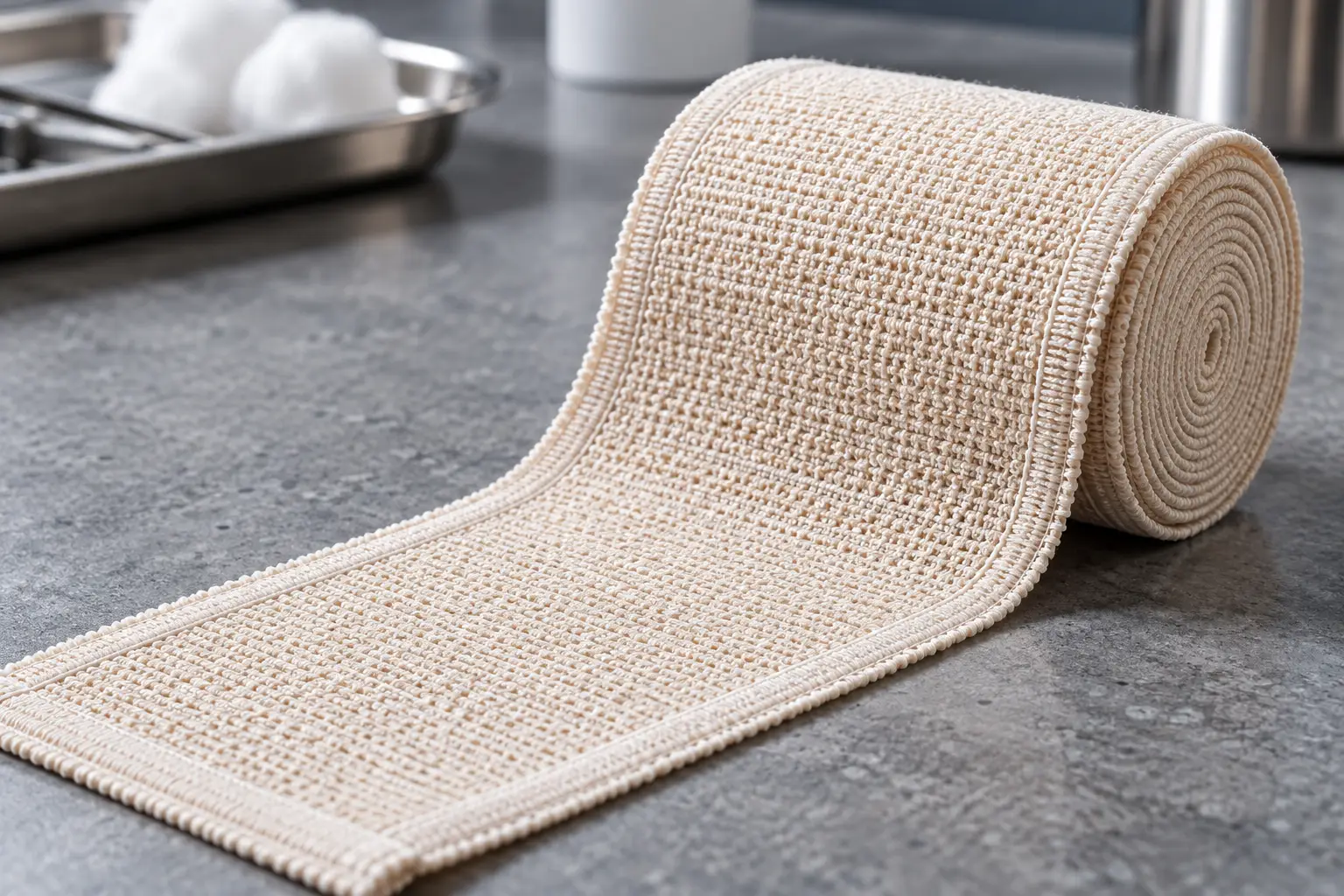
When comparing different options for bulk non-elastic athletic tape, you must pay close attention to the thread count. This is often listed on technical spec sheets as “yarn density” or “mesh size.” It refers to the number of warp (vertical) and weft (horizontal) threads woven into a single square inch of the backing fabric.
The yarn density is the primary factor that determines the tensile strength of your rigid cotton strapping. If the thread count is too low, the tape will feel thin, flimsy, and prone to splitting under heavy lateral pressure.
Let’s look at the numbers. A standard, budget-friendly non-elastic athletic tape often uses a 60×60 thread count fabric. This means there are 60 warp threads and 60 weft threads per square inch. While this is fine for basic retail packaging or lightweight finger wrapping, it might not hold up under the brutal physical force of professional sports.
If you are catering to elite athletic clubs or orthopedic clinics, you want a premium non-elastic athletic tape built with a 68×68 thread count. This denser weave provides a massive boost to the tape’s structural integrity, ensuring that it remains a true zero-stretch tape even under extreme tension.
The formula to calculate the overall yarn density of a fabric is quite simple:
Yarn Density = Warp Threads per Inch + Weft Threads per Inch
Using this basic calculation, we can see that a premium 68×68 tape offers a total of 136 threads per square inch, compared to just 120 threads in a budget 60×60 roll. That is over a 13% increase in fabric density, which translates directly to superior joint stabilization and higher burst resistance.
Dimensional Precision for B2B Sourcing of Non-Elastic Athletic Tape
You can’t just buy any random dimensions of non-elastic athletic tape and assume it will fit your customers’ needs. Different parts of the body require specific widths, and clinical buyers are extremely picky about these dimensions.
Let’s list out the common dimensions you will encounter when sourcing high-quality non-elastic athletic tape. Understanding these standard sizes will help you avoid ordering slow-moving stock that sits in your warehouse forever.
Standard widths of non-elastic athletic tape typically include:
- 1 Inch (2.5cm): Perfect for wrapping fingers and wrists. This size is highly popular among rock climbers, gymnasts, and combat sports athletes.
- 1.5 Inches (3.8cm): The absolute king of sports tape dimensions. Over 70% of all
non-stretch athletic tapesold globally falls into this category. It is the go-to size for ankle strapping, knee support, and shoulder stabilization. - 2 Inches (5cm): Used for larger muscle groups and thigh strapping. It is also favored by veterinary clinics for wrapping larger animal joints.
For standard packaging, a roll of non-elastic athletic tape usually measures 10 meters or 13.7 meters (15 yards) in length. Many retail buyers prefer the 10-meter rolls because they fit nicely into compact retail display boxes. On the other hand, professional sports teams and clinical buyers almost always demand the 13.7-meter length to maximize value and minimize waste during busy training sessions.
Adhesive Formulations and Performance Standards for Non-Elastic Athletic Tape
The fabric of your non-elastic athletic tape is only half the battle; the adhesive formulation is what actually keeps it secured on sweaty skin under intense friction. If the glue is poor, the best fabric in the world won’t save your brand reputation.
Medical-grade zinc oxide hot melt adhesive is the undisputed industry standard for a reliable non-elastic athletic tape. Zinc oxide is prized for its excellent skin tolerance, hypoallergenic properties, and resistance to body oils and sweat.
For extreme clinical situations or heavy-duty outdoor athletic matches, some buyers demand a natural rubber adhesive on their non-elastic athletic tape. Natural rubber offers a stronger initial bite (tack) and a higher shear strength, but it carries a small risk of triggering latex allergies in sensitive individuals.
Measuring Adhesion and Tensile Strength in Non-Elastic Athletic Tape
Let’s look at how manufacturers measure these adhesive qualities. To test the mechanical properties of a batch of non-elastic athletic tape, quality control teams use ASTM D3759 and ASTM D3330 standards. These standards analyze the breaking strength and the peel adhesion of pressure-sensitive tapes.
To determine the mechanical strength of the tape backing, the formula is:
Tensile Strength = Breaking Force / Tape Width
For example, if a 3.8cm (1.5-inch) tape requires a breaking force of 190 Newtons to snap, its tensile strength would be:
Tensile Strength = 190 Newtons / 3.8 cm = 50 N/cm
A high-performance non-elastic athletic tape should comfortably withstand at least 45 to 50 N/cm of pulling force. If your current supplier’s spec sheet shows a tensile strength below 40 N/cm, you are likely looking at a weak fabric that will fail during intense athletic maneuvers.
Another critical metric is peel adhesion, which measures the force required to pull the tape off a standard stainless steel plate at a 180-degree angle. This is calculated using the following formula:
Peel Adhesion = Peel Force / Tape Width
A professional-grade tape should have a peel adhesion rating of 2.5 N/cm to 4.0 N/cm. Anything lower will slip off when the athlete sweats, while anything higher might tear the skin upon removal.
OEM Custom Color Cotton Fabric Sports Tape Manufacturer Factory
Build your brand with our Color Cotton Fabric Sports Tape. As a leading factory, we offer OEM services for custom widths, lengths, and packaging. This high-adhesion cotton sports tape can be customized to match team colors. Partner with us for reliable manufacturing.
Spec Table: Comparing Commercial Grades of Non-Elastic Athletic Tape
Let’s put the specs of different grades of non-elastic athletic tape side by side for easy comparison. This table will help you identify what type of tape fits your specific target market and budget constraints.
| Feature / Spec | Premium Professional Grade | Standard Retail Grade | Budget Economy Grade |
|---|---|---|---|
| Primary Material | 100% Pure Cotton Fabric | 100% Cotton Fabric | Polyester-Cotton Blend |
| Yarn Density (Warp x Weft) | 68 x 68 threads/inch | 60 x 60 threads/inch | 55 x 55 threads/inch |
| Elasticity | Zero-Stretch (Absolute Rigid) | Zero-Stretch (Absolute Rigid) | Low-Stretch (Annoying Give) |
| Tensile Strength | 50 N/cm or higher | 42 N/cm to 45 N/cm | Less than 38 N/cm |
| Adhesive Type | Zinc Oxide Hot Melt / Latex-Free | Zinc Oxide Hot Melt | Acrylic Adhesives |
| Peel Adhesion (ASTM D3330) | 3.5 N/cm to 4.0 N/cm | 2.8 N/cm to 3.2 N/cm | Less than 2.0 N/cm |
| Tearing Method | Easy Hand Tear (Serrated Edge) | Hand Tear (Serrated Edge) | Difficult (Requires Scissors) |
| Common Sizing (Width) | 2.5cm, 3.8cm, 5cm | 2.5cm, 3.8cm, 5cm | 2.5cm, 3.8cm, 5cm |
| Common Sizing (Length) | 13.7m (15 yards) | 10m (11 yards) | 10m (11 yards) |
When sourcing wholesale non-elastic athletic tape, always request a detailed testing report that matches these exact metrics. If a manufacturer hesitates to provide ISO or ASTM certified test results, it is a massive red flag that their fabric or adhesive quality is subpar.
Spotting Low-Quality and Fake Non-Elastic Athletic Tape in the Supply Chain
If you’ve been purchasing medical consumables or sports medicine supplies for any length of time, you’ve probably encountered cheap non-elastic athletic tape that leaves messy, sticky glue residue all over the skin. Or worse, tape that completely falls off the moment an athlete breaks a sweat.
Another common issue with poor-grade non-elastic athletic tape is inconsistent unwind tension. When an athletic trainer pulls the tape off the roll, it should unwind smoothly and evenly from the first meter to the very last.
If the unwind tension of your non-elastic athletic tape is too high or jerky, it can cause hand fatigue for the trainer. Worse, it can cause the tape to bunch up and wrinkle during application. This creates painful friction blisters on the athlete’s skin.
To avoid these headaches, you need to vet your manufacturing partner thoroughly. Look for suppliers who use computerized unwind tension control during the winding process. This ensures that every single roll of non-elastic athletic tape performs exactly the same way, whether it is used in a warm training room or on a freezing outdoor sideline.
On top of that, check how the tape is packaged. Moisture is the ultimate enemy of zinc oxide glue. If you are shipping bulk orders across the ocean, ensure your supplier uses plastic shrink wrapping for individual rolls and silica gel desiccant packs inside the master cartons to prevent the glue from dry-rotting during transit.
A Real-World Sourcing Success Story with Non-Elastic Athletic Tape
To give you a practical example of how much these specifications matter, let’s look at a quick, anonymous success story.
A major European sports therapy brand came to us after their previous factory shipped a massive batch of ‘rigid’ tape that actually stretched under heavy pressure. Their clients—mostly elite soccer and rugby clubs—were complaining that players’ ankles were giving out during games because the tape didn’t hold its shape. It wasn’t true non-elastic athletic tape.
The brand was facing a massive wave of product returns and a serious blow to their industry reputation. They sent us samples of the failed tape, and our laboratory analysis revealed that the factory had used a cheap 55×55 polyester-cotton blend with an acrylic-based adhesive.
We helped them redesign their product specs from the ground up. We shifted them to a verified, pure-cotton non-elastic athletic tape featuring a robust 68×68 thread count and a high-performance zinc oxide adhesive. We also adjusted their roll length to the professional 13.7-meter standard to better fit the needs of their club physiotherapists.
The results were immediate. By switching to a verified, high-quality non-elastic athletic tape, they reduced client complaints and product returns by over 98%. Their brand reputation recovered instantly, and they were able to expand their distribution network into three new European countries within six months. This is the real power of sourcing the correct technical specifications.
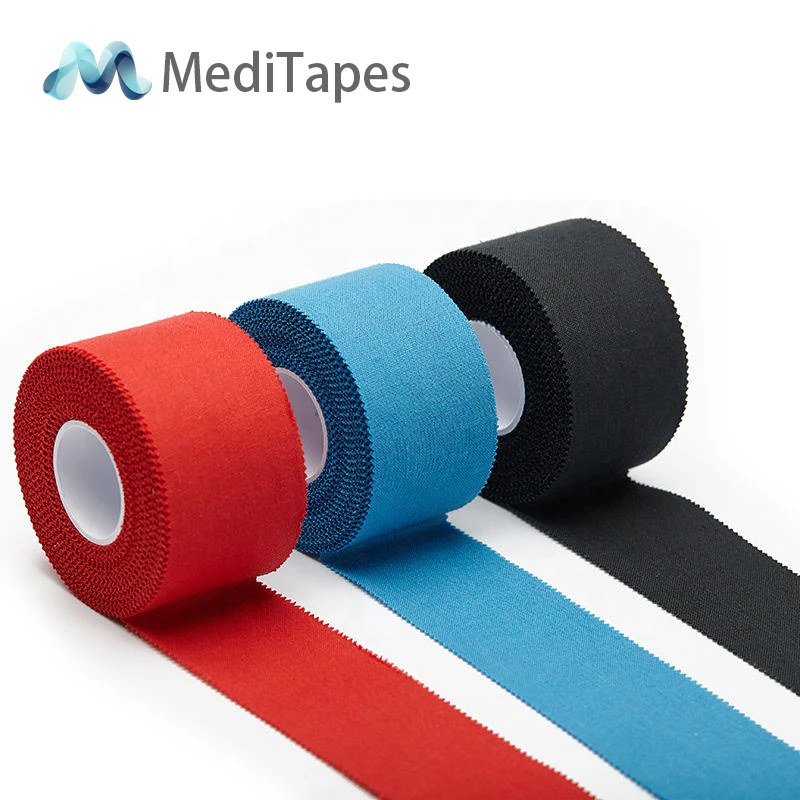
Serrated Edge Cotton Athletic Tape for Boxing & Climbing Protection
Protect hands and joints with our premium Cotton Athletic Tape. Designed with a serrated edge, this cotton sports tape tears easily without scissors. Perfect for boxing wrapping and climbing, offering superior grip and support. Available in red, blue, black, and more.
Crucial Questions About Sourcing Non-Elastic Athletic Tape
Q1: Can athletic trainers easily tear non-elastic athletic tape by hand without using scissors?
Yes, a premium non-elastic athletic tape is specifically designed for quick on-field application. The cotton fabric backing is woven in a way that allows trainers to snap the tape cleanly across both the length and width. Look for tapes with a serrated (zigzag) edge, as this provides easy tearing points and prevents frayed threads during high-speed wrap jobs.
Q2: Why does some cheap non-elastic athletic tape leave sticky glue residue on the athlete’s skin?
This usually happens when a manufacturer uses low-grade hot melt glue or incorrect adhesive coating ratios to save money. When exposed to body heat and sweat, the cheap adhesive breaks down, separating from the cotton backing and sticking to the skin. A high-quality non-elastic athletic tape uses a cross-linked zinc oxide adhesive that maintains its bond with the cotton fabric, leaving the skin perfectly clean after removal.
Q3: What’s the standard shelf life for bulk non-elastic athletic tape in a warehouse?
Under standard storage conditions (cool, dry environment away from direct sunlight), high-quality non-elastic athletic tape has a shelf life of approximately 2 to 3 years. It is highly recommended to store your bulk inventory at temperatures between 15 degrees Celsius and 25 degrees Celsius to prevent the zinc oxide adhesive from dry-rotting or bleeding through the fabric layers.
Secure Your Supply of Premium Non-Elastic Athletic Tape Today!
Are your current suppliers giving you the runaround with subpar, stretchy tapes that hurt your brand’s reputation? It is time to step up your sourcing game.
At MediTapes, we specialize in manufacturing high-performance medical and sports consumables that meet the strict demands of professional B2B buyers. Whether you need standard white rolls or custom shades from our Color Cotton Fabric Sports Tape line, we ensure every single batch matches your exact technical specifications.
Stop guessing about thread counts and adhesive strengths. Let our experts help you secure the consistent, high-quality inventory your business deserves.
If you are ready to request a custom quote, secure free samples, or discuss your private label packaging requirements, please get in touch with us directly or shoot us an email at info@meditapes.com. Our specialist team is ready to help you optimize your supply chain and grow your brand!