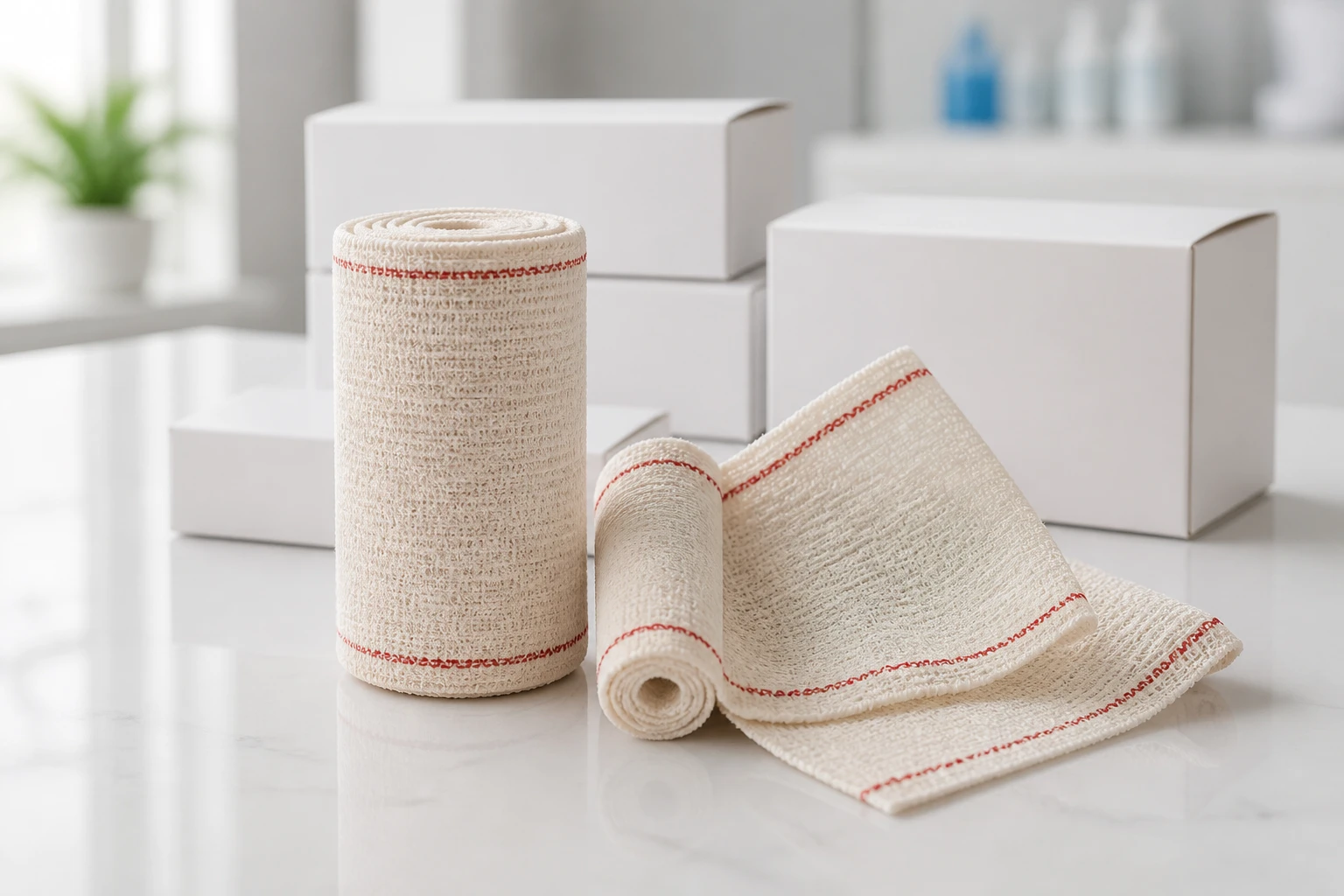
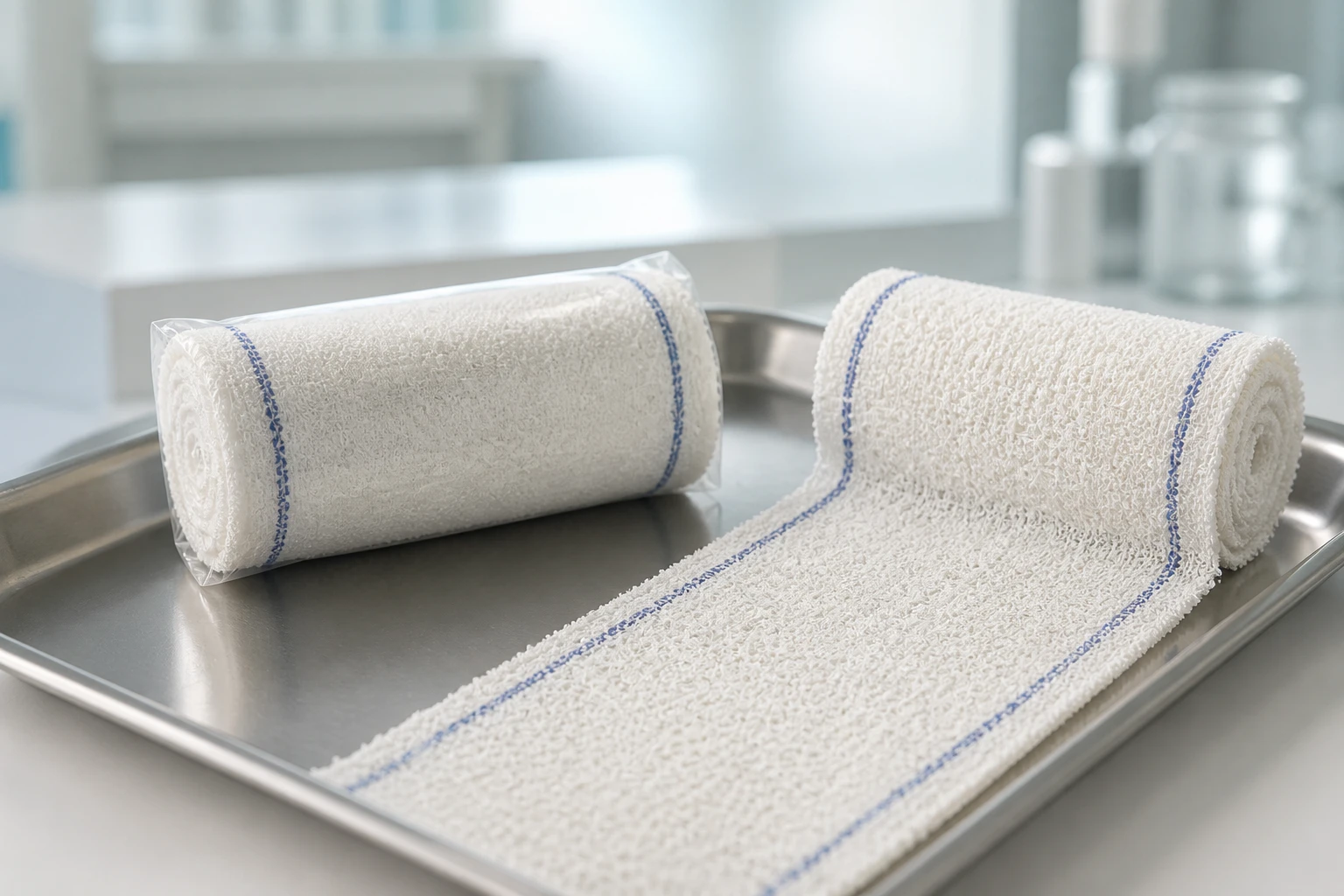
Anyone who has spent ten minutes in an orthopedic clinic or an emergency room knows the frustration: a patient gets wrapped with a standard bandage, walks around for three hours, and returns with the fabric sagging down their ankle like a loose sock. The pressure drops, swelling returns, and the dressing needs reapplication.
In medical manufacturing and procurement, we hear the same complaint over and over again from hospital supply leads. Traditional woven wraps feel nice and soft right out of the polybag, but their mechanical life is short. This brings us straight to the material engineering behind the Spandex-Kreppbandage—a textile solution that completely changes how compression therapy behaves over 12 to 24 hour wear cycles.
When you analyze how a Spandex-Kreppbandage performs under constant dynamic strain, the contrast against pure cotton or rubber weaves is night and day. This breakdown covers polymer physics, yarn construction, hysteresis curves, and why switching to an engineered durable compression bandage solves clinical pressure loss once and for all.
The Hidden Cost of “Bandage Creep”: What Happens at the Limb Interface?
Before getting into the chemistry, let us look at the mechanical problem we are actually trying to solve. When a nurse or physical therapist wraps an edema patient or an unstable joint, they are applying force across a cylinder.
Laut Laplace’s Law applied to medical compression, sub-bandage interface pressure is determined by yarn tension, the number of overlapping layers, bandage width, and limb circumference:
P = (T * n * 4630) / (C * W)
Hierbei gilt:
- P = Sub-bandage interface pressure in millimeters of mercury (mmHg)
- T = Bandage application tension in Newtons (N)
- n = Number of overlapping layers
- C = Circumference of the target limb in centimeters (cm)
- W = Width of the bandage in centimeters (cm)
- 4630 = Constant mathematical conversion factor for standardized textile units
Looking at this formula, limb circumference is fixed. Bandage width is fixed. If the overlap stays constant, interface pressure depends entirely on Tension (T).
If the fabric experiences structural elongation—what polymer engineers call mechanical “creep”—tension drops precipitously. Within two hours, a standard 30 mmHg sub-bandage pressure can drop down to 12 mmHg. The wrap stays physically wrapped on the patient’s arm or leg, but therapeutically, it has completely failed.
This is why hospitals and distributors are actively transitioning toward high-recovery medical textiles like the MediTapes engineered line of elastische Crepe-Bandage products. A properly built Spandex-Kreppbandage prevents this tension drop-off.
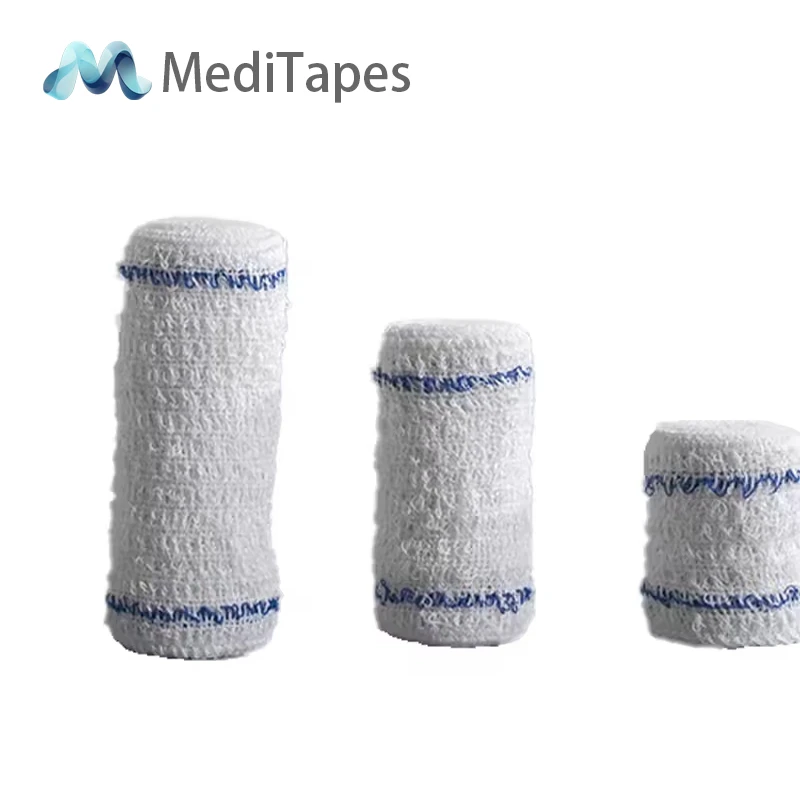
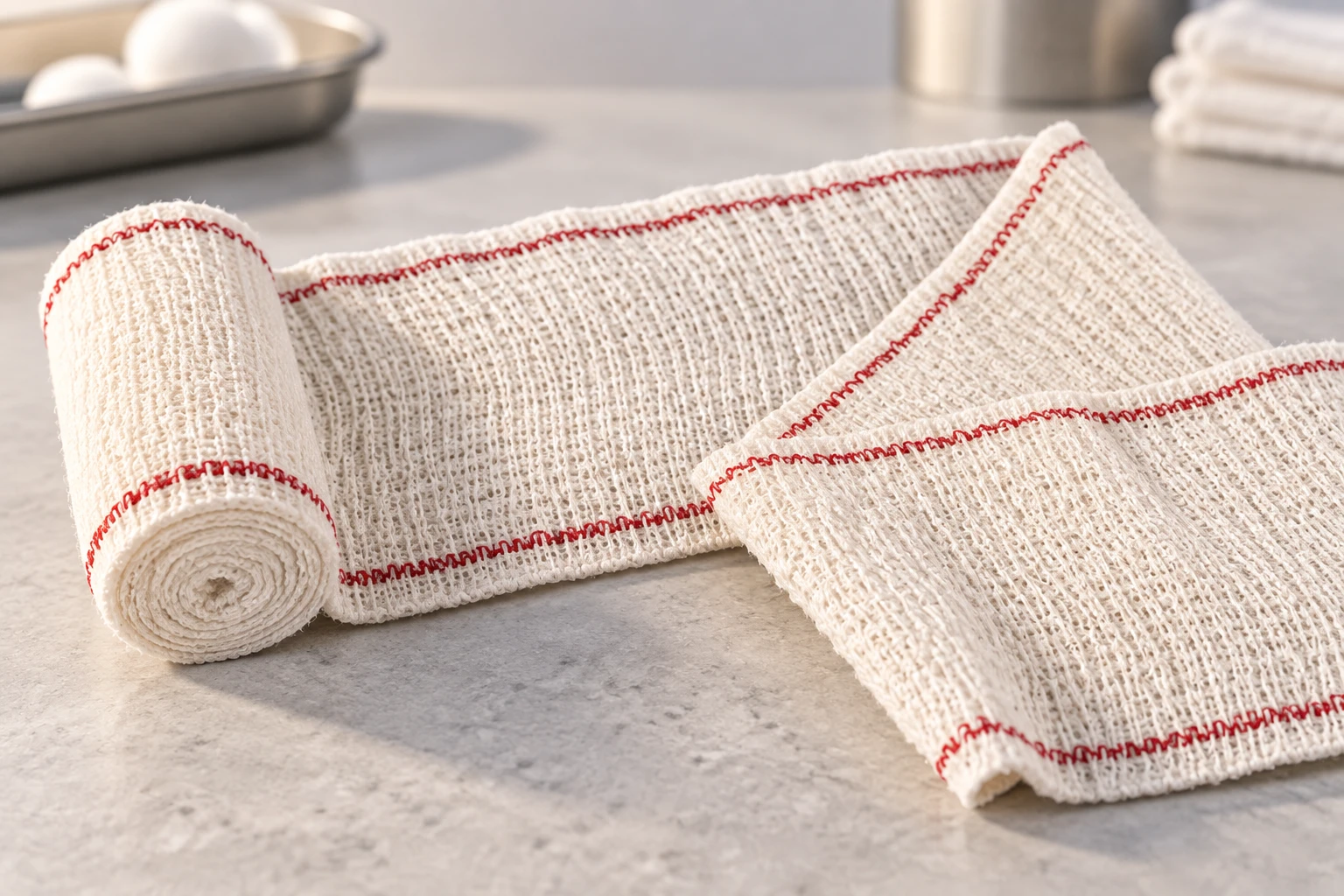
Hautfarbene elastische Kreppbandage zur Behandlung von Krampfadern
Hautfarbene elastische Kreppbandage für Krampfadern | MediTapes Meta-Beschreibung: Hautfarbene elastische Kreppbandagen im Großhandel für die Krampfaderbehandlung und Ödemkontrolle. Diskrete, atmungsaktive Kompressionsrollen in verschiedenen Breiten erhältlich. MediTapes bietet Preise direkt ab Werk für Gefäßstützmittel. Kontaktieren Sie uns für Großbestellungen.
Cotton vs. Spandex: The Molecular Battle for Elastic Memory
To understand why a 100% cotton crepe bandage loses tension so fast while a modern Spandex-Kreppbandage stays snug, you have to look at the fibers under a microscope.
Molecular Behavior Under Mechanical Stress
Cotton Cellulosic Microfibrils:
Bestehend aus starren glykosidischen Ketten, die durch Wasserstoffbrückenbindungen zusammengehalten werden. Unter anhaltender Zugspannung brechen diese Wasserstoffbrückenbindungen und die Mikrofilamente gleiten dauerhaft aneinander vorbei. Dies führt direkt zu plastischem Kriechen ohne spontane Rückstellung.
Spandex-segmentiertes Polyurethan-Copolymer:
Bestehend aus weichen, gewundenen amorphen Polyethersegmenten, die durch starre, kristalline Diisocyanat-Hartblöcke verbunden sind. Unter Zugspannung entwinden sich die weichen Segmente frei, während die kristallinen Hartblöcke als permanente molekulare Ankerpunkte wirken. Wenn die Spannung nachlässt, schnappen die Hartblöcke die weichen Segmente direkt zurück in ihren Dehnungsnullzustand.
Traditionelles Baumwoll-Crepe: Mechanisches Kräuseln ohne echte Polymerelastizität
Traditionelles Baumwoll-Crepe enthält null elastomere Garne. Seine “Dehnbarkeit” stammt ausschließlich von hochverdrehten Kettgarnen (S-Drehung und Z-Drehung abwechselnd angeordnet) und einem Nassfinish-Prozess, der den Stoff schrumpft, um Oberflächenwellen oder “Crepe” zu erzeugen.”
Wenn Sie eine Baumwoll-Crepe-Binde dehnen:
- Entwinden Sie lediglich die mechanischen Knicke, die dem Baumwollgarn beim Weben eingebracht wurden.
- Natürliche Baumwollfasern bestehen aus kristallinen Celluloseketten, die durch Wasserstoffbrückenbindungen verknüpft sind.
- Unter anhaltender Spannung brechen diese Wasserstoffbrückenbindungen und gleiten aneinander vorbei. Sie schnappen nicht von selbst in ihre Dehnungsnullposition zurück.
- Das Ergebnis ist eine dauerhafte plastische Verformung. Einmal überdehnt oder nach einer halben Schicht getragen, bleibt Baumwoll-Crepe verlängert, bis es in kochendem Wasser gewaschen wird, um die Fasern erneut mechanisch zu schrumpfen.
Spandex (Elasthan): Segmentierte Polyurethan-Blockcopolymere
Im Gegensatz dazu integriert ein Spandex-Kreppbandage synthetische Elasthan-Filamente direkt in die Kettstruktur. Spandex ist ein segmentiertes Blockcopolymer, das aus abwechselnden weichen und harten Polymersegmenten besteht [1]:
- Die weichen Segmente (lange Polyetherketten): Diese Segmente sind im amorphen Zustand natürlich verknäuelt und gewunden. Wenn Zuglast angewendet wird, richten sich diese Windungen leicht aus und ermöglichen eine massive Dehnung (bis zu 400% bis 600%) bei minimalem Widerstand.
- Die harten Segmente (starre Diisocyanat-/Harnstoffeinheiten): Diese kristallinen Blöcke wirken als physikalische Vernetzungen. Sie gleiten nicht; sie verankern die Polymerketten an Ort und Stelle. Wenn die Zugkraft nachlässt, ziehen diese Hartbereiche die weichen amorphen Ketten direkt zurück in ihren ursprünglichen ungeordneten, gewundenen Zustand.
Aufgrund dieser dualphasigen Chemie liefert eine hochwertige Spandex-Kreppbandage eine nahezu perfekte elastische Rückstellung statt plastischer Verformung.
Hysterese und dynamische Dehnung: Was die Labordaten beweisen
In Textilprüflaboren führen wir kontinuierliche zyklische Dehnungs-Erholungs-Tests gemäß standardisierten Methoden wie ASTM D4964 für Zug und Dehnung von elastischen Geweben und ISO 13934 Zugprüfung von Geweben.
Eine Universalprüfmaschine spannt ein 100-mm-Probestück aus Bandagenmaterial, dehnt es mit konstanter Geschwindigkeit (z. B. 300 mm/min) auf eine Dehnung von 60% oder 80%, hält es für eine Verweilzeit und entspannt die Probe dann auf Null Last. Dieser Zyklus wiederholt sich zwischen 10 und 500 Mal.
| Leistungskennzahl | Traditionelles 100% Baumwoll-Crepe | Gummi-/Latex-Geflochtenes Crepe-Bandage | strapazierfähige Spandex-Elastik-Kreppbandage |
|---|---|---|---|
| Primärer Elastizitätsmechanismus | Mechanische S/Z-Kettverdrillung | Vernetzter Polyisopren-Kern | Polyurethan-Blockcopolymer (Elasthan) |
| Sofortige elastische Rückstellung (Zyklus 1) | 62% – 71% | 88% – 93% | 96% – 99% |
| Elastische Rückstellung nach 100 Zyklen | Unter 45% (starke Durchhängung) | 81% (Gummimüdigkeit) | 94% – 97% |
| Kriechrate unter Zug (8 Std. unter Last) | Sehr hoch (über 35% Zugverlust) | Moderat (15% Zugverlust) | Außerordentlich niedrig (unter 4% Zugverlust) |
| Allergie- & Hautempfindlichkeitsrisiken | Nicht allergen (reine Baumwolle) | Hoch (Latex-Typ-I- & IV-Allergien) | Hypoallergen (latex-freies Elasthan) |
| Sterilisationsbeständigkeit (Dampfautoklav) | Hohe Schrumpfung, versteift | Baut sich schnell ab (Gummi fault/verhärtet) | Hohe thermische Stabilität bis 135°C |
| Griff & Atmungsaktivität | Weich, hoch atmungsaktiv | Schwer, dick, schweißhemmend | Weiche Baumwolloberfläche, leichtgewichtig, atmungsaktiv |
Die mechanische Überlegenheit eines Spandex-Kreppbandage zeigt sich deutlich in der Arbeits-Erholungs-Gleichung. Die mathematische Formel für den elastischen Rückstellindex bei Gewebeprüfungen lautet:
Rückstellung (%) = [(L1 – L2) / (L1 – L0)] * 100
Hierbei gilt:
- L0 = Ursprüngliche Messlänge des Bandagenprobestücks in Millimetern (mm)
- L1 = Maximale Dehnungslänge unter spezifizierter Zugkraft in Millimetern (mm)
- L2 = Erholte Länge nach Loslassen der Kraft und spezifizierter Entspannungszeit in Millimetern (mm)
Bei vergleichenden Labortests erreicht Baumwoll-Crepe typischerweise einen Rückstellwert zwischen 40% und 55% nach wiederholten Zyklen. Ein hochbelastbare elastische Kreppbandage aus Elasthan erreicht konsistent 94% bis 98% unter identischen mechanischen Parametern. Diese gespeicherte Energie erhält den Arbeitskompressionsdruck an einem bewegten Gelenk.
Core-Spun vs. Bare Filament: Wie wir Weichheit konstruieren, ohne Stärke zu opfern
Ein häufiger Einwand von klinischen Käufern lautet: “Wenn Sie synthetisches Elasthan in die Bandage einarbeiten, verliert es dann nicht das klassische weiche, atmungsaktive Baumwollgefühl, das Patienten gut vertragen?”
Die Antwort liegt in der Garnspinn-Technologie. Man webt niemals nackte Spandex-Filamente direkt in eine klinische Wickel. Dies würde Hautreibung, ungleichmäßige Spannungsverteilung und lokale Druckstellen verursachen.
Die Anatomie von Core-Spun-Garn (CSY)
Äußere Baumwoll-Mantel (100% Hautkontakt):
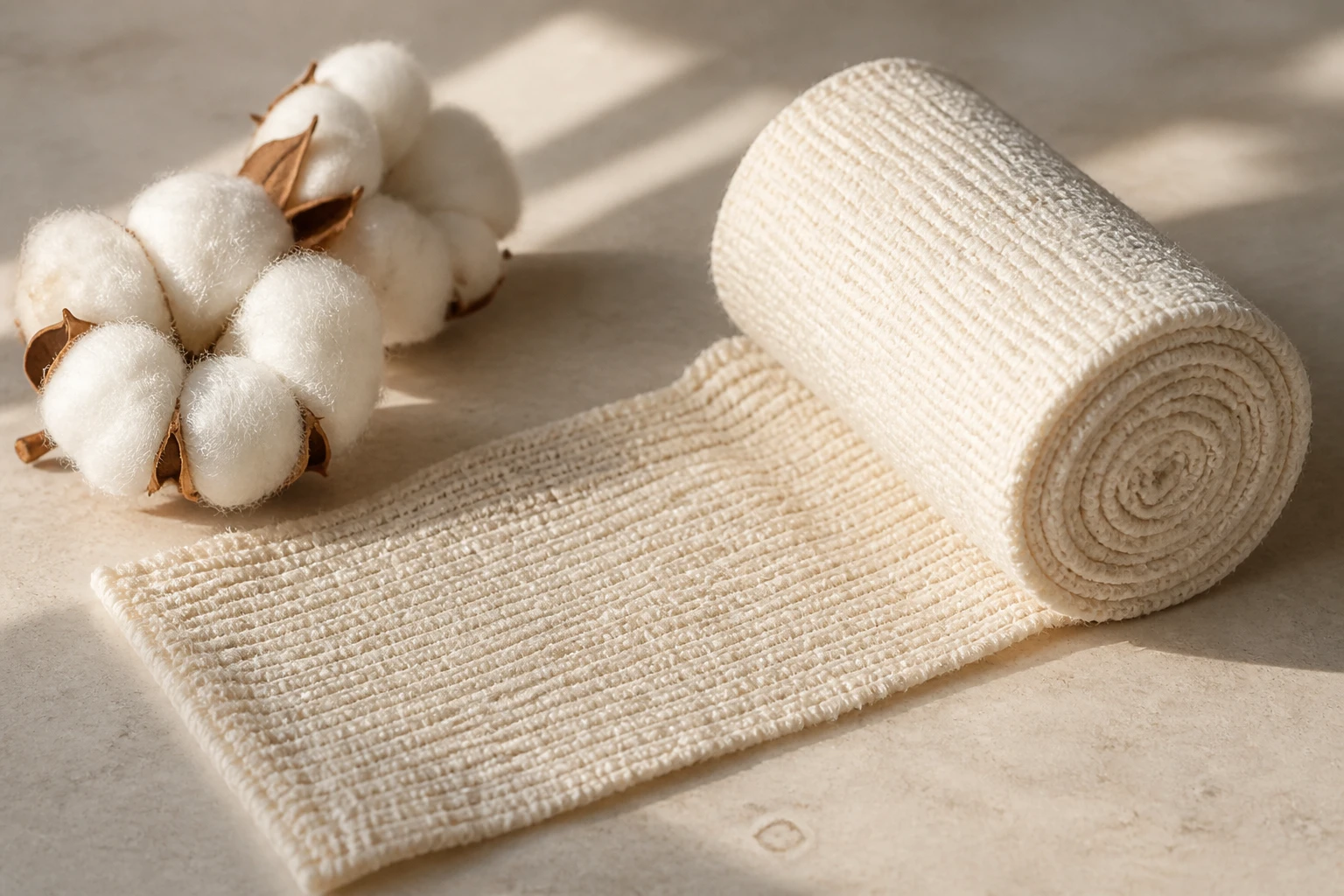
Langstapelige Naturbaumwollfasern werden um den Kern herum versponnen und bilden eine schützende, hoch atmungsaktive, saugfähige äußere Schicht. Patienten spüren nur natürliche Baumwolle auf ihrer Haut.
Innerer Elasthan-Kern (Hoch-Denier-Muskel):
A continuous filament of high-grade polyurethane elastane (70D to 210D) runs straight down the center, providing continuous mechanical recoil and memory without touching the skin.
In high-grade manufacturing, this core-spun structure delivers the following performance advantages:
- The Core: The internal filament generates sustained recoil force and structural memory across hundreds of extension cycles.
- The Sheath: The natural cotton exterior absorbs wound exudate and perspiration while preventing skin abrasion or allergic reactions.
When a patient wears a Spandex-Kreppbandage, the only material contacting their skin is pure natural cotton. The synthetic elastane works silently inside the yarn sheath, generating sustained recoil force without ever touching the patient’s epidermis.
This hybrid construction makes the product an ideal elastic recovery medical wrap that combines soft clinical hand-feel with industrial-grade mechanical tension.
Spandex vs Rubber Bandage: Why Polyurethane Wins the War on Fatigue
For decades, if a hospital needed serious compression that cotton could not deliver, they ordered rubber-elastic wraps. But rubber (natural polyisoprene or synthetic SBR) has major technical flaws when measured against elastane. A realistic spandex vs rubber bandage comparison reveals several clear engineering advantages:
1. Resistance to Heat, Washing, and Body Oils
Natural rubber breaks down quickly when exposed to body sweat, skin lipids, topical ointments, and medical laundering detergents. Its unsaturated polymer backbone is prone to oxidative cleavage and cross-link degradation. Put a rubber-threaded bandage through three high-temperature autoclave or wash cycles, and the rubber threads snap inside the casing, leaving brittle white flakes.
Spandex, being a synthetic polyurethane, is chemically resistant to lipids, perspiration, and washing detergents. A Spandex-Kreppbandage can be washed, boiled, or autoclaved repeatedly without embrittlement or loss of elastic modulus.
2. Elimination of Type I Latex Reactions
Natural rubber latex contains proteins that trigger Type I immediate hypersensitivity reactions, a massive liability in modern medical environments. Using a Spandex-Kreppbandage eliminates latex allergy concerns completely, making hospital purchasing decisions safe for all patients.
3. Strength-to-Denier Efficiency
Polyurethane elastane possesses a far higher tensile strength per unit density than extruded rubber thread. We can build a thinner, lighter, more conformable durable compression bandage with spandex that delivers identical or superior interface pressure to a heavy, bulky rubber wrap.

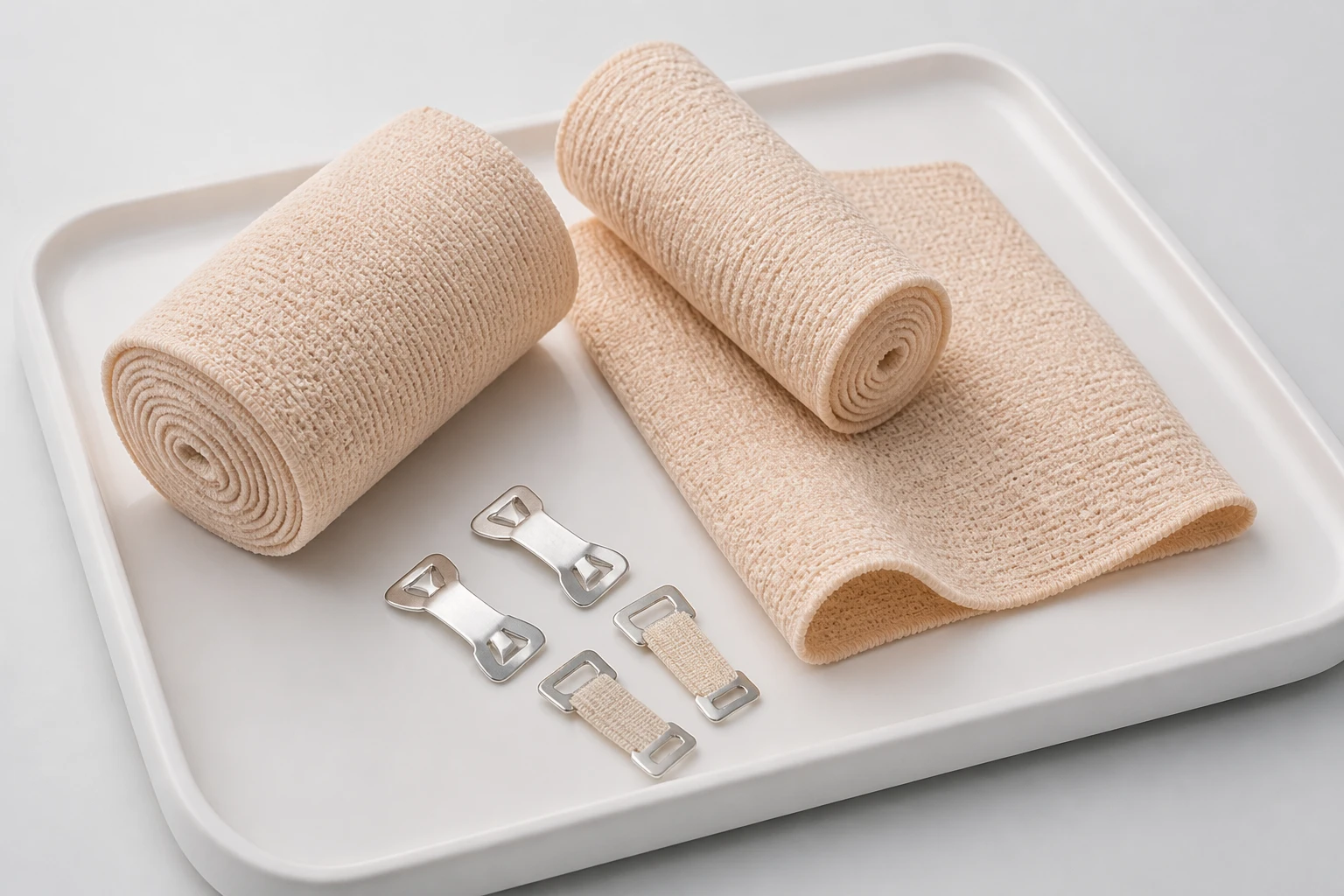
Sterile elastische Kreppbandagen-Rolle mit Klammern – OEM verfügbar
Zertifizierte sterile elastische Kreppbandage mit sicheren Metall- oder Elastikklammern. Wir bieten OEM-Anpassungen für Größe und Verpackung an. Diese hochwertige elastische Kreppbandage gewährleistet sterilen Schutz für chirurgische Wunden. Zuverlässiger Halt und weiche Textur machen sie zu einem unverzichtbaren Bestandteil von Erste-Hilfe-Sets.
Real-World Case: Solving Pressure Drop in Lymphedema Wrap Protocols
Consider an outpatient lymphedema clinic managing lower-limb edema in high-mobility patients.
The Clinical Problem
The clinic originally used traditional cotton crepe wraps applied at 35 mmHg target resting pressure. Within 4 hours of normal walking, patients consistently reported the bandages loosening at the calf and bunching around the ankle. Pressure probe readings under the cotton bandages showed an average drop of 54% interface tension (falling from 35 mmHg to 16 mmHg) before lunchtime.
| Wear Time (Hours) | Cotton Crepe Interface Pressure (mmHg) | Spandex Crepe Bandage Interface Pressure (mmHg) |
|---|---|---|
| 0 Hours (Initial Application) | 35.0 mmHg | 35.0 mmHg |
| 2 Hours (Light Walking) | 24.5 mmHg | 32.8 mmHg |
| 4 Hours (Normal Ambulation) | 16.1 mmHg | 30.5 mmHg |
| 8 Hours (Full Shift) | 12.4 mmHg | 28.5 mmHg |
| 12 Hours (End of Protocol) | 11.0 mmHg | 27.8 mmHg |
The Intervention
The facility swapped their standard cotton rolls for a core-spun Spandex-Kreppbandage line supplied by MediTapes. Application protocols, practitioner wrapping technique, and layer counts remained identical.
The Clinical Results
- Tension Maintenance: Sub-bandage interface pressure maintained an average of 28.5 mmHg after 8 continuous hours of dynamic walking—a tension loss of only 18.5%, compared to 54% with cotton.
- Reduction in Re-wraps: Nursing staff reduced mid-day re-wrapping interventions by 72%, freeing up clinical staff hours.
- Patientenkomfort: No skin marks or excessive sweat buildup were reported thanks to the cotton-sheathed core-spun yarn.
When you switch to a hochbelastbare elastische Kreppbandage aus Elasthan, the clinical workflow stabilizes because the wrap behaves consistently regardless of patient movement.
Quality Indicators: How to Inspect a Spandex Crepe Bandage Before Sourcing
For hospital buyers, medical wholesalers, and private-label distributors, verifying fabric quality before ordering container loads is critical. Here is what to inspect:
| Inspection Parameter | Target Standard / Laboratory Metric | Practical Significance |
|---|---|---|
| 1. Yarn Structure | 100% Core-Spun Spandex / Cotton Sheath | Prevents bare elastane from touching skin, ensuring comfort |
| 2. Edge Fastness | Reinforced non-fray woven selvedge | Prevents unravelling and loose threads during repeated wash cycles |
| 3. Elastic Recovery Index | Greater than or equal to 95% after 100% elongation | Guarantees long-term compression retention on active patients |
| 4. Crepe Texture Density | Uniform pebble weave pattern, no flat spots | Provides non-slip inter-layer friction without requiring metal clips |
| 5. Chemical Safety | OEKO-TEX Standard 100 and REACH compliant | Confirms absence of harmful heavy metals, formaldehyde, or harsh dyes |
When reviewing production batches, keep these three physical checks in mind:
- Selvedge Edge Construction: Inspect the cut edges. A poorly manufactured bandage uses cheap open-weave edges that fray after two washes. A premium Spandex-Kreppbandage features woven, reinforced fast edges that resist unravelling even when stretched to capacity.
- True Weight (GSM – Grams per Square Meter): Ensure the unstretched GSM meets medical specifications (typically 75 gsm to 110 gsm depending on whether it is light support or heavy duty). Inferior manufacturers lower the cotton density to cut costs, which reduces sweat absorption.
- Core Yarn Concentricity: Cut a cross-section of the warp yarn under magnification. The elastane filament should sit centrally within the surrounding cotton fibers, ensuring consistent friction coefficients across the bandage surface.
If you are sourcing medical supplies, you can browse our full technical catalog of elastische Crepe-Bandage specifications directly on our site.
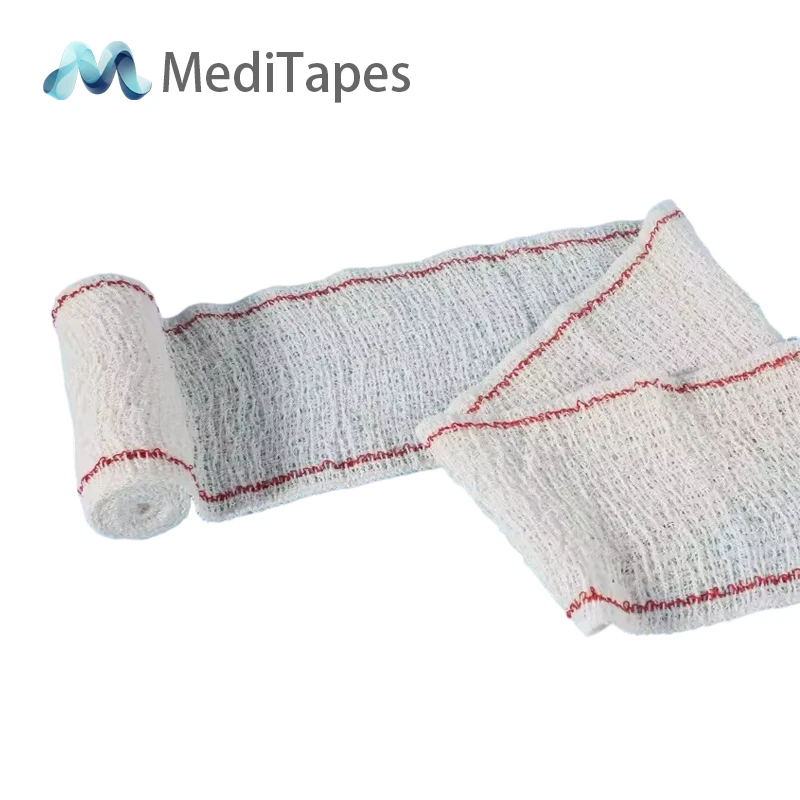
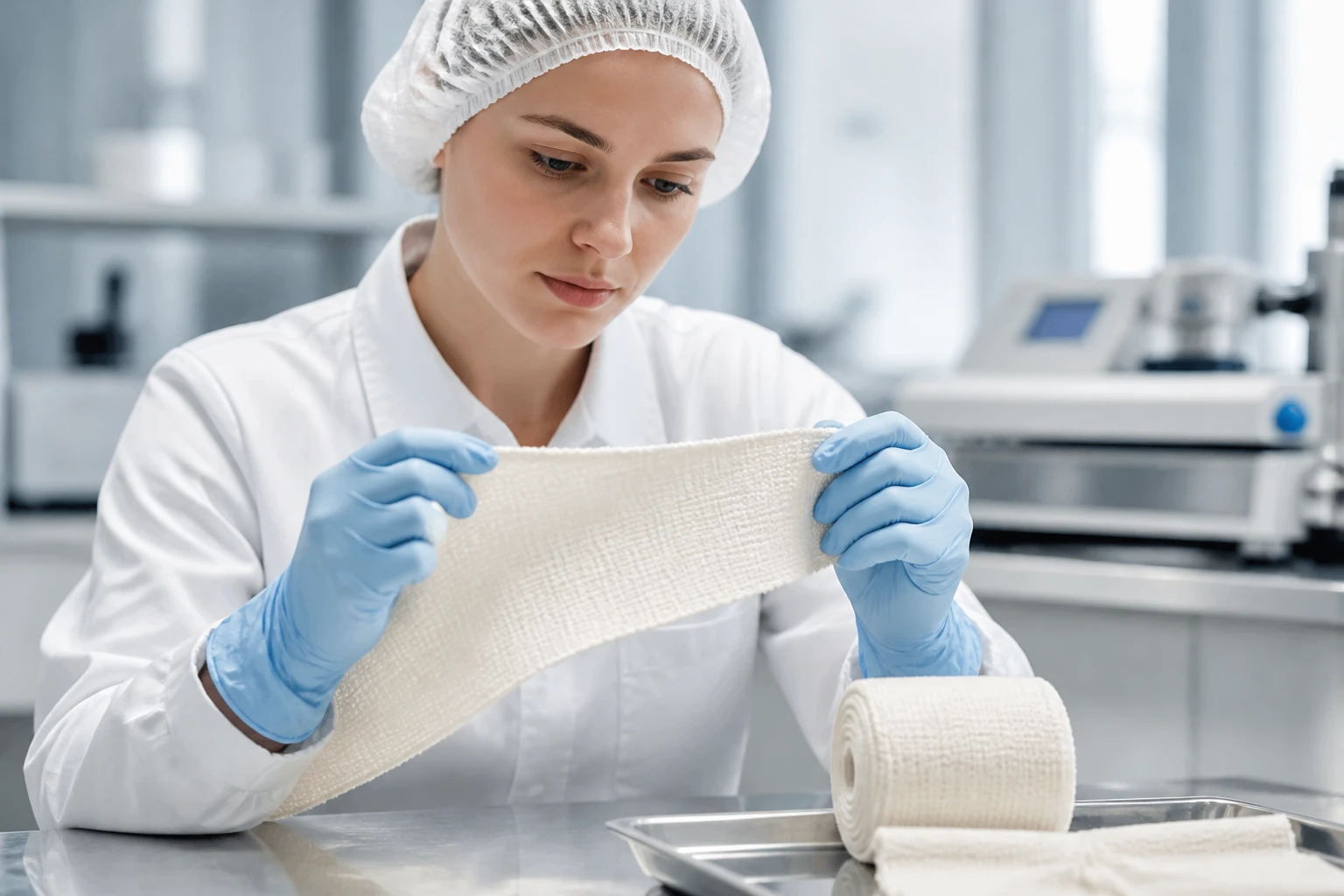
Großhandel für atmungsaktive elastische Kreppbandagen für Sportverletzungen
Kaufen Sie atmungsaktive elastische Kreppbandagen in großen Mengen für die Regeneration im Sport. Diese leichte Kreppbandage passt sich mühelos Körperkonturen wie Knien und Knöcheln an. Sie reduziert Schwellungen und lässt die Haut gleichzeitig atmen. Eine erstklassige Wahl für Sporttrainer, die eine zuverlässige Unterstützung bei Sportverletzungen benötigen.
Häufig gestellte Fragen (FAQ)
Was unterscheidet einen Spandex-Kreppeverband von einem Standard-Elastikverband?
A standard elastic bandage often relies on thick, synthetic elastic bands or rubber threads woven into a flat ribbon. A Spandex-Kreppbandage utilizes high-twist cotton yarns combined with core-spun polyurethane elastane fibers. This gives it the textured, non-slip “crepe” surface that clings to itself and prevents slipping on limbs, while the spandex provides consistent, long-term elastic tension without the harsh stiffness of standard elastic wraps.
Kann ein Spandex-Kreppverband mehrmals gewaschen und wiederverwendet werden?
Yes. Unlike cotton crepe wraps that lose their tension permanently once the crimp relaxes, a well-constructed durable compression bandage with an elastane core can be washed in warm water with mild detergent and dried flat. The polymer memory in the spandex pulls the crepe structure back to its original unstretched length without degrading the fabric.
Enthält ein Spandex-Kreppverband natürlichen Gummilatex?
No. High-quality Spandex-Kreppbandage products use synthetic polyurethane block copolymers (elastane/spandex) instead of natural rubber latex. This makes the wrap safe for patients and medical staff with Type I latex allergies, reducing clinical liability while offering superior creep resistance.
How does the tension stability of an elastic recovery medical wrap affect healing?
When interface pressure drops due to fabric slackening, interstitial fluid accumulates in the injured tissue, worsening swelling and delaying recovery. An elastic recovery medical wrap powered by spandex maintains steady baseline pressure throughout dynamic movement, ensuring sustained venous return, joint stability, and consistent therapeutic support.
Upgrade Your Medical Textile Supply Chain with MediTapes
Clinical performance comes down to raw material engineering. When wrapping injured joints, managing post-op swelling, or treating venous disorders, you cannot afford bandages that slacken after two hours of movement.
Bei MediTapes, we manufacture professional-grade medical wraps, core-spun elastic bandages, and orthopedic consumables engineered to meet strict international performance benchmarks. Whether you are an international medical distributor looking for reliable OEM/private-label production or a hospital network aiming to reduce bandage replacement cycles, our engineering team delivers tested quality.
- Looking for lab test reports, tension decay curves, or customized GSM options?
- Need bulk wholesale pricing on our certified spandex crepe bandage line?
Reach out to our technical team today through our Kontaktseite oder senden Sie eine E-Mail direkt an info@meditapes.com. Let us help you provide superior compression performance that doctors and patients can rely on.