Hospital procurement committees across Europe and North America have run out of patience for product ambiguity. If you are an importer or distributor bidding on public clinical tenders, you already know the stakes. A single ambiguous material claim can disqualify an entire multi-million-euro container shipment before it ever clears customs. Worse, an unverified allergen claim can trigger a hospital-wide adverse event report, pulling your business into clinical liability disputes that linger for years.
In clinical tenders, the debate between natural rubber latex and synthetic polymers is no longer a matter of simple unit pricing. It is a strict matter of clinical risk management, patient safety protocols, and regulatory defense. A modern hospital latex safe bandage tender requires absolute chemical transparency, certified batch-to-batch consistency, and unyielding compliance with standards like EU MDR 2017/745 and FDA labeling guidelines.
If your portfolio still relies on legacy natural rubber wraps or vague “hypoallergenic” declarations from undocumented trading firms, your tender margins are at direct risk. To win and keep national health accounts, importers must supply a fully documented latex-free high elastic bandage that matches the sustained compression of natural rubber while completely eliminating the threat of Type I anaphylactic reactions.
The Clinical Tender Landscape: The Real Cost of “Latex-Safe” Failures
Public healthcare systems—such as the NHS in the UK, AP-HP in France, or regional hospital alliances across Germany and the Nordics—do not treat elastic wraps as trivial commodities. In emergency rooms, orthopedic trauma bays, and post-surgical wards, elastic wraps are applied directly to compromised, broken skin, over open wound dressings, and on vulnerable vascular beds.
When a tender dossier specifies “Latex-Safe,” clinical procurement boards are safeguarding against two distinct clinical phenomena:
Allergy Pathway Comparison:
Natural Rubber Latex Pathway: Extruded natural rubber threads release water-soluble proteins (Hev b 1 through Hev b 13). When these proteins contact perspiration or broken skin, they prompt an immediate, IgE-mediated immune trigger, leading directly to Type I systemic anaphylaxis.
Synthetic Elastane Pathway: Precision-engineered synthetic elastane cores contain zero natural plant proteins. Because they are scoured clean without thiuram or carbamate accelerators, they carry zero Type I allergy risk and minimize the risk of delayed contact dermatitis.
Type I Anaphylaxis vs. Type IV Contact Dermatitis
Procurement teams frequently reject bids because distributors submit generic “skin-friendly” lab reports that do not distinguish between distinct allergic pathways:
- Type I Hypersensitivity (Immediate, IgE-Mediated): This is triggered by residual, water-soluble plant proteins found in natural rubber latex derived from Hevea brasiliensis sap. According to peer-reviewed data on clinical latex hypersensitivity published by the NCBI, exposure to these proteins (specifically Hev b 1 through Hev b 13) can prompt rapid systemic vasodilation, severe bronchospasm, and fatal anaphylactic shock. A clinical tender panel will never accept a natural rubber bandage in a general-admission ward where sensitized patients or healthcare workers are present.
- Type IV Hypersensitivity (Delayed, Cell-Mediated Contact Dermatitis): This allergic reaction typically manifests 24 to 72 hours post-application. It is rarely triggered by the elastic filament itself. Instead, it is sparked by chemical vulcanization accelerators (such as thiurams, dithiocarbamates, and mercaptobenzothiazoles) used during cheap rubber compounding or synthetic curing.
Tender Risk Alert: If your bid documents state that your wrap is “hypoallergenic” because it uses synthetic rubber, but your mill uses sulfur-donor chemical accelerators during finishing, you remain fully exposed to Type IV clinical complaints. To secure high-scoring evaluation marks, tender submissions must verify that your latex-free high elastic bandage uses clean synthetic elastomeric cores free of toxic chemical processing residues.
When hospitals draft their tender documents, disqualification criteria are binary. If an audit detects unlisted natural latex proteins, or if clinical wards experience unexplained contact dermatitis outbreaks during ward trials, your contract is terminated for cause.
Material Science: Natural Rubber Latex (NRL) vs. Synthetic Elastane
For decades, textile engineers favored natural rubber latex (NRL) because of its steep mechanical recovery. Natural rubber possesses an innate molecular structure that snaps back immediately after stretching. However, in modern hospital supply chains, those mechanical perks are heavily outweighed by clinical risk and environmental instability.
When manufacturing a high-grade latex-free high elastic bandage, top-tier mills replace natural rubber threads with precision-engineered synthetic elastane (polyurethane-polyurea block copolymers, widely known as Spandex).
Filament Architecture:
- Natural Rubber Core (NRL): Extruded latex filaments feature irregular cross-sections, degrade under hospital heat and skin lipids, and constantly shed plant proteins over time.
- Modern Synthetic Core: Synthetic elastane filaments consist of uniform micro-filaments with zero plant proteins, offering total resistance to body oils, paraffin ointments, and industrial laundering cycles.
Comparing the Polymers in Clinical Use
| Performance Attribute | Natural Rubber Latex (NRL) Bandage | Modern Latex-Free High Elastic Bandage | Clinical & Procurement Impact |
|---|---|---|---|
| Allergenic Protein Content | High (50 to >1000 mcg/g extractable protein) | 0.0 mcg/g (Non-detectable via ASTM D5712) | Eliminates Type I anaphylaxis risk across all patient classes. |
| Chemical Accelerators | Thiurams, Carbamates, Mercapto compounds | Zero accelerators needed for dry-spun elastane | Drastically lowers incidence of delayed Type IV contact dermatitis. |
| Lipid & Ointment Resistance | Poor (swells, softens, and disintegrates) | High (hydrophobic polyurethane backbone) | Resists paraffin-based wound ointments and topical steroids. |
| Aging & Shelf Life | Degrades rapidly via UV, ozone, and heat | Stable (maintains elastomeric modulus >3 years) | Prevents inventory loss in government stockpile depots. |
| Launderability / Autoclaving | Brittle after boiling or steam sterilization | Retains tension profile through multiple laundry cycles | Ideal for hospital reuse programs requiring high-temperature washing. |
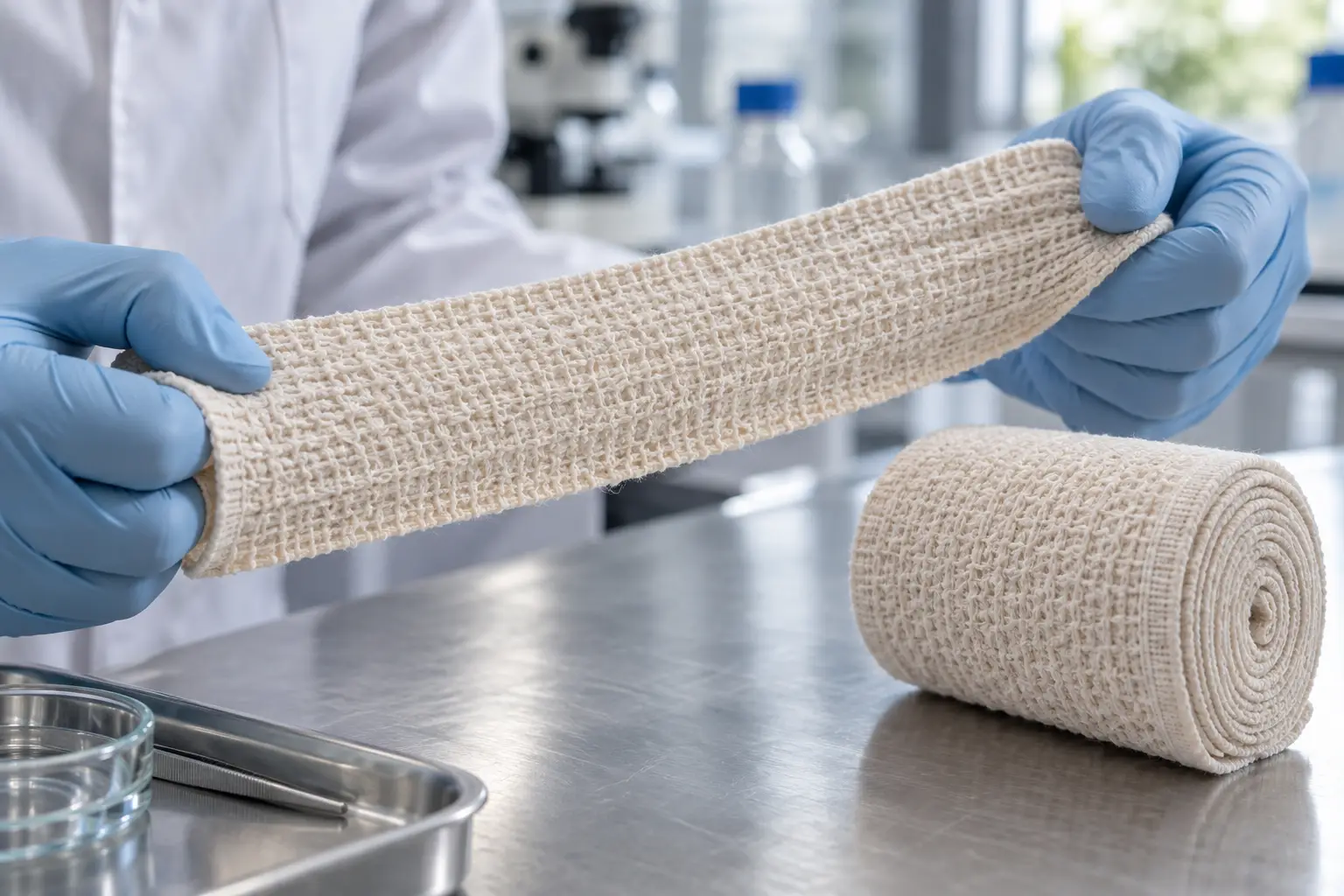
To get the same high-modulus compression that surgeons expect from natural rubber, a capable synthetic elastane bandage manufacturer cannot simply substitute rubber thread with low-denier spandex. They must engineer a composite yarn structure: spinning textured polyamide or high-count combed cotton around an elastane core. This prevents “fiber creep,” ensuring that the latex-free high elastic bandage sustains its target resting pressure without snapping or slumping after two hours on a mobile patient’s limb.

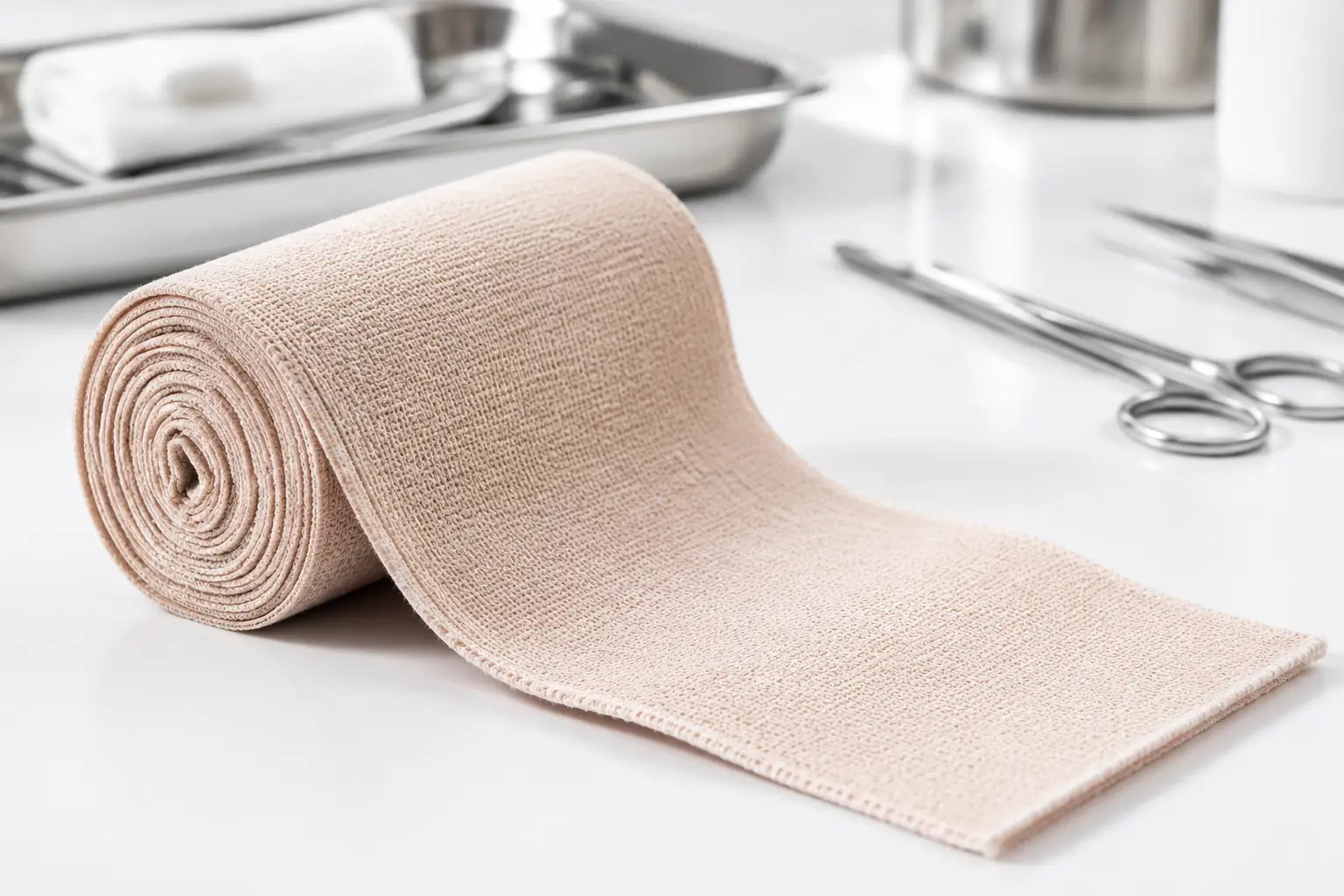
Permanent High Elastic Compression Bandage – Sports & Orthopedic Use
Designed for orthopedics, this High Elastic Bandage delivers permanent elasticity. Unlike standard wraps, our elastic compression bandage retains tension after washing. Excellent for sports rehabilitation and joint fixation. A premium choice for distributors targeting the professional sports market.
Biomechanical Engineering: Laplace’s Law and Tension Retention
Bandage failure in clinical settings is almost always caused by unpredictable pressure delivery. Clinical tenders for edema reduction, venous insufficiency, and post-traumatic orthopedic support require reliable sub-bandage pressure.
Sub-bandage pressure is governed by the physical principles of Laplace’s Law. In clinical textile engineering, the practical sub-bandage pressure can be determined through the following continuous plain-text formula:
Sub-bandage Pressure (mmHg) = (Tension in Newtons * 4620) / (Limb Circumference in cm * Bandage Width in cm * Layers Applied)
Where:
- Tension (N) is the pulling force applied by the nurse during application.
- Limb Circumference (cm) is the anatomical target dimension.
- Bandage Width (cm) is the width of the wrap (typically 5cm, 7.5cm, 10cm, or 15cm).
- Layers Applied represents the wrap overlap (typically 50% overlap, yielding 2 full layers).
- 4620 is the mathematical constant accounting for conversion between SI units and millimeters of mercury (mmHg).
Understanding the Pressure Dynamics:
- Bandage Tension (T) directly increases sub-bandage pressure.
- Limb Circumference inversely decreases sub-bandage pressure as anatomical width broadens.
- Bandage Width (W) inversely distributes applied force across a wider surface area, reducing localized pressure peaks.
The Problem of Hysteresis and Stretch Decay
Every elastic textile exhibits hysteresis: the energy lost between mechanical extension and mechanical retraction. If an importer sources cheap, unregulated non-latex compression bandage wholesale lots, the bandage often suffers from aggressive tension decay.
Consider this standard stretch elongation test formula:
Bandage Elongation Percentage (%) = ((Extended Length – Resting Length) / Resting Length) * 100
A certified latex-free high elastic bandage must deliver an elongation rating between 160% and 180% (Class 3a/3b high-stretch criteria). More importantly, it must retain that stretch over time. When wrapped at 170% elongation, an inferior wrap loses up to 45% of its sub-bandage pressure within six hours because cheap synthetic polymers undergo plastic deformation.
| Elongation Duration | MediTapes Certified Latex-Free High Elastic Bandage | Generic Off-Brand Non-Latex Wrap | Clinical Consequence |
|---|---|---|---|
| Initial Application (0 Hours) | 100% of Target Pressure (e.g., 30 mmHg) | 100% of Target Pressure (e.g., 30 mmHg) | Immediate therapeutic compression achieved in ward. |
| 6 Hours Post-Application | ~92% Sustained Pressure (~27.6 mmHg) | ~70% Retained Pressure (~21.0 mmHg) | Generic wrap begins slumping down the calf. |
| 12 Hours Post-Application | ~88% Sustained Pressure (~26.4 mmHg) | ~58% Retained Pressure (~17.4 mmHg) | Edema control fails in generic option; requires re-wrapping. |
| 24 Hours Post-Application | ~85% Sustained Pressure (~25.5 mmHg) | <50% Retained Pressure (<15.0 mmHg) | Generic bandage completely loses therapeutic efficacy. |
In contrast, our engineered latex-free high elastic bandage integrates tightly twisted warp yarns that counter elastomeric relaxation. Sub-bandage pressure remains within the therapeutic target window (25 to 35 mmHg for moderate ambulatory compression) for up to 24 consecutive hours, easily passing clinical field audits conducted by hospital nursing boards.
Regulatory Landmines: MDR 2017/745 and FDA Testing Compliance
If your tender strategy relies on a simple self-declaration certificate from an unverified trading broker, you are taking an immense commercial gamble. European and American regulatory inspectors expect verifiable, accredited third-party lab documentation before awarding public healthcare contracts.
1. EU MDR 2017/745 Annex I (Section 10.4.5)
Under the European Medical Device Regulation (EU MDR 2017/745 Annex I General Safety Requirements), medical devices containing natural rubber latex must display clear warnings on the outer packaging and inner unit containers. If a manufacturer markets a device as latex-free, the Notified Body audit trail must prove that raw material streams, spinning lines, and packaging environments are clean and protected from cross-contamination.
2. FDA Labeling Realities: Why “100% Latex-Free” Is a Trap
Many tender applicants fail FDA pre-market documentation because they use outdated marketing slogans like “100% Latex-Free” or “Completely Hypoallergenic.”
As explicitly detailed in the FDA Guidance on Labeling Medical Products Not Made with Natural Rubber Latex, the FDA strongly advises manufacturers against printing “Latex-Free.” The agency’s scientific reasoning is straightforward: science cannot test for the total, absolute absence of every single trace latex molecule down to infinity.
Instead, compliant tender documentation and sterile cartons must read: “Not made with natural rubber latex.” Stating “100% Latex-Free” on your submission can result in immediate regulatory pushback or formal warning letters from US-based tender committees.
3. Essential Testing Standards Matrix for Tender Files
To build an unshakeable tender dossier, your latex-free high elastic bandage must be supported by the following testing portfolio:
- ASTM D5712 (Modified Lowry Test): Quantifies total aqueous extractable protein content. The results for your synthetic wrap should register as “Below Limit of Detection” (typically <0.2 mcg/g). Review the protocol via ASTM D5712-15.
- ASTM D6499 (ELISA Inhibition Assay): Measures specific antigenic latex protein fractions (Hev b 1, 3, 5, and 6.02). Must verify non-detectable antigenic levels.
- ISO 10993-5 (Biological Evaluation – In Vitro Cytotoxicity): Proves that finishing chemicals, scours, and synthetic elastomers do not leach substances that destroy cellular integrity (cell viability must remain >70%).
- ISO 10993-10 (Skin Sensitization / Guinea Pig Maximization Test or LLNA): Confirms that residual processing chemicals do not trigger cell-mediated sensitization reactions. Learn more from ISO 10993-10 Standards.

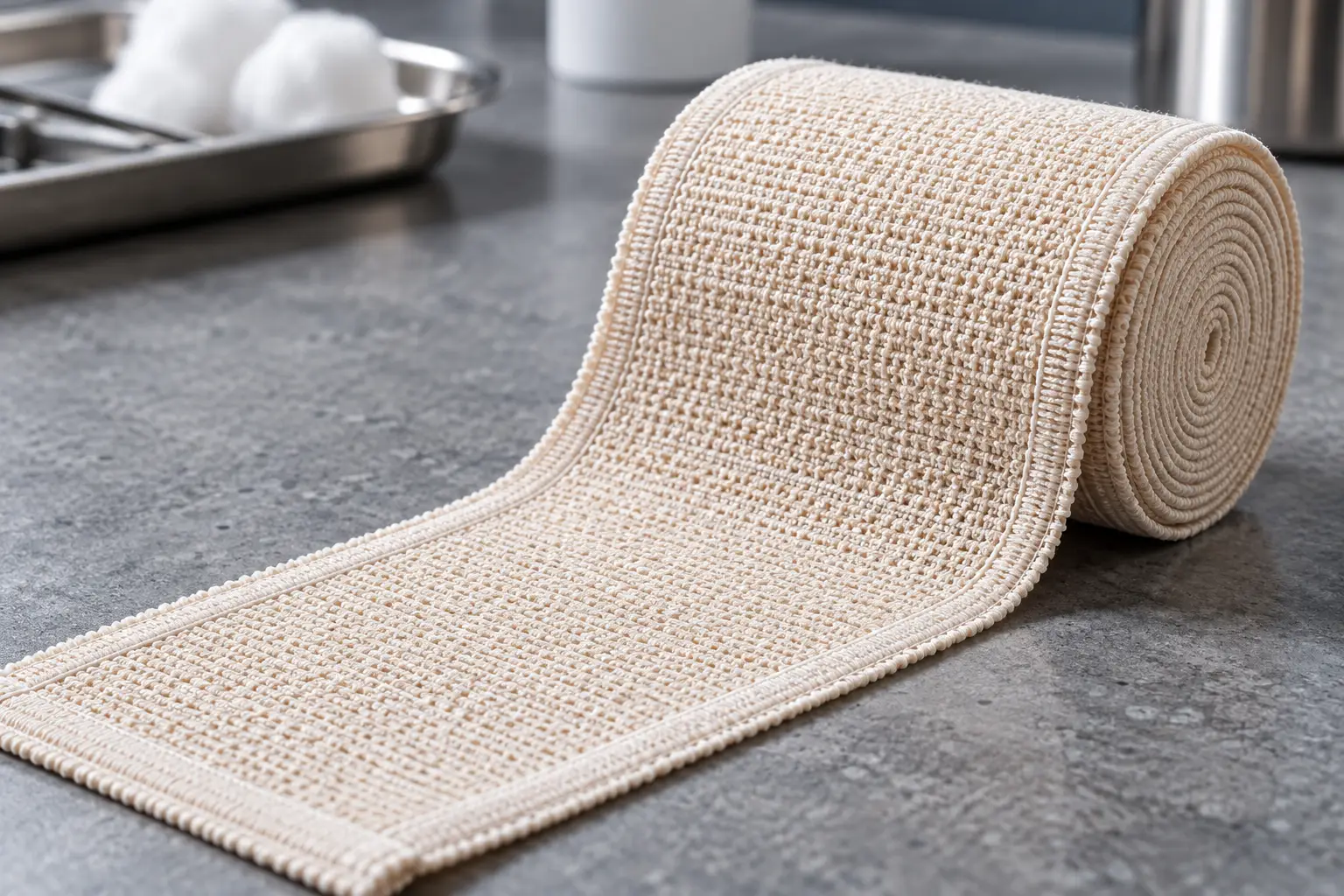
Heavy Duty High Elastic Bandage Wholesale – CE/ISO Certified Supplier
Sourcing a reliable High Elastic Bandage manufacturer? Our heavy-duty bandages provide strong, consistent elasticity. As a CE/ISO certified supplier, we guarantee quality elastic compression bandages for bulk orders. Perfect for treating varicose veins and sports injuries. Custom sizes available.
Case Study: How a Tier-2 European Importer Rescued a €1.4M Public Tender
In late 2024, a medical supply distributor based in Rotterdam faced contract termination on a major framework agreement with a regional Dutch-Belgian hospital group. The contract covered 450,000 units of high-stretch compression wraps annually across four acute surgical centers.
Tender Rescue Timeline:
- Crisis Trigger: A hospital consortium skin-patch audit detected micro-dermatitis clusters among post-operative patients, prompting an immediate investigation.
- Root Cause Analysis: The distributor’s offshore supplier had run synthetic elastane yarns on open looms directly adjacent to natural rubber lines. Airborne plant-protein cross-contamination was discovered along the woven selvedge edges.
- Emergency Sourcing: The Rotterdam distributor contacted the MediTapes technical procurement desk for rapid batch qualification.
- Remediation & Compliance: MediTapes dispatched certified, segregated latex-free high elastic bandage lots backed by third-party ASTM D5712 and ISO 10993 reports.
- Tender Contract Restored: The hospital consortium cleared the replacement lot within 18 days, safeguarding the full €1.4M agreement value.
The Crisis
During routine ward evaluations, nursing staff reported localized erythematous flare-ups in two orthopedic wards. A clinical audit of the distributor’s wraps detected trace natural rubber proteins along the woven edges (selvedges) of the bandages, despite packaging marked “Latex-Free.”
The root cause was cross-contamination. The distributor’s private-label Asian supplier was operating both natural rubber bandages and synthetic elastane lines inside the same open weaving shed. Microscopic rubber particulate had drifted onto the synthetic warp beams during warping and weaving.
The Intervention
The distributor turned to MediTapes to supply an emergency replacement lot. As an experienced hypoallergenic medical wrap supplier, we immediately provided:
- Certified batch testing verifying non-detectable protein levels via ASTM D5712.
- Full physical segregation documentation: our latex-free high elastic bandage is manufactured on dedicated, enclosed high-speed looms that never process natural rubber filaments.
- Rapid dispatch of pilot samples of our certified latex-free high elastic bandage to the hospital consortium’s infection control board.
The Result
The hospital group accepted the revised technical file, rescinded the default notice, and approved the shipment within 18 days. The distributor not only protected their €1.4M contract value but was also awarded a secondary lot for chronic venous ulcer bandaging the following quarter.
Product Configurations: Matching Tender Specifications
Hospital tenders are not one-size-fits-all. Orthopedic fracture wards demand heavy, high-tension stabilization, while burn units and outpatient lymphedema clinics require lightweight, breathable compression.
To help distributors construct flexible tender proposals, MediTapes manufactures a targeted portfolio of high-stretch medical compression textiles:
- Standard Clinical Elastic Wraps:
- The latex-free high elastic bandage is our flagship hospital-grade product, using combed cotton wrapped around a synthetic elastane core for soft skin contact and long-lasting stretch.
- The standard high elastic bandage serves general limb stabilization and basic post-injury support in cost-sensitive outpatient settings.
- The traditional elastic bandage with metal clips delivers classic surgical fixation with dual securement points.
- Specialized Heavy Compression Wraps:
- The permanent high elastic compression bandage features high-twist composite filaments that withstand repeated hospital laundry and autoclave cycles without losing elastomeric recovery.
- The heavy duty high elastic bandage utilizes a reinforced warp structure to provide high mechanical stability for severe joint sprains and orthopedic casting support.
Securing Options: Metal Clips vs. Modern Closures
A frequent pitfall in tender submissions is the closure mechanism. Many tenders still call for a traditional elastic bandage with metal clips.
However, you must review the tender specifications carefully:
- Metal Clips: Familiar, highly requested by surgical teams, and cheap. But ensure the elastic web holding the aluminum teeth is constructed from a non-latex elastomeric thread. If that small 2-cent clip contains natural rubber, your entire “Latex-Safe” submission will fail inspection.
- Hook-and-Loop Closures: Modern clinical tenders increasingly request clip-free designs to prevent accidental skin scratching or pressure necrosis on fragile geriatric skin.
Review the full range of high elastic bandages to align your bid with the specific technical parameters of your target tender.
Technical Comparison Matrix for Tender Specifications
Use this reference table to map your tender requirements against the physical characteristics of our certified non-latex product range:
| Technical Parameter | Standard Latex-Free High Elastic Bandage | Permanent High Elastic Compression Bandage | Heavy Duty High Elastic Bandage |
|---|---|---|---|
| Material Composition | Cotton, Polyamide, Synthetic Spandex | Cotton, High-Twist Polyamide, Elastane | Reinforced Heavy Cotton, Double-Core Elastane |
| Elongation Rating | ~170% (+/- 10%) | ~180% (+/- 10%) | ~160% (+/- 10%) |
| Sub-Bandage Working Pressure | Moderate (20-30 mmHg) | High Sustained (30-40 mmHg) | Firm / High Immobilizing (>40 mmHg) |
| Latex Status | Not made with natural rubber latex | Not made with natural rubber latex | Not made with natural rubber latex |
| Woven Edge Structure | Bound feathered selvedges (no fraying) | Reinforced looped edge | Heavy bound double-selvedge |
| Sterilization Options | Ethylene Oxide (EtO), Steam (121°C) | Steam Autoclave (134°C), EtO | Ethylene Oxide (EtO), Steam Autoclave |
| Primary Clinical Target | General wards, trauma first-aid, sprains | Venous disease, lymphedema, vascular surgery | Orthopedic casting support, tendon bracing |
Supply Chain Strategy: Procurement Checklist for Importers
Sourcing a compliant latex-free high elastic bandage requires thorough factory audits. If you are importing container volumes under your own private label, here is the exact audit protocol you should follow with any prospective synthetic elastane bandage manufacturer:
- Raw Material Ingestion:
- Require certificates of origin for all raw elastane filaments.
- Confirm that the supplier does not process natural rubber threads on adjacent spinning creels.
- Weaving & Environmental Controls:
- Audit the weaving mill for physical separation between synthetic and natural rubber lines.
- Inspect HVAC and air-handling units to verify that airborne rubber dust cannot settle on synthetic warp beams.
- Finishing & Washing Chemistry:
- Confirm that all scouring surfactants are completely free of nonylphenol ethoxylates (NPEOs).
- Demand analytical certificates proving the total absence of sulfur-donor vulcanization accelerators.
- Packaging Line Verification:
- Verify that heat-seal adhesives on primary polybags and peel pouches do not contain natural rubber tackifiers.
- Ensure the outer cartons and individual labels use the compliant wording: “Not made with natural rubber latex.”
When importing bulk non-latex compression bandage wholesale inventory, consistency is your greatest asset. An unpredictable delivery with mismatched stretch characteristics or frayed selvedges will spark nursing complaints, leading to formal vendor evaluation penalties that harm your ability to re-tender in subsequent cycles.

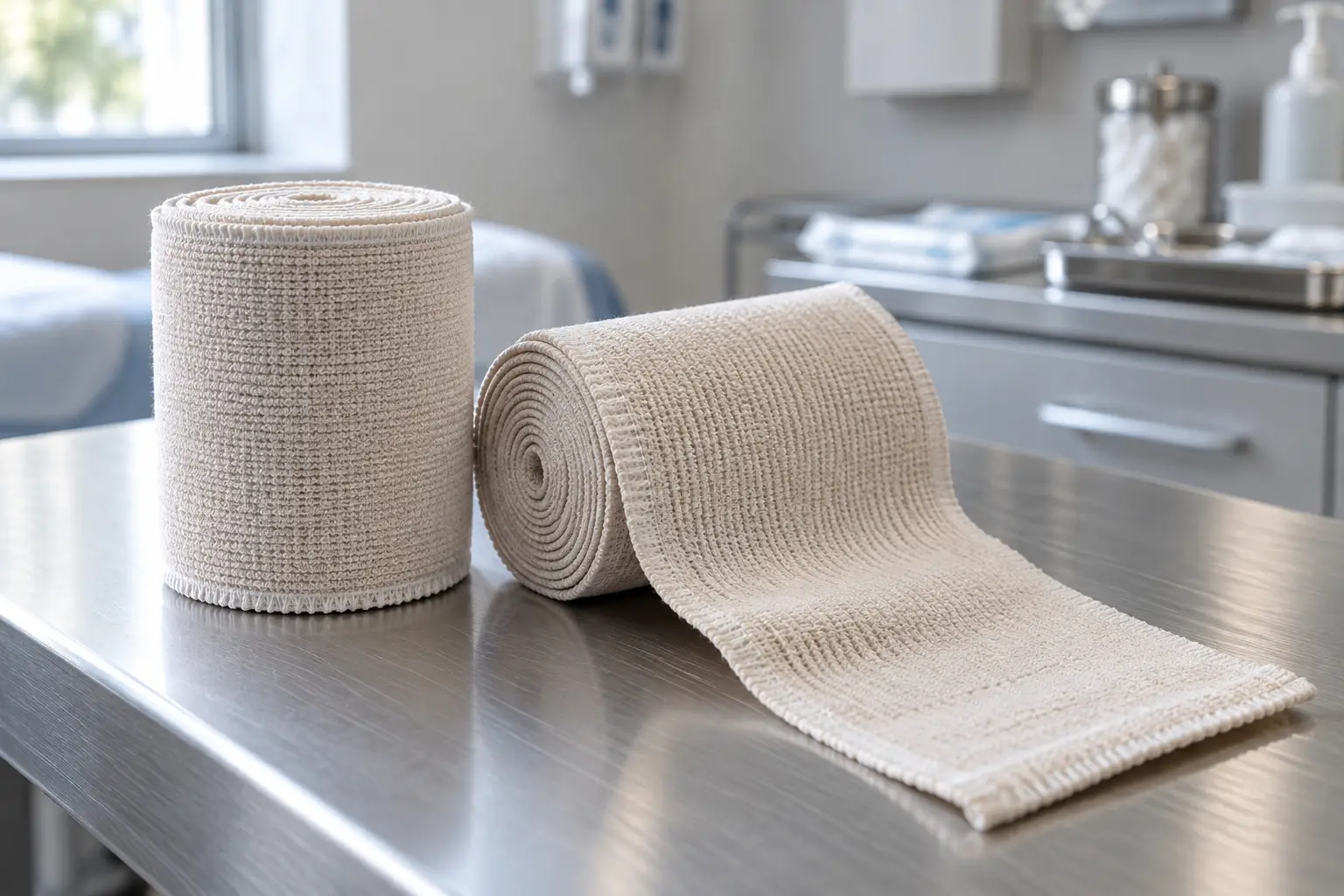
Latex-Free High Elastic Bandage – Skin-Friendly Wound Dressing Wrap
Minimize allergic reactions with our Latex-Free High Elastic Bandage. This hypoallergenic elastic bandage is safe for sensitive skin while providing firm compression. Essential for First Aid Kits and emergency care. Secure your supply of skin-friendly high elastic bandages today. Soft and secure.
Frequently Asked Questions (FAQ)
What is the maximum extractable protein limit for a bandage labeled “Latex-Safe” in European tenders?
Under EU MDR expectations and consensus standards like ASTM D5712, a product labeled “Latex-Safe” or “Not made with natural rubber latex” should show extractable protein levels below the limit of detection (typically <0.2 micrograms per gram of textile). Any detectable presence of Hevea brasiliensis proteins disqualifies the lot from strict latex-safe tender awards.
Why do some synthetic elastane bandages lose elasticity after hospital washing?
Loss of elasticity in low-quality bandages occurs when the manufacturer uses cheap polyurethane filaments without protective yarn wraps. When subjected to hot hospital laundry cycles (60°C to 90°C) or chemical detergents, the bare synthetic core degrades. A premium latex-free high elastic bandage wraps the elastane core in high-grade polyamide or combed cotton yarns, shielding the elastic polymer from thermal and chemical breakdown.
Can an elastic bandage with metal clips still qualify for a “Latex-Safe” tender?
Yes, but only if the small elastic connector strip holding the metal clips is also manufactured using synthetic elastane. In many budget wraps, the main body of the bandage is synthetic, but the small connector strip on the metal clip is made from cheap natural rubber elastic. Tender inspectors inspect this detail closely. Ensure your supplier documents that both the bandage web and clip assemblies are entirely free of natural rubber.
What is the shelf-life difference between natural rubber wraps and synthetic elastane bandages?
Natural rubber bandages typically carry an effective shelf-life of 2 to 3 years before oxidation causes the rubber threads to become brittle and lose recovery. A quality latex-free high elastic bandage maintains its elasticity, tensile strength, and recovery profiles for 5 years or more when stored in normal clinical warehouse conditions, significantly lowering the risk of expired inventory during extended national framework agreements.
Win Your Next Hospital Tender with MediTapes
Clinical procurement boards don’t leave room for second chances. If you are preparing to bid on upcoming regional, national, or private hospital supply tenders in Europe, North America, or Australasia, your product documentation must be as reliable as the bandage itself.
Why MediTapes is Your Tender Manufacturing Partner:
- 100% Fully Documented Synthetic Formulations: Zero natural rubber proteins and zero sulfur accelerators.
- Complete Regulatory Dossiers: Turnkey access to third-party MDR, FDA, ISO 10993, and ASTM D5712 testing files.
- Reliable OEM/ODM Production Capacity: Dedicated weaving clean lines that completely eliminate allergen cross-contamination.
Secure Your Tender Pricing and Free Sample Kit
Don’t let ambiguous allergen claims compromise your tender position. Contact our OEM medical tender support team today to review technical specifications, request complete ISO 10993 / ASTM testing dossiers, and receive a direct production quote.
- Explore Our Products: View the complete high-elastic compression category
- Contact Our B2B Tender Desk: Request Tender Dossier & Physical Sample Kit
- Direct Technical & Quotation Inquiries: Email our team directly at info@meditapes.com