Any procurement manager who has sourced components for medical wearables knows the drill. You go online, find a supplier claiming to have the best factory, and they promise you the world. But when you finally get the physical product in your hands, the adhesive either falls off after ten minutes of sweating, or it rips the epidermis right off your customer’s nose.
I’ve been in the medical adhesive game for over a decade, and I’ll tell you a controversial truth right now: most overseas factories will lie to your face about their nasal strips raw materials. They swap out certified medical-grade acrylics for cheap industrial glues just to save a fraction of a cent. And who pays the price? You do, when your Amazon seller account gets nuked or your distributor returns a whole container.
If you’re buying for your brand, you need to understand exactly what goes into these little breathing aids. Sourcing the right nasal strips raw materials isn’t just about getting the lowest MOQ; it’s about chemistry, physics, and preventing lawsuits. Whether you are dealing with sports brands wanting maximum airflow or pharmacies needing sensitive skin options, the nasal strips raw materials you choose will make or break your product line.
Today, I’m pulling back the curtain on the top 5 nasal strips raw materials, the exact specs you should be demanding from your suppliers, and the great debate of PE vs non-woven nasal strips.
Why You Can’t Afford to Cut Corners on Nasal Strips Raw Materials
Let’s get straight to the physics. A nasal strip works by using elastic tension to pull the nasal passages open. That means the strip is constantly fighting to tear itself off the user’s face.
The combination of your nasal strips raw materials has to do three things flawlessly:
- Stick to oily, sweaty skin for 8-12 hours.
- Provide enough upward spring force to actually open the airway.
- Come off without causing contact dermatitis or skin tearing.
A failure in any of your nasal strips raw materials ruins the whole unit. If you buy a premium spring but pair it with a trash medical tape material, the strip pops off. If you buy a great adhesive but the backing fabric is stiff, the user feels like they have cardboard on their face.
So let’s break down the exact nasal strips raw materials you need to be evaluating, quoting, and testing.
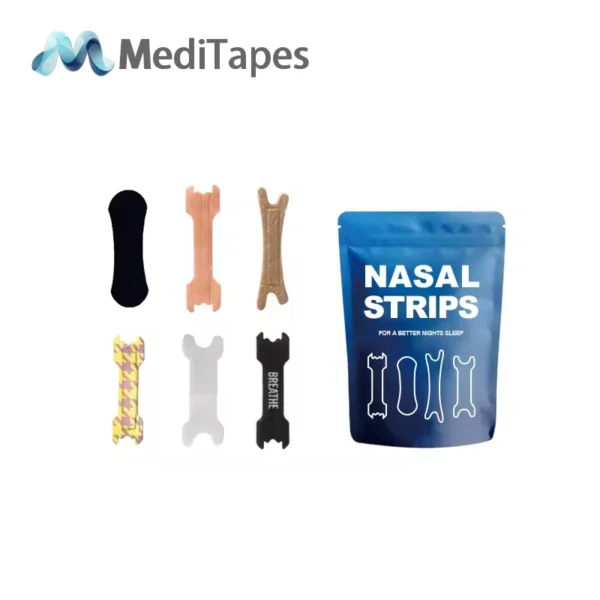
Wholesale Anti-Snoring Nasal Strips for Better Breathing Relief
Breathe better instantly with our premium anti-snoring nasal strips. Designed for maximum airflow, these strips provide drug-free relief from congestion. Ideal for pharmacies and sleep clinics looking for reliable nasal strips bulk supply. Customizable sizes available.
Deep Dive: The Top 5 Nasal Strips Raw Materials
1. Spunlace Non-Woven Fabric (The Comfort King)
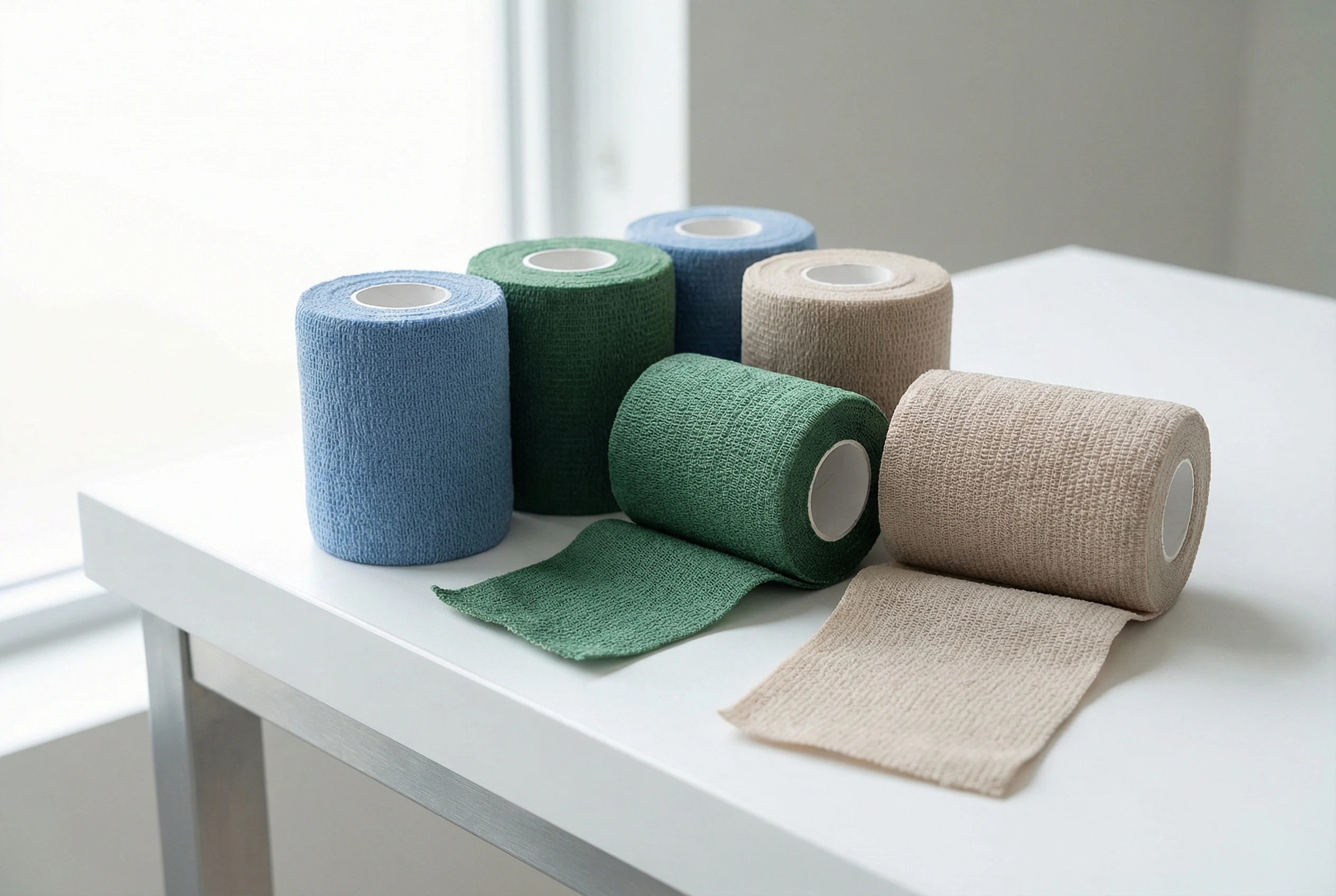
When we talk about the backing—the part people actually see and touch—spunlace non-woven fabric is the absolute standard. If you are building a generic, high-volume product, this is one of the most critical nasal strips raw materials you’ll buy.
Spunlace is made by using high-pressure water jets to entangle fibers together. Unlike thermal bonding, spunlace leaves the fabric incredibly soft and highly breathable.
What buyers need to specify:
When you ask for quotes on these nasal strips raw materials, don’t just ask for “non-woven.” You need to specify the blend and the GSM (Grams per Square Meter).
- The Blend: You want a mix of Viscose and Polyester (PET). Viscose gives it that soft, cotton-like feel, while polyester gives it structural strength. A 70/30 or 50/50 ratio is typical.
- The GSM: For nasal strips raw materials, you generally want something around 40 to 60 GSM. Any thinner, and the sharp PET spring might poke through. Any thicker, and it won’t conform to the curves of the nose.
The real-world test: Moisture Vapor Transmission Rate (MVTR). A good non-woven backing should have an MVTR of over 500 g/m2/24h. If the skin can’t breathe, moisture builds up, and the adhesive fails.
2. Polyethylene (PE) Film (The Waterproof Warrior)
Here is where the market splits. While non-woven is the standard “tan” strip, Polyethylene (PE) film is what you use for clear strips or heavy-duty sports strips.
As a procurement officer evaluating nasal strips raw materials, PE film offers a massive advantage: it’s highly water-resistant. If your target demographic is athletes or people who sleep in humid enviornment (excuse the typo, you get the idea), PE is often superior.
But here’s the catch with this specific medical tape material:
Solid PE film does not breathe. At all. If you just slap a solid piece of PE on someone’s nose, their skin will macerate (get white, soggy, and weak) within hours.
To use PE as your primary nasal strips raw materials, you MUST ensure the factory is using micro-perforated PE film.
- Cold Needle vs Hot Needle Perforation: Ask your supplier which one they use. Hot needle perforation melts the edges of the tiny holes, keeping them open so moisture can escape. Cold needle just punches a hole that can close back up when the material stretches. Always demand hot needle micro-perforation for your nasal strips raw materials.
- Thickness: Look for a thickness around 0.08mm to 0.12mm.
This brings us to a major buyer decision, which we’ll cover later in the PE vs non-woven nasal strips showdown.
3. Medical-Grade Acrylic Adhesives (The Unsung Hero)
Listen to me carefully on this one. The adhesive is the single most critical medical tape material in your entire BOM (Bill of Materials). It is also the number one place where shady factories will try to screw you over on your nasal strips raw materials.
You cannot use standard packaging adhesive. You need a pressure-sensitive adhesive (PSA) that passes ISO 10993 standards for biocompatibility (specifically testing for cytotoxicity, skin irritation, and sensitization).
The Science of the Stick:
When sourcing these nasal strips raw materials, you need to look at two specific metrics: Tack (initial grab) and Peel Adhesion (long-term hold).
- Peel Adhesion: Tested using ASTM D3330 standards. A machine pulls the tape off a stainless steel plate at a 180-degree angle at a speed of 300 mm/min.
- The Formula you need to know: Peel strength (F) is calculated as the pull force (P) divided by the width of the tape (W).
F = P / W
For high-quality nasal strips raw materials, you want a peel adhesion of around 1.5 to 2.5 N/cm. If it’s below 1.5, the strip will pop off at night. If it’s above 2.5, you are going to rip the user’s skin off in the morning.
Many buyers don’t know this, but you actually want a solvent-based acrylic adhesive rather than a hot-melt one. Solvent-based acrylics handle temperature changes and skin oils way better. Yes, they cost a little more, but when evaluating nasal strips raw materials, this is not where you pinch pennies.
4. PET (Polyethylene Terephthalate) Spring Bands
Without the spring, a nasal strip is just a band-aid. The PET band is the engine of the product.
When you are buying nasal strips raw materials, the PET bands come in different thicknesses. This thickness dictates the “strength” of the strip (e.g., Kids, Regular, Extra Strength).
The Physics of the Pull:
The force exerted by the strip relies on the bending mechanics of the PET material. The spring force can be roughly understood by the cantilever beam deflection formula:
Force (F) = (E * w * t^3 * d) / (4 * L^3)
Where:
- E = Modulus of elasticity of the PET material
- w = width of the spring
- t = thickness of the spring (THIS is the variable you control)
- d = the distance it’s bent
- L = length of the spring
Notice that the thickness (t) is cubed! That means even a tiny change in the thickness of your nasal strips raw materials makes a massive difference in the pulling force.
- Kids/Sensitive: ~0.18mm thickness
- Adult Regular: ~0.25mm thickness
- Adult Extra Strength: ~0.30mm thickness
If your supplier has poor quality control on their PET nasal strips raw materials and the thickness varies by just 0.02mm from batch to batch, your customers will experience wildly different tension levels. Consistent extrusion is a must.
5. Siliconized Release Liners
The last of our top 5 nasal strips raw materials is the release liner. This is the paper or plastic backing the customer peels off before applying the strip.
It seems simple, but it impacts the user experiance heavily. If the release force is too high, the customer bends and ruins the strip just trying to get it off the paper.
What to specify for these nasal strips raw materials:
You want a single-sided silicone-coated glassine paper or a PET release liner.
- Weight: Usually around 60 to 80 GSM.
- Release Force: It should be very low, typically between 10 to 20 grams per inch.
If you are machine-packing these into individual wrappers, a glassine paper liner is usually the most cost-effective of the nasal strips raw materials while keeping the high-speed machines running smoothly without jams.
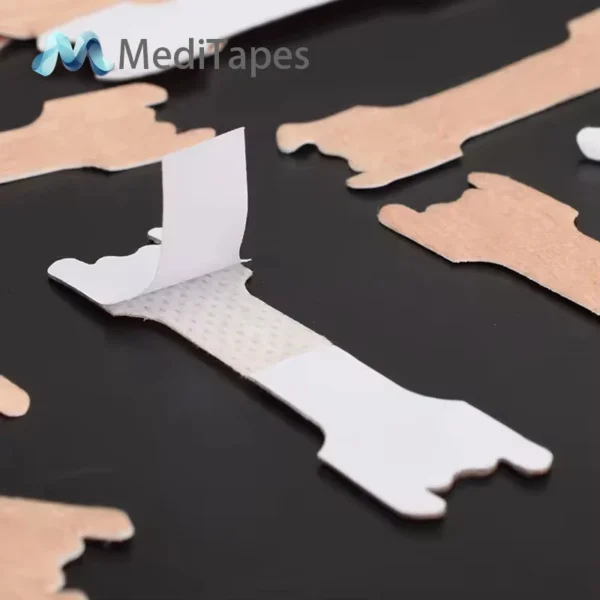
Custom Private Label Nasal Strips: Skin, Blue, Black Colors
Launch your own brand with our private label nasal strips. Available in skin, blue, and black, these strips offer effective congestion relief. We specialize in OEM manufacturing, ensuring high-quality adhesive and custom packaging to meet your specific market needs.
PE vs Non-Woven Nasal Strips: The Ultimate Procurement Showdown
So, you know the core nasal strips raw materials. But the biggest question I get from B2B buyers is: “Should I buy PE vs non-woven nasal strips?”
TBH, there is no single right answer. It depends entirely on your retail price point and your target demographic. Let’s look at a breakdown of PE vs non-woven nasal strips.
| Feature / Metric | Spunlace Non-Woven Strips | Micro-perforated PE Strips |
|---|---|---|
| Visual Appearance | Opaque (Usually Tan or Colored) | Transparent / Clear |
| Target Audience | General sleep aid, sensitive skin | Sports, daytime use, heavy sweating |
| Breathability | Excellent (naturally porous) | Moderate (relies purely on micro-holes) |
| Cost of Nasal Strips Raw Materials | Lower (approx $0.015 – $0.02 / unit) | Slightly Higher (approx $0.02 – $0.025 / unit) |
| Flexibility | Very high, conforms to nose shape | Slightly stiffer |
| Adhesive Compatibility | Excellent absorption of medical tape material | Adhesive sits on the surface, requires high-tack acrylic |
When analyzing PE vs non-woven nasal strips, you have to think about the marketing. Clear PE strips are massive right now for daytime use because they are less visible on Zoom calls or out in public. But for pure sleeping aids, non-woven nasal strips raw materials dominate the market because they are simply more comfortable to wear for 8 straight hours.
If you want my professional advice? Source both. Use the non-woven nasal strips raw materials for your “Nighttime” SKU, and the PE materials for your “Sport/Active” SKU.
What Makes a Good Medical Tape Material for Breathing Strips?
I want to circle back to the adhesive for a minute because “medical tape material” is a broad term. You can’t just use standard zinc oxide hospital tape materials for nasal strips.
A high-performance medical tape material used in nasal strips raw materials must balance shear strength and biocompatibility.
Shear strength is the tape’s resistance to sliding along the skin. Because the PET spring is pulling upwards and outwards, the medical tape material is under constant shear stress.
If you buy cheap nasal strips raw materials, the adhesive will undergo “creep”—it slowly stretches and slides down the oily surface of the nose until it pops off. To prevent this, elite factories use cross-linked acrylic medical tape material. Cross-linking creates a 3D polymer network that absolutely refuses to stretch under shear load, locking the strip in place until the user intentionally peels it off.
A B2B Buyer’s Case Study: Cost-Cutting That Backfired
I want to share an anonymous story about a client who learned about nasal strips raw materials the hard way.
A mid-sized health brand was doing about $50k a month on Amazon selling a standard non-woven breathing strip. A new procurement manager came in and decided to “optimize” their nasal strips raw materials. He found a factory that quoted him $0.005 less per unit by switching out the imported German acrylic medical tape material for a domestic generic equivalent.
Half a cent. That’s all they saved on their nasal strips raw materials.
Three months later, the new inventory hit the fulfillment centers. Within two weeks, their Amazon return rate spiked from 2% to 18%. The reviews were brutal. Customers were posting photos of their noses with the skin literally peeled off, leaving raw red patches. The generic medical tape material had an aggressive initial tack but zero moisture resistance. As soon as the customer sweat, the adhesive chemically reacted, locking onto the dead skin cells like superglue.
Amazon suspended their listing for safety violations. They had to recall $120,000 worth of inventory and write it off as a total loss.
The lesson? Do not mess around with your nasal strips raw materials. The cost difference between world-class medical tape material and garbage is a fraction of a penny per strip, but the liability difference is millions of dollars. Work with a trusted Nasal Strip manufacturer who actually understands the chemistry.
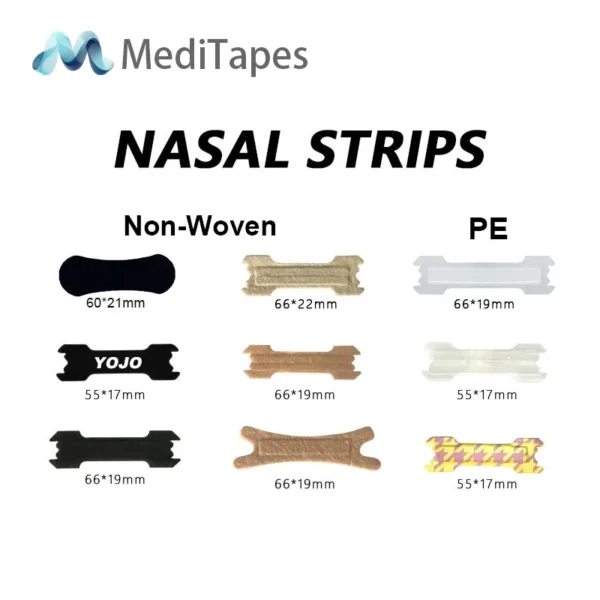
Bulk Medical Grade Nasal Strips – Drug-Free Congestion Relief
Source safe, drug-free congestion relief with our medical-grade nasal strips. These hypoallergenic strips gently lift nasal passages to alleviate snoring and cold symptoms. A trusted choice for medical suppliers requiring consistent quality and flexible bulk packaging options.
Sourcing Your Nasal Strips Raw Materials with MediTapes
Look, navigating the world of medical adhesives and non-woven fabrics is a massive headache if you don’t have a background in material science. You don’t want to spend your days testing peel adhesion formulas or arguing with overseas suppliers about whether their PE vs non-woven nasal strips actually have hot-needle perforations.
That’s where MediTapes comes in. We don’t just assemble products; we engineer them. We source only the absolute highest tier of nasal strips raw materials, ensuring every single roll of medical tape material we use passes stringent biocompatibility tests. Whether you are looking to develop a highly breathable spunlace product or a sweat-proof transparent PE strip, we have the supply chain and the technical know-how to make it flawless.
Your brand’s reputation is literally stuck to your customer’s face. Make sure it stays there comfortably.
Frequently Asked Questions (FAQ)
Q1: What is the most expensive component when buying nasal strips raw materials?
Generally, the medical-grade acrylic adhesive is the most expensive and critical part of the nasal strips raw materials. While the PET spring and the non-woven backing are important, achieving biocompatibility and high shear strength in the medical tape material costs money. Cheap out here, and the product fails.
Q2: How do PE vs non-woven nasal strips compare in production lead times?
There usually isn’t a massive difference in lead times between the two. However, sourcing high-quality micro-perforated PE nasal strips raw materials can sometimes take slightly longer because the hot-needle perforation process is an extra manufacturing step compared to simply buying standard spunlace non-woven rolls.
Q3: Can I lower the cost of my nasal strips raw materials without losing quality?
Yes, but you have to be smart about it. Instead of downgrading your medical tape material, look at optimizing the size of the strip to reduce waste during die-cutting. You can also negotiate better rates on the release liners or bulk-order the PET springs. Never, ever downgrade the adhesive.
Q4: Do I need FDA approval for the nasal strips raw materials I choose?
Nasal strips are generally considered Class I medical devices in the US. While the final product needs to be listed with the FDA, the individual nasal strips raw materials themselves don’t get “FDA approved.” However, the materials (especially the medical tape material) absolutely must pass ISO 10993 testing for skin contact.
Ready to Upgrade Your Product Line?
Stop gambling with unverified suppliers and cheap nasal strips raw materials. If you want to build a product that gets 5-star reviews and repeat subscriptions, you need the right engineering partner.
At MediTapes, we handle the complex science of medical tape material so you can focus on growing your brand.
Don’t wait until a bad batch ruins your reputation. Reach out to our team today to discuss your specs, get samples of our PE vs non-woven nasal strips, and secure a transparent quote.
Drop us an email directly at info@meditapes.com or head over to our Contact Us page to get the conversation started. Let’s build something great together.