Look, we’ve all been there. You receive a container of surgical tapes in the dead of February. The shipment has been sitting in a non-heated warehouse in Chicago or maybe bouncing around a truck in Northern Europe for three days. You open a box, pull out a roll, and… nothing. The tape feels like a sheet of dry plastic. It doesn’t stick.
Panic sets in. Did the manufacturer screw up? Did I buy a bad batch?
As a distributor, this is the nightmare scenario. But before you call your supplier screaming, let’s get real about what’s actually happening. It’s usually not a manufacturing defect; it’s physics.
I’ve spent years at MediTapes dealing with exactly this. I’ve seen pallets of perfectly good tape get rejected because nobody understood the thermodynamics of adhesives. Today, we aren’t doing the generic “keep it in a cool dry place” advice. We are diving deep into medical tape cold resistance, the chemistry of adhesion, and how to salvage stock you think is dead.
The Science: Why Cold Kills Stickiness
To understand medical tape cold resistance, you have to stop thinking of glue as “sticky stuff” and start thinking of it as a liquid that moves really slowly.
Pressure-sensitive adhesives (PSAs), which are used in almost all our Surgical Tape Series, rely on a property called viscoelasticity. This means the material acts like both a viscous liquid (it flows) and an elastic solid (it bounces back).
When you press tape onto skin, the adhesive needs to “wet out.” It needs to flow into the microscopic valleys of the skin or substrate.
The Villain: Glass Transition Temperature (Tg)
Here is the technical bit that most spec sheets hide in the fine print. Every polymer has a Glass Transition Temperature, denoted as Tg.
- Above Tg: The polymer chains are loose, wiggly, and flexible. The adhesive is tacky.
- Below Tg: The polymer chains lock up. The adhesive turns into a hard, brittle glass.
If your warehouse drops below the adhesive’s Tg, the tape loses its “liquid” properties. It cannot flow. No flow = no contact area = zero adhesion.
We can express the temperature dependence of viscosity (how hard it is to flow) using a simplified text-based version of the Williams-Landel-Ferry (WLF) Equation:
log(aT) = -C1 * (T – Tg) / (C2 + (T – Tg))
Where:
- T is your current warehouse temperature.
- Tg is the glass transition temperature.
- C1 and C2 are material constants.
What this means for you: If T gets close to Tg, the shift factor (aT) skyrockets. The adhesive becomes exponentially stiffer. You don’t need a degree in chemistry to know that stiff adhesive won’t stick to soft skin.
Easy Tear Surgical PE Tape – Perforated Plastic Medical Tape Bulk
Maximize efficiency with our Easy Tear Surgical PE Tape, featuring a perforated design for quick, bi-directional tearing. This transparent Surgical PE Tape requires no scissors, making it ideal for emergency response. We supply bulk Surgical PE Tape for cost-effective stocking.
Key Features:
– Bi-directional easy tear.
– Serrated edge option available.
Material Showdown: Acrylic vs. Rubber vs. Silicone
Not all glues freeze the same. When sourcing products, specific medical tape specs matter immensely depending on your target market’s climate.
Here is a breakdown of how the big three handle the cold. This data comes from our internal testing and general industry standards (ASTM D3330).
| Adhesive Type | Approx. Glass Transition (Tg) | Cold Weather Behavior | Recovery Time |
|---|---|---|---|
| Solvent Acrylic | -30°C to -40°C | Best. Maintains tack in freezing temps. Good for winter logistics. | Fast |
| Water-Based Acrylic | -10°C to -20°C | Risky. Can freeze (literally, ice crystals form) if water content is high. | Slow / Permanent Damage |
| Synthetic Rubber (Hot Melt) | -10°C to +10°C | Poor. Becomes brittle very quickly. “Shocky” release from liner. | Medium |
| Soft Silicone | -100°C+ | Excellent. Remains stable, but initial tack is naturally lower than acrylics. | Instant |
Note: Data represents typical ranges. Specific formulations vary.
Acrylic Adhesive Cold Resistance
If you are shipping to Canada, Scandinavia, or Russia, you generally want acrylic adhesive cold resistance. Solvent-based acrylics are the MVPs here. Because they don’t contain water, they don’t form ice crystals inside the adhesive matrix.
I remember a client in Minnesota who switched from a cheap hot-melt synthetic rubber tape to our solvent acrylic line. Their return rate during Q1 (winter months) dropped by 90%. Why? Because the rubber tape was hitting its Tg in the delivery truck, arriving hard as a rock, and the nurses didn’t have time to warm it up. The acrylic tape, having a much lower Tg, stayed tacky even when cold.
Winter Logistics: The “Silent Killer” of Adhesion
Let’s talk logistics. You might have a heated warehouse, but your freight forwarder usually doesn’t.
When we ship from MediTapes, we track temperature spikes and drops. The biggest danger isn’t just the cold; it’s the Thermal Cycle (Freeze-Thaw).
The Condensation Problem
Imagine a pallet of tape sitting in a truck at -5°C. It arrives at your loading dock, which is 22°C. You pull it inside immediately.
What happens? Condensation.
Moisture from the warm air condenses on the cold rolls of tape. If that moisture gets between the adhesive and the release liner, or penetrates a paper backing (like Micropore style tape), it can kill the chemical bond.
Pro Tip: If a shipment arrives freezing cold, DO NOT OPEN THE SHRINK WRAP. Leave the pallet wrapped in the receiving area for at least 24 hours. Let it acclaimate slowly. This prevents condensation from forming directly on the product.
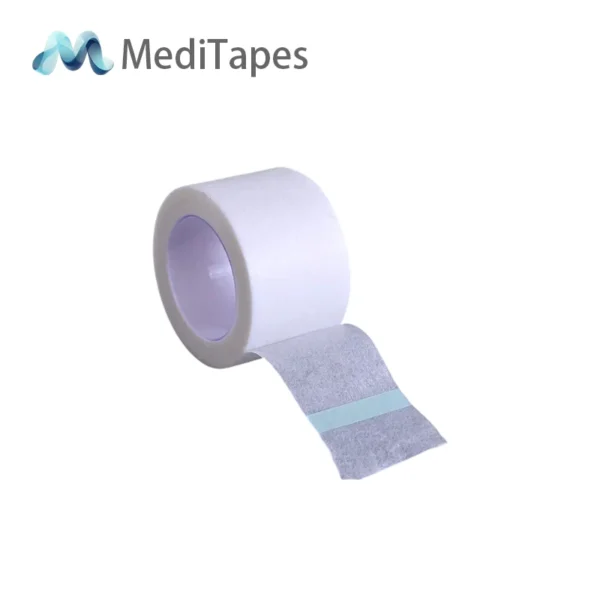
Wholesale Medical Non-woven Tape | Soft & Conformable Surgical Tape
Bulk buy our Wholesale Medical Non-woven Tape, featuring a soft, conformable texture for joint areas. This surgical tape allows moisture evaporation to aid healing. As a trusted supplier, we deliver premium medical non-woven tape tailored for pharmacies and medical distributors globally.
Case Study: The “Defective” Container
I want to share a story (names changed to protect the innocent, obviously). A distributor in Germany contacted us claiming an entire container of Zinc Oxide Plaster had “no glue.”
This was a major issue. We checked our retention samples from the same batch number. They were perfect. Sticky, strong, compliant.
So, I hopped on a call. We dug into their receiving logs.
The Situation:
- The container arrived in January.
- It sat at the port of Hamburg for 4 days (Temp: -2°C to 4°C).
- It was trucked to a warehouse (unheated section).
- The QC manager grabbed a roll immediately upon arrival, walked into a warm office, and tried to stick it to a steel test plate.
- Result: It failed.
The Fix:
I told them to put the “defective” box in a room at 25°C for 48 hours. Just leave it alone.
Two days later, I got an email. “It works now.”
Why? The adhesive hadn’t chemically degraded; it was just physically frozen (below its Tg). Once the polymer chains warmed up, they regained their viscoelasticity (their ability to flow). The medical tape cold resistance threshold had been crossed temporarily, but the product wasn’t destroyed.
How to Test If Your Tape Is Actually Dead
Sometimes, cold does permanently damage tape (especially water-based acrylics where ice crystals shear the polymer bonds). How do you tell the difference between “sleeping” adhesive and “dead” adhesive?
You need to perform a basic Peel Adhesion test, but you have to control the variables.
The Formula for Peel Strength (Simplified):
G = P / b * (1 – cos(theta))
Where:
- G is Fracture Energy (how tough the glue is).
- P is the Peel Force (what you measure).
- b is the width of the tape.
- theta is the peel angle (usually 180 degrees).
The Distributor’s Field Test:
- Acclimatize: Take the sample roll and keep it at 23°C ± 2°C for 24 hours.
- The Thumb Test: Press your thumb firmly into the adhesive for 5 seconds. Withdraw slowly.
- Observation:
- Legging: Do you see strings of glue stretching between your thumb and the tape? That’s good. That’s viscoelastic flow.
- Clean Break: Does it pop off your thumb with no resistance and no residue? That’s bad. The adhesive has likely oxidized or crystallized permanently.
If the tape passes the “Thumb Test” after warming up, your stock is safe. If it doesn’t, you might have a claim.
5 Rules for Storage and Handling
If you want to maintain optimal medical tape cold resistance properties, you need to enforce these rules in your warehouse.
- The 24-Hour Rule: Never test or ship tape that has just come in from the cold. Give it 24 hours to stabilize.
- Avoid the Floor: Concrete floors in warehouses are massive heat sinks. They are much colder than the air. Store pallets on racks, or at least put cardboard/wood between the pallet and the cement.
- First-In-First-Out (FIFO): Adhesives cross-link over time. An old tape is already less tacky; add cold temps to that, and it will fail faster than fresh tape.
- Humidity Control: Cold air is dry air. Extremely low humidity can dry out the paper liners, causing them to curl or pop off the adhesive (a phenomenon called “tunneling”).
- Know Your Specs: Check the medical tape specs for “Service Temperature” vs. “Application Temperature.”
- Application Temp: The temp needed to stick it on (usually >10°C).
- Service Temp: The temp it can hold once stuck (can be lower).

OEM Sterile Non-woven Fabric Dressing Roll – Bulk Medical Supply
Sourcing reliable non-woven fabric dressing rolls? We offer OEM/ODM bulk manufacturing. This sterile medical dressing roll features grid-backing for precise cutting. High-quality acrylic adhesive ensures durability. Perfect for distributors seeking customized branding and cost-effective wound care solutions for hospitals.
Is Your Current Supplier Ignoring This?
Lots of manufacturers just want to sell you the container. They don’t care if it works when it lands in Alaska or Norway. They’ll blame “improper storage” and walk away.
At MediTapes, we view ourselves as technical partners, not just box movers. We formulate our adhesives with specific tackifiers that lower the Tg, improving acrylic adhesive cold resistance so our partners in colder climates don’t face these headaches.
If you are dealing with brittle tape, inconsistent batches, or suppliers who can’t explain why their product fails in winter, we need to talk.
FAQ: Cold Weather & Adhesives
Q: Can I use a heat gun to warm up the tape quickly?
A: Please don’t. High, direct heat can “plasticize” the adhesive, making it ooze and turn into a gooey mess. It can also shrink the backing material. Gentle, ambient warming (room temperature) is the only safe way to recover medical tape cold resistance.
Q: Does cold weather affect sterilization?
A: Generally, no. EO (Ethylene Oxide) sterilization happens at warm temperatures. However, if the tape was frozen before sterilization and the liner lifted (tunneling), the sterility barrier of the individual pouch might be compromised if the seal was stressed. Always check the package integrity.
Q: Why does the tape stick to the package but not the skin?
A: This is often a “surface energy” issue, exacerbated by cold. Plastic packaging has high surface energy (easy to stick to). Human skin is low energy, rough, and maybe cold/dry in winter. The adhesive needs to be warm enough to flow into the skin. If it’s cold, it chooses the path of least resistance—the packaging.
Q: Which tape is best for winter sports/outdoor rescue?
A: You want a heavy-duty cloth tape with a solvent rubber or aggressive acrylic adhesive. Standard paper tapes (micropore) will often fail if applied to cold, sweaty skin in freezing temps. Check out our Surgical Tape Series for high-tack options.

High Strength Cotton Medical Tape – Latex Free & Hypoallergenic
Ensure patient safety with our latex-free cotton medical tape. Designed for sensitive skin, this hypoallergenic tape offers high tensile strength for stable immobilization. The cotton medical tape allows skin to breathe while providing durable adhesion. Perfect for surgical fixation and sports injury support.
Don’t Let Winter Freeze Your Business
Adhesive science isn’t magic, but it can feel like it when your inventory suddenly “stops working.” Understanding the limits of medical tape cold resistance puts you in control. It allows you to educate your customers, reduce returns, and handle logistics with confidence.
Don’t guess about your inventory. If you need a technical audit of your current tape specs, or you’re looking for a product that can handle the freeze-thaw cycle of global logistics, let’s chat.
Ready to upgrade your adhesive reliability?
- Ask a Question: Not sure which adhesive fits your climate?
- Get a Sample: Test our cold-resistant formulas yourself.
- Request a Quote: See how competitive high-performance tape can be.
Drop us a line at info@meditapes.com or visit our Contact Page. Let’s make sure your products stick, no matter the weather.