Winter is messy. If you manage a farm or run a veterinary supply business, you know exactly what I’m talking about. The ground freezes, then it thaws into a sludge of mud, manure, and ice. For livestock, this season is basically an obstacle course. Hoof rot, mud fever, scrapes from hidden ice shards—it’s a nightmare waiting to happen.
Over the years, I’ve seen plenty of “fancy” solutions come and go, but honestly, the humble roll of cohesive bandages for livestock remains the MVP of the barn. It’s not just about slapping some tape on a leg; it’s about compression, protection, and keeping the wet out.
Let’s dig into why these wraps are critical right now, how to source veterinary bandage wholesale without getting ripped off, and the actual science behind wrapping a leg so you don’t cause more damage than you fix.
Why Winter is the Enemy of Hooves and Legs
Look, animals are tough, but winter conditions in the Northern Hemisphere don’t mess around. When a horse or cow is standing in cold mud for hours, the skin barrier weakens.
Here is the deal. Moisture softens the skin. Bacteria (like Dermatophilus congolensis) loves that softened skin. Next thing you know, you’ve got Mud Fever (Scratches) or thrush in horses. For cattle, foot rot becomes a major profit killer.
This is where cohesive bandages for livestock stop being a “nice-to-have” and start being a necessity. A properly applied bandage creates a barrier. It keeps the medication on the wound and the muck off the skin.
But here is the catch—most people use them wrong. Or they buy cheap garbage that unravels in ten minutes.
The “Stick” Factor: How It Actually Works
You might think all self-adhesive wraps are the same. They aren’t.
I remember chatting with a materials engineer a few years back about what makes MediTapes stick without glue. It’s all about the coating and the weave. Good cohesive bandages for livestock use a latex (or latex-free synthetic) coating that adheres only to itself.
If you grab a cheap roll, you’ll notice it feels “slick.” That’s because the coating is too thin. A quality bandage needs a specific coefficient of friction.
When you layer the bandage, the layers interlock. It’s mechanical bonding, not chemical gluing. This is why it doesn’t rip the hair off a prize stallion’s leg.
The Breathability Test
Another thing. If you wrap a leg in plastic, you cook the tissue. The skin needs to breathe, especially if you are treating an infection. Good vet wrap is porous.
Try this: Hold the bandage up to the light. You should see pinpricks of light coming through the weave. If it looks solid, throw it out. It’s going to trap moisture and breed fungus.
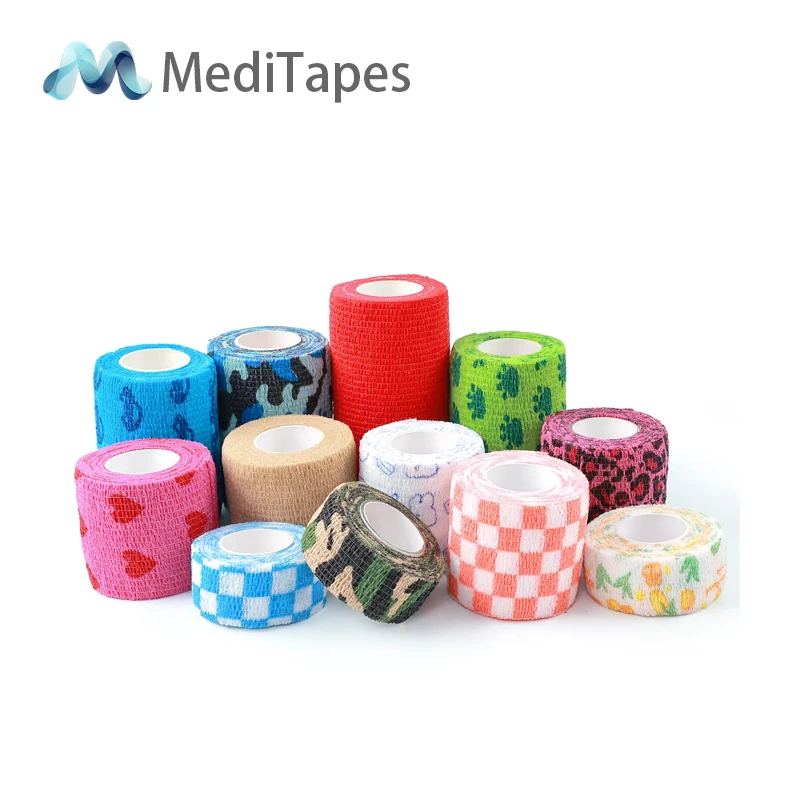
Bulk Printed Cohesive Bandage Rolls – Assorted Designs Vet Wrap
Save on costs with Bulk Printed Cohesive Bandage Rolls. Our mixed carton offers assorted designs vet wrap to keep your inventory diverse. From neon colors to geometric shapes, this printed self-adhesive bandage ensures you always have the right style. High elasticity and strong cohesion guaranteed.
Buying Veterinary Bandage Wholesale: Stop Wasting Money
Let’s talk business for a second. If you are buying these rolls one by one at the local tack shop, you are burning cash.
The demand for veterinary bandage wholesale spikes in October and stays high through March. Suppliers know this. Smart farm managers and clinics buy in bulk before the snow hits.
When you look for veterinary bandage wholesale deals, don’t just look at the price per roll. Look at the length per roll under tension.
Here is a quick breakdown I threw together based on average market data from 2024. This shows why buying bulk matters.
| Purchase Type | Avg Cost Per Roll ($) | Rolls per Case | Total Cost ($) | Savings vs Retail |
|---|---|---|---|---|
| Retail Single Roll | $2.50 – $4.00 | 1 | N/A | 0% |
| Small Box (12 pk) | $1.80 – $2.20 | 12 | $21.60 | ~25% |
| Wholesale Case | $0.80 – $1.10 | 144 | $129.00 | ~65% |
Note: Prices vary by region, but the ratio is usually the same.
If you run a stable with 20 horses, you go through about 10 rolls a week during mud season. That wholesale case pays for itself in three months. At MediTapes, we see a lot of savvy buyers switching to the Self-adhesive Bandage Series in bulk packs just for this reason.
Horse Leg Wrap Bulk: The Equine Specifics
Horses are high-maintenance. We love them, but they are fragile.
When sourcing horse leg wrap bulk orders, color coding is actually a functional tool, not just fashion.
- Red: Left Hind (injury).
- Blue: Right Front (medication applied).
- Yellow: Monitor for swelling.
I visited a large training facility in Kentucky last winter. They had a massive stock of horse leg wrap bulk inventory. They used neon colors for turnout (easier to find if it falls off in the snow) and dark colors for stable rest.
One issue with buying horse leg wrap bulk from random suppliers on Amazon is the “telescoping” effect. This is when the inner layers of the roll slide out like a telescope because the tension during manufacturing was uneven. It makes the roll useless. Always check your supplier’s quality control guarantees.
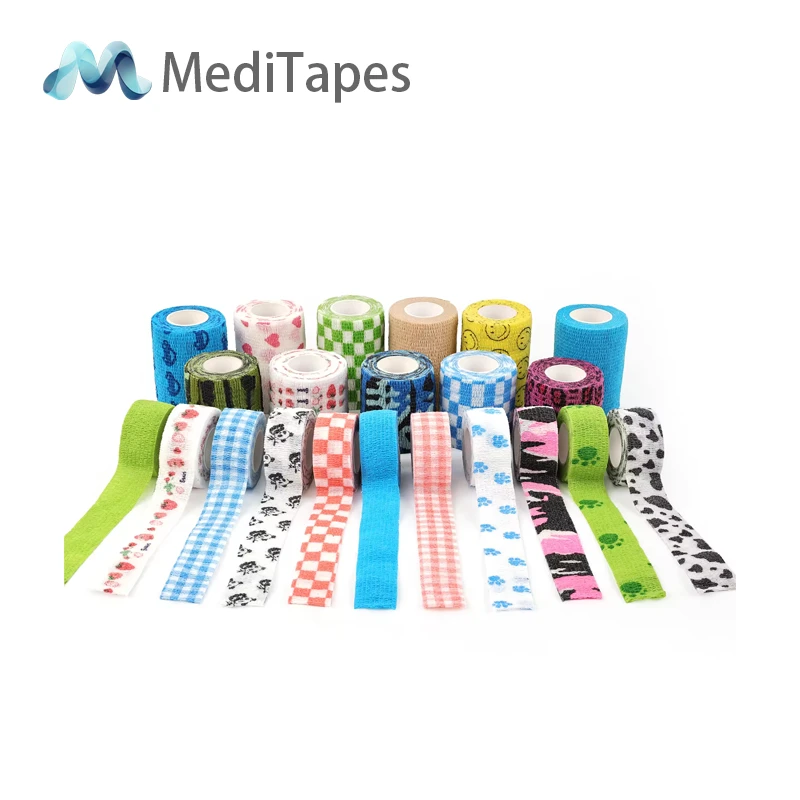
Cute Pattern Cohesive Bandage – Paw Print Self Adhesive Vet Tape
Stock the popular Cute Pattern Cohesive Bandage featuring adorable designs like paw prints. This self-adhesive vet tape is a favorite for small animal care, calming pets during treatment. Breathable and easy to tear, our patterned cohesive bandage combines style with reliable wound support.
The Physics of Wrapping: Don’t create a Tourniquet!
Okay, this is the part where experience counts. I have seen necrosis caused by tight wrapping. It’s ugly.
When you apply cohesive bandages for livestock, you are applying physics. Specifically, Laplace’s Law.
In simple terms, the pressure exerted by a bandage is determined by the tension you pull with, the number of layers, and the size of the limb.
The formula looks roughly like this in plain text:
Pressure = (Tension x Number of Layers) / (Limb Radius x Bandage Width)
What does this mean for you?
- Limb Radius matters: A bandage applied with the same tension on a thin pony leg exerts more pressure than on a thick Clydesdale leg.
- Layers multiply pressure: If you overlap by 50% (standard), you effectively have two layers. If you overlap 70%, you are tripling the pressure spots.
The 50% Rule:
Always unroll a few inches of the bandage off the roll before laying it on the animal. Never pull directly from the roll onto the leg. That stretches the elastic to max capacity. When it recoils, it acts like a rubber band snapping back, cutting off circulation.
Stretch it to about 50% of its elasticity, lay it down, and smooth it out.
Material Battle: Non-Woven vs. Cotton
You will see different materials out there.
- Non-Woven: This is your standard “vet wrap.” It is lightweight, water-resistant, and tears easily by hand. This is perfect for cohesive bandages for livestock in winter because it doesn’t absorb water like a sponge.
- Cotton-Based: These are heavier, stickier, and harder to tear. They offer more support but if they get wet, they get heavy and sag.
For winter/outdoor use? Stick to Non-Woven. You don’t want a heavy, wet rag hanging off a cow’s hoof.
Case Study: The Wisconsin Dairy Turnaround
I want to share a story (names changed for privacy) about a dairy farm in Wisconsin I consulted with. “Green Acres Dairy” was struggling with Digital Dermatitis (hairy heel warts).
They were treating the cows, but the wraps kept falling off in the slurry. They were using a cheap knock-off brand they found on eBay.
The Problem:
- Poor adhesion in cold temps (the glue froze).
- Wraps fell off within 2 hours.
- Infection rates dropped only 5%.
The Fix:
We switched them to a high-grade cohesive bandage for livestock designed for fluctuating temps. We also implemented a cleaning protocol: Clean hoof -> Dry thoroughly -> Apply medication -> Apply padding -> Apply Vet Wrap.
The Result:
Because the bandages actually stayed on for 24-48 hours, the medication had time to work. Within 6 weeks, their active lesion cases dropped by 60%. They now order veterinary bandage wholesale pallets twice a year.
It wasn’t magic medication; it was just a bandage that actually stuck.

Bitter Taste Cohesive Bandage – No Chew Vet Wrap for Pets & Dogs
Stop pets from gnawing wounds with Bitter Taste Cohesive Bandage. This no chew vet wrap contains a safe bitter agent to deter licking and biting. Protects dressings effectively while remaining breathable. The smart choice for veterinary post-surgery care using non-woven bandage.
Common Mistakes (Don’t Do This)
I see these errors constantly.
- The “End Tuck”: People try to tuck the end of the bandage under the previous layer. Don’t. Just smooth it down firmly. The heat from your hand helps the cohesive agent bond.
- Reusing Wraps: Just no. Once stretched and soiled, the elasticity is gone and the pores are clogged with dirt. It’s single-use for a reason.
- Ignoring Swelling: If you wrap a swollen leg, check it every few hours. As swelling goes down, the bandage gets loose. If swelling goes up, the bandage becomes a tourniquet.
Where to Get the Good Stuff
If you are tired of wraps that don’t stick or cost a fortune, you need to check out what we are doing at MediTapes.
We specialize in medical tapes and bandages. We aren’t a general store selling birdseed and bandages; we just do tapes. Our Self-adhesive Bandage Series is rigorously tested.
Need to stock up? Whether you need horse leg wrap bulk orders for a stable or veterinary bandage wholesale for a clinic, we can handle the volume.
You can browse our Self-adhesive Bandage Series here.
FAQ: Questions I Get Asked a Lot
Q: Can I use cohesive bandages for livestock on open wounds?
A: Not directly. You should always have a primary dressing (like sterile gauze) touching the wound. The cohesive bandage is the secondary layer to hold the gauze in place and provide compression. Placing it directly on a raw wound can damage the granulation tissue when you peel it off.
Q: How tight is too tight for a horse leg wrap?
A: The “Two-Finger Test” is a good rule of thumb. You should be able to slide two fingers snugly under the top of the bandage. If you can’t, it’s too tight. If your fingers slide in and wiggle around easily, it’s too loose and will slide down.
Q: Why does my vet wrap unravel in the snow?
A: Cold temperatures can affect the cohesive properties of cheaper latex coatings. Also, if snow gets under the wrap, it pushes the layers apart. Ensure you have a good overlap (50%) and finish the wrap with a solid press of your hand to warm the adhesive layers for a better bond. Using higher quality cohesive bandages for livestock usually solves the temperature issue.
Q: Do you offer samples before I buy a wholesale lot?
A: Absolutely. We know you don’t want to commit to a pallet without testing the tear strength and adhesion. Contact us and we can chat about sending some samples to your facility.

Printed Cohesive Bandage Manufacturer – Custom Pattern Vet Tape OEM
Looking for unique designs? As a Printed Cohesive Bandage Manufacturer, we offer custom pattern vet tape. Add your logo or cute prints (paws, hearts) to stand out. High-quality non-woven fabric with strong self-adhesion. Boost your brand with customized cohesive bandages.
Wrapping It Up (Pun Intended)
Winter is hard enough without fighting with your equipment. Your animals rely on you to keep their legs sound and their hooves dry.
Don’t settle for subpar gear. The difference between a healed hoof and a chronic injury often comes down to how well that bandage holds up in the mud.
If you are ready to stop wasting money on wraps that don’t work and start sourcing professional-grade cohesive bandages for livestock, we should talk.
Action Steps:
- Check your inventory. Are you low?
- Visit our Contact Page or email us at info@meditapes.com.
- Ask for a quote on veterinary bandage wholesale pricing.
Stay warm out there, and keep those legs wrapped right!